
Enhanced with market attractiveness analysis, total addressable market evaluation, company benchmarking matrices, interactive Excel dashboards, expanded supply chain intelligence, emerging startup coverage, and detailed product insights, The Business Research Company’s 2026 market reports deliver more actionable and strategically valuable research.
Smart Textiles For Military Market Revenue Growth Supported By A CAGR Of $5.87 Through 2030
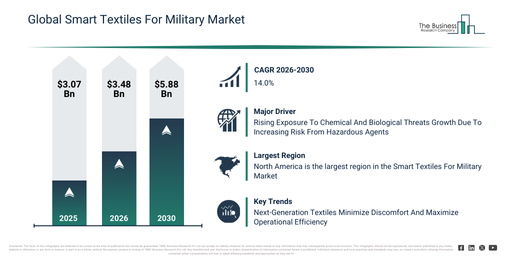
The market size for smart textiles in military applications is projected to experience substantial growth over the coming years. This sector is anticipated to reach $5.88 billion by 2030, demonstrating a compound annual growth rate (CAGR) of 14.0%. Factors contributing to this expansion during the forecast period include the creation of fully integrated sensor and navigation fabrics, increased use in smart armor, AI integration for real-time physiological tracking, deployment in challenging environmental conditions, and the rise of multifunctional protective and adaptive apparel. Key trends anticipated during this time involve the advancement of lightweight, highly durable combat fabrics, greater incorporation of on-uniform physiological monitoring systems, broader application of adaptive camouflage and thermal signature management, increased uptake of energy-harvesting military wearables, and a heightened focus on improved ballistic and blast protection.
The smart textiles for military market is expected to expand due to an increasing incidence of chemical and biological threats. These threats encompass the actual or potential use of dangerous chemical substances or biological agents like toxins, viruses, or bacteria, which can harm human health, animals, plants, or the environment, often in contexts of warfare, terrorism, or accidental exposure. The growing exposure to chemical and biological threats is linked to increased industrialization, leading to greater production, broader use of hazardous substances, and an elevated risk of their accidental or intentional release into the environment. Smart textiles for military address these threats by providing protective clothing embedded with sensors and materials capable of detecting, neutralizing, or shielding against hazardous agents. For instance, in June 2025, a report published by United Nations, a US-based intergovernmental organization, documented 9,712 cases from February 2023 to June 2025, where Russian occupation forces used munitions containing hazardous chemical agents, including riot control agents, as a method of warfare. This increasing exposure to chemical and biological threats is thus propelling the growth of the smart textiles for military market.
Download A Free Sample Report For Comprehensive Market Insights:
Smart Textiles For Military Market Growth Drivers: What Factors Are Accelerating Expansion?
Leading companies in the smart textiles for military market are concentrating on developing advanced solutions, such as moisture-wicking fabrics, to significantly improve soldier comfort, operational effectiveness, and stamina under challenging conditions. Moisture-wicking fabrics are textiles designed to draw perspiration away from the skin towards the outer surface for evaporation, thereby keeping the wearer dry, assisting in body temperature regulation, preventing chafing, reducing discomfort during prolonged activity, and enhancing overall performance and resilience in demanding environments. For instance, in April 2024, Heathcoat Fabrics Limited, a manufacturing company based in the UK, introduced Drytec, a patent-pending surface-to-surface moisture-wicking spacer fabric specifically engineered for military gear. This fabric not only moves moisture away from the skin and disperses it to the exterior but also includes advanced breathable and quick-drying attributes to maintain optimal body temperature, alleviate discomfort during extended operations, and boost overall operational performance and endurance in extreme and challenging environments. Drytec has been developed with high durability and abrasion resistance to meet the rigorous requirements of military operations, while its lightweight construction ensures ease of movement and flexibility. The fabric’s innovative structure also supports long-term wearability, minimizing the risk of skin irritation, chafing, and heat-related stress, consequently contributing to the safety, comfort, and effectiveness of soldiers across various climates and operational scenarios.
Smart Textiles For Military Market Segmentation Trends And Revenue Drivers
The smart textiles for military market covered in this report is segmented –
1) By Type: Passive Smart Textiles, Active Smart Textiles, Ultra-Smart Textiles
2) By Raw Material: Conductive Fibers, Phase Change Materials, Nanofibers, Smart Polymers
3) By Application: Camouflage, Ballistic Protection, Energy Harvesting, Health Monitoring, Other Applications
4) By End User: Army, Navy, Air Force, Special Forces
Subsegments:
1) By Passive Smart Textiles: Temperature Regulating Fabrics, Moisture Absorbing Fabrics, Antimicrobial Fabrics, Ultraviolet Protecting Fabrics
2) By Active Smart Textiles: Energy Harvesting Fabrics, Conductive Fabrics, Shape Memory Fabrics, Thermochromic Fabrics
3) By Ultra-Smart Textiles: Sensor Integrated Fabrics, Communication Enabled Fabrics, Health Monitoring Fabrics, Adaptive Camouflage Fabrics
Smart Textiles For Military Market Strategic Trends: What Is Defining The Next Phase Of Growth?
Leading companies in the smart textiles for military market are concentrating on developing advanced solutions, such as moisture-wicking fabrics, to significantly improve soldier comfort, operational effectiveness, and stamina under challenging conditions. Moisture-wicking fabrics are textiles designed to draw perspiration away from the skin towards the outer surface for evaporation, thereby keeping the wearer dry, assisting in body temperature regulation, preventing chafing, reducing discomfort during prolonged activity, and enhancing overall performance and resilience in demanding environments. For instance, in April 2024, Heathcoat Fabrics Limited, a manufacturing company based in the UK, introduced Drytec, a patent-pending surface-to-surface moisture-wicking spacer fabric specifically engineered for military gear. This fabric not only moves moisture away from the skin and disperses it to the exterior but also includes advanced breathable and quick-drying attributes to maintain optimal body temperature, alleviate discomfort during extended operations, and boost overall operational performance and endurance in extreme and challenging environments. Drytec has been developed with high durability and abrasion resistance to meet the rigorous requirements of military operations, while its lightweight construction ensures ease of movement and flexibility. The fabric’s innovative structure also supports long-term wearability, minimizing the risk of skin irritation, chafing, and heat-related stress, consequently contributing to the safety, comfort, and effectiveness of soldiers across various climates and operational scenarios.
#Smart Textiles For Military Market Industry Leaders: Which Organizations Are Driving Competition?
Major companies operating in the smart textiles for military market are BAE Systems plc, Sioen Industries NV, Teijin Limited (Teijin Aramid), DuPont de Nemours Inc., TenCate Protective Fabrics, WL Gore & Associates Inc., Milliken & Company, Schoeller Textil AG, Noble Biomaterials Inc., Mide Technology Corporation, Myant Inc., Bally Ribbon Mills, Nano Dimension Ltd., BeBop Sensors, Advanced Fabric Technology LLC, Ohmatex A/S, Outlast Technologies LLC, MMI Textiles Inc., Hexoskin, Loomia Inc., Elitac Wearables BV, Directa Plus S.p.A, Nautilus Defense, Texas Instruments (TI) Inc., Toray Industries Inc., Hyperstealth Biotechnology Corp.
Access The Complete Smart Textiles For Military Market Report:
#Smart Textiles For Military Market Largest Region: Which Geography Holds The Highest Market Share?
North America was the largest region in the smart textiles for military market in 2025. Asia-Pacific is expected to be the fastest-growing region in the forecast period. The regions covered in the smart textiles for military market report are Asia-Pacific, South East Asia, Western Europe, Eastern Europe, North America, South America, Middle East, Africa.
Access a Customized Smart Textiles For Military Market Report for Deeper Competitive Insights
https://www.thebusinessresearchcompany.com/customise?id=29209&type=smp
The Business Research Company: https://www.thebusinessresearchcompany.com/
Americas: +1 310-496-7795
Asia: +44 7882 955267 & +91 8897263534
Europe: +44 7882 955267
Email us at: marketing@tbrc.info
Follow us on:
LinkedIn: https://in.linkedin.com/company/the-business-research-company
YouTube: https://www.youtube.com/channel/UC24_fI0rV8cR5DxlCpgmyFQ
Global Market Model: https://www.thebusinessresearchcompany.com/global-market-model

Wasay has over a decade of experience in market research, data modelling, and analytics, with prior experience at GlobalData and Decision Tree Consulting Services. At The Business Research Company , he leads research operations across syndicated studies, customized consulting engagements, and the Global Market Model platform. His professional experience includes supporting organizations such as Boston Consulting Group, KPMG, and Ernst & Young. Wasay holds a degree in Electronics and Communications Engineering, postgraduate management qualifications from International Management Institute Belgium and Indian School of Business and Entrepreneurship, and completed the Integrated Program in Business Analytics from Indian Institute of Management Indore.
