Delivering more actionable and strategically valuable research, The Business Research Company’s 2026 market reports feature market attractiveness analysis, total addressable market evaluation, company benchmarking matrices, interactive Excel dashboards, expanded supply chain intelligence, emerging startup coverage, and detailed product insights.
Software-Defined Satellite Market Growth Analysis: How Will Revenue Expand During The Forecast Period?
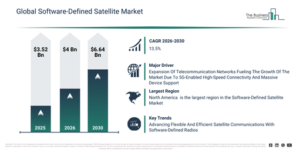
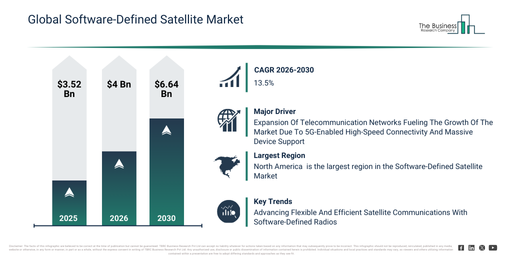
The software-defined satellite market is projected to experience substantial expansion in the coming years, anticipated to reach $6.64 billion by 2030, exhibiting a compound annual growth rate (CAGR) of 13.5%. This expansion throughout the forecast period stems from factors such as the broader application of AI-powered in-orbit reconfiguration, an increase in the deployment of multi-mission software-defined satellites, the creation of ground control integration platforms, a greater dependence on remote software updates and reprogramming, and the expansion of commercial and defense satellite software services. Key trends expected during this time include dynamic in-orbit reconfiguration, a growing need for flexible payload designs, the proliferation of SDR-based satellite platforms, advancements in real-time beam steering capabilities, and the increasing integration of cloud-controlled satellite operations.
The growth of the software-defined satellite market is expected to be propelled by the expansion of telecommunication networks in the coming period. Telecommunication networks are defined as interconnected systems that enable the transmission of voice, data, and video between people and devices over various distances. This expansion in telecommunication networks is attributed to the deployment of 5G technology, which facilitates faster data speeds, lower latency, and supports vast device connectivity. Software-defined satellites enhance telecommunication networks by offering reconfigurable payloads, making them ideal for adapting to changing bandwidth and coverage demands. They improve network efficiency by allowing dynamic service adjustments, thereby boosting connectivity and operational flexibility. For instance, in April 2025, the Office of Communications (Ofcom), a UK-based government department, stated that the number of fixed broadband lines reached 29.2 million by the end of the fourth quarter of 2024, indicating a year-on-year increase of 691,000 (2.4%). Therefore, the expansion of telecommunication networks is driving the growth of the software-defined satellite market.
Download A Free Sample Report For Comprehensive Market Insights:
Software-Defined Satellite Market Opportunity Drivers: What Is Creating New Revenue Potential?
Major companies within the software-defined satellite market are focusing on developing innovative solutions, including software-defined radios (SDRs), to enable adaptable, reconfigurable, and high-performance satellite communications. Software-defined radios (SDRs) are communication systems where signal processing occurs via software rather than fixed hardware, allowing satellites to dynamically modify frequencies, protocols, and functions. This capability supports flexible, multi-standard communications, enhances efficiency, and extends satellite lifespan compared to traditional fixed radios. For instance, in May 2025, Alén Space, an aerospace company based in Spain, launched the SATMAR nanosatellite, a 6U CubeSat designed to further the digital transformation of the maritime sector. The satellite, scheduled for deployment aboard a SpaceX Falcon 9 as part of the Transporter-14 mission from Vandenberg Space Force Base in California, aims to test the new VHF Data Exchange System (VDES) standard in actual operational scenarios, which is intended to improve maritime communications by replacing the current Automatic Identification System (AIS). SATMAR will facilitate bidirectional data transmission via satellite in the VHF band, helping to reduce network congestion and improve efficiency, safety, and sustainability across global maritime traffic.
Software-Defined Satellite Market Segmentation And Category Breakdown
The software-defined satellite market covered in this report is segmented –
1) By Component: Hardware, Software, Services
2) By Orbit Type: Low Earth Orbit (LEO), Medium Earth Orbit (MEO), Geostationary Orbit (GEO)
3) By Technology: Software-Defined Radio, Artificial Intelligence (AI), Cloud Computation, Reconfigurable Payload
4) By Application: Communication, Earth Observation, Navigation, Scientific Research, Other Applications
5) By End-User: Commercial, Government, Defense, Other End-Users
Subsegments:
1) By Hardware: Antennas, Transponders, Power Amplifiers, Receivers, Onboard Processors
2) By Software: Network Management Software, Signal Processing Software, Payload Management Software, Ground Control Software, Data Analytics Software
3) By Services: Integration And Deployment Services, Consulting Services, Maintenance And Support Services, Managed Services, Training And Education Services
Software-Defined Satellite Market Trends: What Is Shaping Future Industry Growth?
Major companies within the software-defined satellite market are focusing on developing innovative solutions, including software-defined radios (SDRs), to enable adaptable, reconfigurable, and high-performance satellite communications. Software-defined radios (SDRs) are communication systems where signal processing occurs via software rather than fixed hardware, allowing satellites to dynamically modify frequencies, protocols, and functions. This capability supports flexible, multi-standard communications, enhances efficiency, and extends satellite lifespan compared to traditional fixed radios. For instance, in May 2025, Alén Space, an aerospace company based in Spain, launched the SATMAR nanosatellite, a 6U CubeSat designed to further the digital transformation of the maritime sector. The satellite, scheduled for deployment aboard a SpaceX Falcon 9 as part of the Transporter-14 mission from Vandenberg Space Force Base in California, aims to test the new VHF Data Exchange System (VDES) standard in actual operational scenarios, which is intended to improve maritime communications by replacing the current Automatic Identification System (AIS). SATMAR will facilitate bidirectional data transmission via satellite in the VHF band, helping to reduce network congestion and improve efficiency, safety, and sustainability across global maritime traffic.
Software-Defined Satellite Market Competitive Analysis Of Major Industry Participants
Major companies operating in the software-defined satellite market are The Boeing Company, Lockheed Martin Corporation, Airbus S.A.S., General Dynamics Mission Systems Inc., Northrop Grumman Corporation, Thales S.A., L3Harris Technologies Inc., SES S.A., Hughes Network Systems LLC, Eutelsat Communications S.A., Iridium Communications Inc., Inmarsat Global Limited, Spire Global Inc., Innoflight Inc., Vector Launch Inc., Muon Space Inc., Antwerp Space N.V., XDLINX Space Labs Inc., SatixFy Communications Ltd., ReOrbit Inc.
Access The Complete Software-Defined Satellite Market Report:
Software-Defined Satellite Market Regional Analysis And Leading Geography
North America was the largest region in the software-defined satellite market in 2025. Asia-Pacific is expected to be the fastest-growing region in the forecast period. The regions covered in the software-defined satellite market report are Asia-Pacific, South East Asia, Western Europe, Eastern Europe, North America, South America, Middle East, Africa.
Access a Customized Software-Defined Satellite Market Report for Deeper Competitive Insights
https://www.thebusinessresearchcompany.com/customise?id=27863&type=smp
The Business Research Company: https://www.thebusinessresearchcompany.com/
Americas: +1 310-496-7795
Asia: +44 7882 955267 & +91 8897263534
Europe: +44 7882 955267
Email us at: marketing@tbrc.info
Follow us on:
LinkedIn: https://in.linkedin.com/company/the-business-research-company
YouTube: https://www.youtube.com/channel/UC24_fI0rV8cR5DxlCpgmyFQ
Global Market Model: https://www.thebusinessresearchcompany.com/global-market-model

Wasay has over a decade of experience in market research, data modelling, and analytics, with prior experience at GlobalData and Decision Tree Consulting Services. At The Business Research Company , he leads research operations across syndicated studies, customized consulting engagements, and the Global Market Model platform. His professional experience includes supporting organizations such as Boston Consulting Group, KPMG, and Ernst & Young. Wasay holds a degree in Electronics and Communications Engineering, postgraduate management qualifications from International Management Institute Belgium and Indian School of Business and Entrepreneurship, and completed the Integrated Program in Business Analytics from Indian Institute of Management Indore.