The Business Research Company’s 2026 market reports are designed to deliver research that is more actionable and strategically valuable. Key offerings include market attractiveness scoring, total addressable market sizing, company benchmarking matrices, interactive Excel dashboards, deeper supply chain intelligence, emerging startup tracking, and granular product-level insights.
#Space Archaeology Market Size Insights: Annual Growth Rate, Revenue Outlook And Forecast Drivers#_x000D_
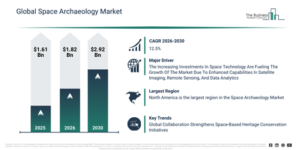
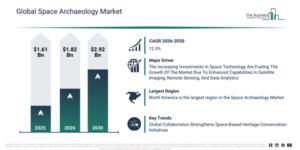
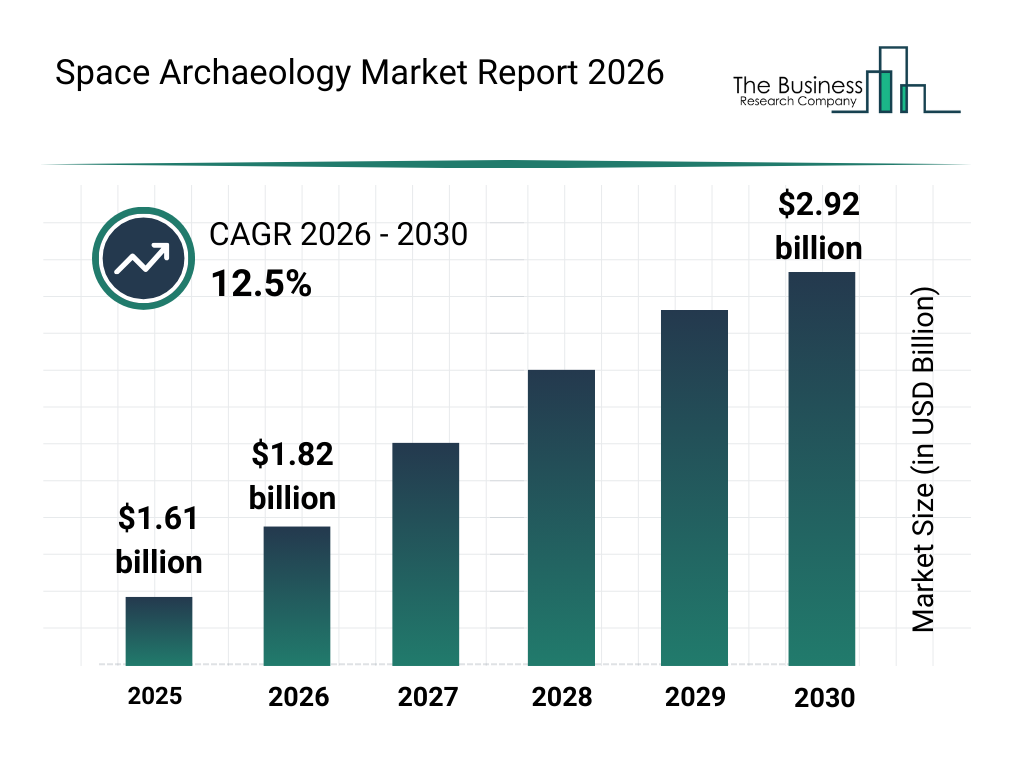
The space archaeology market has experienced substantial expansion in recent years. This market is projected to expand from $1.61 billion in 2025 to $1.82 billion in 2026, demonstrating a compound annual growth rate (CAGR) of 13.0%. Historically, this expansion has been driven by several factors, including the increasing accumulation of satellites and space artifacts which has prompted initial documentation efforts, the development of remote sensing data packages enabling the analysis of orbital debris and lunar objects, the expansion of space exploration missions providing new archaeological targets and records, a rising academic interest in the cultural impacts of human space activity fostering structured research, and the introduction of telescopes and tracking systems supporting the observation of heritage objects in orbit._x000D_
_x000D_
The space archaeology market is projected for significant expansion over the coming years, reaching $2.92 billion by 2030, exhibiting a compound annual growth rate (CAGR) of 12.5%. This growth trajectory is driven by several factors, including the increasing demand for preservation planning amid growing regulatory focus on space debris mitigation and heritage protection. Further drivers include technological progress in robotics and drones, facilitating comprehensive inspections of extraterrestrial archaeological sites; the expanding commercialization of space, which necessitates cultural impact assessments; the broadening of public education and outreach initiatives to promote engagement with space heritage; and the creation of archaeological risk assessment models to aid mission planning and ensure heritage-safe operations. Key trends anticipated during this forecast period encompass the proliferation of space heritage preservation programs, the increasing application of planetary imaging for tracking artifacts, the broadening scope of space debris archaeological mapping, a greater integration of cultural impact assessments, and a rising requirement for analyzing records from lunar and Martian missions._x000D_
_x000D_
#Request A Free Excerpt Of The Space Archaeology Global Market Report 2026:#_x000D_
_x000D_
#What Will Drive Space Archaeology Market Growth Through 2030?#_x000D_
The future expansion of the space archaeology market is anticipated due to rising investments in space technology. This involves committing financial resources to advance and implement technologies for space exploration, observation, and data gathering. A key catalyst for this investment is the increased governmental emphasis on pioneering satellite solutions to improve worldwide mapping and surveillance. Such investments significantly support space archaeology through enhanced satellite imaging, remote sensing, and analytical instruments. For example, data from the European Space Agency, a France-based intergovernmental organization, indicated that by December 2024, space budgets hit €121 billion ($138.75 billion) in 2024. This represented a 7% jump from 2023, with 47% of this budget directed towards civil spending, marking a 5% increase compared to the previous year. Consequently, the expanding investments in space technology are fostering the growth of the space archaeology market._x000D_
_x000D_
#Space Archaeology Market Segment Analysis Covering All Major Categories#_x000D_
The space archaeology market covered in this report is segmented – _x000D_
_x000D_
1) By Technology: Remote Sensing, Satellite Imaging, Ground-Penetrating Radar, Other Technologies_x000D_
2) By Application: Historical Site Discovery, Artifact Analysis, Environmental Monitoring, Other Applications_x000D_
3) By End-User: Academic Research, Government Agencies, Private Sector, Other End-Users_x000D_
_x000D_
Subsegments:_x000D_
1) By Remote Sensing: Hyperspectral Imaging, Light Detection And Ranging (LiDAR), Multispectral Imaging, Thermal Imaging, Synthetic Aperture Radar (SAR)_x000D_
2) By Satellite Imaging,: Optical Imaging Satellites, Radar Imaging Satellites, CubeSats And SmallSats Imaging, Geostationary Satellites, Low Earth Orbit (LEO) Satellites_x000D_
3) By Ground-Penetrating Radar: High-Frequency Ground-Penetrating Radar Systems, Low-Frequency Ground-Penetrating Radar Systems, Airborne Ground-Penetrating Radar, Vehicle-Mounted Ground-Penetrating Radar, Handheld Ground-Penetrating Radar Devices_x000D_
4) By Other Technologies: Drone-Based Imaging, Artificial Intelligence And Machine Learning For Data Analysis, Photogrammetry, Three-Dimensional (3D) Modeling And Visualization Tools, Magnetometry Sensors_x000D_
_x000D_
#Major Trends Shaping The Future Of The Space Archaeology Market#_x000D_
Leading entities within the space archaeology market are concentrating on developing advanced solutions, such as international networking, to improve data sharing and quicken the discovery and preservation of ancient sites through space-based observations. International networking refers to collaborating and exchanging information and resources across various countries to achieve common research and development goals. For example, in May 2025, the International Centre on Space Technologies for Natural and Cultural Heritage (HIST), a China-based international platform focused on integrating space technology with heritage conservation, launched its third operational phase (2025–2033). This phase commenced under a new agreement that brought together the Chinese Academy of Sciences (CAS), UNESCO, and HIST. The collaboration aims to bolster the application of space technologies for monitoring and protecting heritage sites designated by UNESCO. It signifies a renewed pledge to uphold worldwide heritage conservation, aligning with the UN 2030 Sustainable Development Agenda. This latest phase indicates an expansion of international cooperation and innovation in space-based heritage safeguarding._x000D_
_x000D_
#Space Archaeology Market Competitive Environment And Key Companies#_x000D_
Major companies operating in the space archaeology market are Airbus, National Aeronautics and Space Administration (NASA), Hexagon AB, Trimble Inc., European Space Agency (ESA), The German Aerospace Center, Maxar Technologies, L3Harris Technologies, Planet Labs, ICEYE Ltd., Surrey Satellite Technology Limited (SSTL), BlackSky Technology Inc., Capella Space Corp., GHGSat Inc., SatSure, Satellite Imaging Corporation, Satellogic, Astro Digital, Environmental Systems Research Institute Inc. (Esri), Nara Space Technology Inc., Umbra Lab Inc. _x000D_
_x000D_
#Access Expert Space Archaeology Market Analysis In The Full Report:#_x000D_
_x000D_
#Which Regions Are Covered In The Space Archaeology Market Report?#_x000D_
North America was the largest region in the space archaeology market in 2025. Asia-Pacific is expected to be the fastest-growing region in the forecast period. The regions covered in the space archaeology market report are Asia-Pacific, South East Asia, Western Europe, Eastern Europe, North America, South America, Middle East, Africa._x000D_
_x000D_
#Reach Out To Our Team:#_x000D_
_x000D_
The Business Research Company: https://www.thebusinessresearchcompany.com/_x000D_
Americas: +1 310-496-7795_x000D_
Asia: +44 7882 955267 & +91 8897263534_x000D_
Europe: +44 7882 955267_x000D_
Email us at: marketing@tbrc.info_x000D_
_x000D_
#Follow us on:#_x000D_
_x000D_
LinkedIn: https://in.linkedin.com/company/the-business-research-company_x000D_
YouTube: https://www.youtube.com/channel/UC24_fI0rV8cR5DxlCpgmyFQ_x000D_
Global Market Model: https://www.thebusinessresearchcompany.com/global-market-model

Wasay has over a decade of experience in market research, data modelling, and analytics, with prior experience at GlobalData and Decision Tree Consulting Services. At The Business Research Company , he leads research operations across syndicated studies, customized consulting engagements, and the Global Market Model platform. His professional experience includes supporting organizations such as Boston Consulting Group, KPMG, and Ernst & Young. Wasay holds a degree in Electronics and Communications Engineering, postgraduate management qualifications from International Management Institute Belgium and Indian School of Business and Entrepreneurship, and completed the Integrated Program in Business Analytics from Indian Institute of Management Indore.