Delivering more actionable and strategically valuable research, The Business Research Company’s 2026 market reports feature market attractiveness analysis, total addressable market evaluation, company benchmarking matrices, interactive Excel dashboards, expanded supply chain intelligence, emerging startup coverage, and detailed product insights.
Space-Based Artificial Intelligence Assistants Market Growth Analysis: How Will Revenue Expand During The Forecast Period?
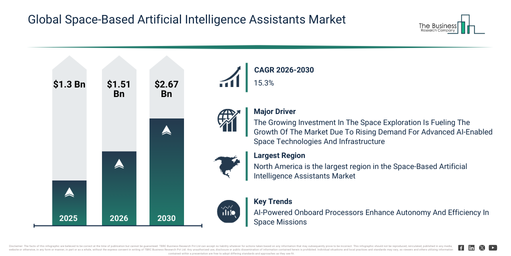
The space-based artificial intelligence assistants market is anticipated to undergo rapid expansion over the next few years, set to reach $2.67 billion by 2030 with a compound annual growth rate (CAGR) of 15.3%. This projected growth within the forecast period is driven by increasing adoption of AI assistants for deep-space exploration, the deployment of radiation-hardened AI processors and edge computing modules, a rising demand for autonomous mission planning and navigation, an increase in AI-driven environmental monitoring and system diagnostics, and collaborations between aerospace and AI technology firms for advanced space operations. Noteworthy trends during this period include the expansion of radiation-hardened AI hardware for orbital reliability, the growth in autonomous mission planning and spacecraft navigation systems, an escalating demand for onboard real-time data analytics for scientific missions, greater integration of astronaut assistance systems utilizing NLP and diagnostics, and the adoption of edge-processing modules to reduce reliance on ground-station communication.
Growing investments in space exploration are anticipated to drive the expansion of the space-based artificial intelligence assistants market in the coming years. These investments represent financial commitments from both public and private entities, aimed at advancing technologies, missions, and infrastructure crucial for space discovery and development. The surge in space exploration investments is primarily fueled by a heightened demand for satellite services, which are essential for global communication, navigation, and Earth observation, playing a vital role in the contemporary global economy. Such investments accelerate the development of space-based artificial intelligence assistants by bolstering AI technologies and improving onboard computing capabilities. This enhancement, in turn, boosts spacecraft autonomy, facilitates real-time data analysis, and ensures more efficient mission execution in the challenging space environment. As an illustration, the Space Foundation, a US-based nonprofit organization supporting the global space community, reported in July 2024 that the global space economy achieved $570 billion in 2023, reflecting a 7.4% rise from the adjusted 2022 figure of $531 billion. Consequently, the escalating investments in space exploration are indeed propelling the expansion of the space-based artificial intelligence assistants market.
Download A Free Sample Report For Comprehensive Market Insights:
Space-Based Artificial Intelligence Assistants Market Expansion Supported By Key Demand Factors
Companies operating in the space-based artificial intelligence assistants market are prioritizing the development of advanced products like AI-based onboard processors to lessen their dependency on ground control systems during space missions. AI-based onboard processors are intelligent computing systems embedded within spacecraft or satellites that leverage artificial intelligence for real-time data analysis. They facilitate autonomous functions and reduce the need for ground-based oversight by processing information directly onboard. For example, in March 2024, Mitsubishi Heavy Industries, a Japan-based electronics corporation, introduced AIRIS, an AI-based onboard object detector. This system utilizes the next-generation space-grade microprocessor SOISOC4 to enhance image processing and object detection capabilities in space. The AIRIS system is scheduled for an in-orbit demonstration as part of JAXA’s Innovative Satellite Technology Demonstration-4 mission. This demonstration will involve using AI to identify vessels from satellite images, transmit only relevant data back to the ground, retrain the AI model with new data, and update the onboard AI accordingly, thereby showcasing sophisticated AI features and the robust, low-power SOISOC4 processor in a genuine space environment.
Space-Based Artificial Intelligence Assistants Market Segment Analysis And Revenue Opportunities
The space-based artificial intelligence assistants market covered in this report is segmented –
1) By Component: Hardware, Software, Services
2) By Application: Satellite Operations, Space Exploration, Spacecraft Navigation, Communications, Other Applications
3) By End-User: Government, Commercial, Defense, Research Organizations, Other End-Users
Subsegments:
1) By Hardware: Onboard Processors, Artificial Intelligence (AI) Accelerators, Edge Computing Devices, Sensor Suites, Communication Modules, Power Systems
2) By Software: Machine Learning Algorithms, Natural Language Processing (NLP) Engines, Predictive Analytics Software, Computer Vision Systems, Autonomous Navigation And Control Systems, Data Fusion And Decision-Making Platforms
3) By Services: Artificial Intelligence (AI) Training And Simulation Services, System Integration And Testing, Data Analysis And Interpretation, Predictive Maintenance Services, Mission Support And Operational Monitoring, Custom Software Development And Upgrades
#Space-Based Artificial Intelligence Assistants Market Trends Influencing Long-Term Demand
Companies operating in the space-based artificial intelligence assistants market are prioritizing the development of advanced products like AI-based onboard processors to lessen their dependency on ground control systems during space missions. AI-based onboard processors are intelligent computing systems embedded within spacecraft or satellites that leverage artificial intelligence for real-time data analysis. They facilitate autonomous functions and reduce the need for ground-based oversight by processing information directly onboard. For example, in March 2024, Mitsubishi Heavy Industries, a Japan-based electronics corporation, introduced AIRIS, an AI-based onboard object detector. This system utilizes the next-generation space-grade microprocessor SOISOC4 to enhance image processing and object detection capabilities in space. The AIRIS system is scheduled for an in-orbit demonstration as part of JAXA’s Innovative Satellite Technology Demonstration-4 mission. This demonstration will involve using AI to identify vessels from satellite images, transmit only relevant data back to the ground, retrain the AI model with new data, and update the onboard AI accordingly, thereby showcasing sophisticated AI features and the robust, low-power SOISOC4 processor in a genuine space environment.
Space-Based Artificial Intelligence Assistants Market Major Participants And Competitive Dynamics
Major companies operating in the space-based artificial intelligence assistants market are Airbus, International Business Machines Corporation, Mitsubishi Heavy Industries Ltd., National Aeronautics and Space Administration, Safran S.A., Thales Group, L3Harris Technologies Inc., SpaceX, Blue Origin LLC, German Aerospace Centre (DLR), Sierra Nevada Corporation, Axiom Space Inc., Sidus Space Inc., Klepsydra Technologies AG, KP Labs Inc., Cognitive Space, EdgeCortix Inc., Nebula AI, Planetary Systems AI, Aistrospace Limited
Access The Complete Space-Based Artificial Intelligence Assistants Market Report:
Space-Based Artificial Intelligence Assistants Market Regional Analysis: Which Region Leads By Revenue?
North America was the largest region in the space-based artificial intelligence assistants market in 2025. Asia-Pacific is expected to be the fastest-growing region in the forecast period. The regions covered in the space-based artificial intelligence assistants market report are Asia-Pacific, South East Asia, Western Europe, Eastern Europe, North America, South America, Middle East, Africa.
Access a Customized Space-Based Artificial Intelligence Assistants Market Report for Deeper Competitive Insights
https://www.thebusinessresearchcompany.com/customise?id=25613&type=smp
The Business Research Company: https://www.thebusinessresearchcompany.com/
Americas: +1 310-496-7795
Asia: +44 7882 955267 & +91 8897263534
Europe: +44 7882 955267
Email us at: marketing@tbrc.info
Follow us on:
LinkedIn: https://in.linkedin.com/company/the-business-research-company
YouTube: https://www.youtube.com/channel/UC24_fI0rV8cR5DxlCpgmyFQ
Global Market Model: https://www.thebusinessresearchcompany.com/global-market-model

Wasay has over a decade of experience in market research, data modelling, and analytics, with prior experience at GlobalData and Decision Tree Consulting Services. At The Business Research Company , he leads research operations across syndicated studies, customized consulting engagements, and the Global Market Model platform. His professional experience includes supporting organizations such as Boston Consulting Group, KPMG, and Ernst & Young. Wasay holds a degree in Electronics and Communications Engineering, postgraduate management qualifications from International Management Institute Belgium and Indian School of Business and Entrepreneurship, and completed the Integrated Program in Business Analytics from Indian Institute of Management Indore.