
Enhanced with market attractiveness analysis, total addressable market evaluation, company benchmarking matrices, interactive Excel dashboards, expanded supply chain intelligence, emerging startup coverage, and detailed product insights, The Business Research Company’s 2026 market reports deliver more actionable and strategically valuable research.
Space-Based Health Monitoring Market Expansion Outlook: What Revenue Opportunities Lie Ahead?
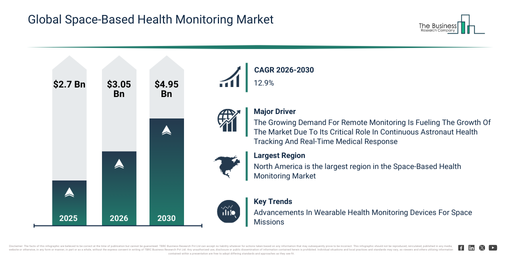
The space-based health monitoring market is projected to experience substantial expansion in the coming years. Its valuation is anticipated to reach $4.95 billion by 2030, exhibiting a compound annual growth rate (CAGR) of 12.9%. This upward trajectory is attributable to several factors, including the increasing integration of predictive health analytics in space missions, the broadening scope of satellite-enabled remote medical surveillance, the creation of sophisticated wearable health devices tailored for microgravity conditions, the greater utilization of geospatial mapping for evaluating health risks, and the advancement of telemedicine solutions for both earthbound and space-related healthcare needs. Key trends anticipated during this period encompass the management of space radiation exposure, the incorporation of wearable health devices into space missions, the evolution of remote health diagnostics applicable to both space and Earth, the extension of telemedicine services to isolated and underserved regions, and the transmission of real-time health data facilitated by satellites.
The increasing demand for remote monitoring is expected to boost the growth of the space-based health monitoring market in the future. Remote monitoring utilizes digital technologies to track, collect, and transmit health data from individuals in real-time without requiring physical presence. This rise in remote monitoring is due to the growing necessity to continuously oversee astronaut health in space, an environment with limited medical support and extreme conditions. Space-based health monitoring supports remote care through satellite communication, relaying real-time health data from astronauts to medical teams on Earth. This ensures continuous oversight, early detection of issues, and prompt medical response without needing on-site presence. For instance, in August 2023, Vivalink, a US-based healthcare technology company, reported that 81% of clinicians use remote patient monitoring (RPM), marking a 305% increase compared to 2023. Therefore, the expanding demand for remote monitoring is propelling the growth of the space-based health monitoring market.
Download A Free Sample Report For Comprehensive Market Insights:
#Space-Based Health Monitoring Market Growth Factors: Which Forces Are Supporting Market Expansion?
Leading companies in the space-based health monitoring market are prioritizing the creation of advanced products, including wearable health monitoring devices, to facilitate timely medical interventions during space missions. Wearable health monitoring devices are sensor-equipped tools worn on the body that continuously track vital signs. These tools enable early detection of health issues and support remote medical evaluations, especially in extreme environments such as space. For instance, in November 2024, Hexoskin, a Canada-based provider of health monitoring devices, revealed that the Canadian Space Agency awarded it a contract to develop and adapt the Astroskin Bio-Monitor wearable sensor system for use on Gateway, the forthcoming lunar-orbiting space station. Astroskin, already utilized on the International Space Station to continuously monitor astronauts’ vital signs, will be re-engineered to endure the distinct challenges of deep space, thereby supporting crew health during missions around the Moon.
Space-Based Health Monitoring Market Segmentation Trends And Revenue Drivers
The space-based health monitoring market covered in this report is segmented –
1) By Component: Hardware, Software, Services
2) By Application: Astronaut Health Monitoring, Remote Patient Monitoring, Telemedicine, Other Applications
3) By End-User: Space Agencies, Healthcare Providers, Research Institutes, Other End-Users
Subsegments:
1) By Hardware: Sensors, Wearable Devices, Satellite Payload Equipment, Communication Modules, Monitoring Consoles
2) By Software: Data Analytics Platforms, Health Monitoring Dashboards, Artificial Intelligence (AI) And Machine Learning Algorithms, Remote Diagnostic Software, Telemedicine Integration Software
3) By Services: Remote Health Monitoring Services, Data Management And Cloud Storage Services, System Integration And Deployment, Maintenance And Technical Support, Training And Consultation Services
Space-Based Health Monitoring Market Innovation Trends: Which Developments Are Transforming The Industry?
Leading companies in the space-based health monitoring market are prioritizing the creation of advanced products, including wearable health monitoring devices, to facilitate timely medical interventions during space missions. Wearable health monitoring devices are sensor-equipped tools worn on the body that continuously track vital signs. These tools enable early detection of health issues and support remote medical evaluations, especially in extreme environments such as space. For instance, in November 2024, Hexoskin, a Canada-based provider of health monitoring devices, revealed that the Canadian Space Agency awarded it a contract to develop and adapt the Astroskin Bio-Monitor wearable sensor system for use on Gateway, the forthcoming lunar-orbiting space station. Astroskin, already utilized on the International Space Station to continuously monitor astronauts’ vital signs, will be re-engineered to endure the distinct challenges of deep space, thereby supporting crew health during missions around the Moon.
Space-Based Health Monitoring Market Company Landscape And Strategic Competition
Major companies operating in the space-based health monitoring market are Medtronic plc, National Aeronautics and Space Administration, Philips Healthcare, SpaceX, Garmin Ltd., Blue Origin LLC, European Space Agency, Sierra Nevada Corporation, Spacelabs Healthcare, Luna Innovations, BioIntelliSense, Deep Breathe Inc., Danish Aerospace Company, Ejenta, Hexoskin, Synapsis Medical Technologies, Applications MD, Momentum Health, NURA Medical, iLAuNCH
Access The Complete Space-Based Health Monitoring Market Report:
Space-Based Health Monitoring Market Regional Distribution: Which Areas Drive Market Expansion?
North America was the largest region in the space-based health monitoring market in 2025. Asia-Pacific is expected to be the fastest-growing region in the forecast period. The regions covered in the space-based health monitoring market report are Asia-Pacific, South East Asia, Western Europe, Eastern Europe, North America, South America, Middle East, Africa.
Access a Customized Space-Based Health Monitoring Market Report for Deeper Competitive Insights
https://www.thebusinessresearchcompany.com/customise?id=25619&type=smp
The Business Research Company: https://www.thebusinessresearchcompany.com/
Americas: +1 310-496-7795
Asia: +44 7882 955267 & +91 8897263534
Europe: +44 7882 955267
Email us at: marketing@tbrc.info
Follow us on:
LinkedIn: https://in.linkedin.com/company/the-business-research-company
YouTube: https://www.youtube.com/channel/UC24_fI0rV8cR5DxlCpgmyFQ
Global Market Model: https://www.thebusinessresearchcompany.com/global-market-model

Wasay has over a decade of experience in market research, data modelling, and analytics, with prior experience at GlobalData and Decision Tree Consulting Services. At The Business Research Company , he leads research operations across syndicated studies, customized consulting engagements, and the Global Market Model platform. His professional experience includes supporting organizations such as Boston Consulting Group, KPMG, and Ernst & Young. Wasay holds a degree in Electronics and Communications Engineering, postgraduate management qualifications from International Management Institute Belgium and Indian School of Business and Entrepreneurship, and completed the Integrated Program in Business Analytics from Indian Institute of Management Indore.
