
The Business Research Company’s 2026 market reports combine market attractiveness scoring, total addressable market sizing, company benchmarking matrices, interactive Excel dashboards, deeper supply chain intelligence, emerging startup tracking, and granular product-level insights to deliver research that is more actionable and strategically valuable.
Is The Space-Based Missile Warning and Defense System Market Expanding? Latest Size Estimates And 2030 Projections
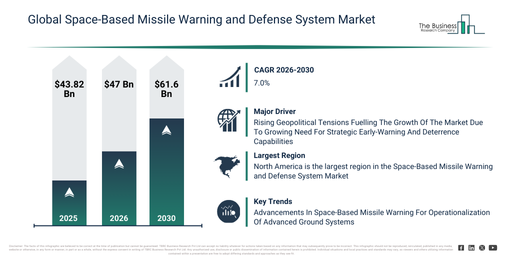
The space-based missile warning and defense system market size has experienced significant expansion in recent years. It is projected to increase from $43.82 billion in 2025 to $47 billion in 2026, exhibiting a compound annual growth rate (CAGR) of 7.3%. The historical growth in this sector can be linked to the development of early missile detection satellites, improvements in infrared and electro-optical sensor technologies, government and military financial backing for space-based defense initiatives, the integration of low Earth orbit satellites for global surveillance, and the implementation of mission data processing systems for threat analysis.
The space-based missile warning and defense system market is projected to experience substantial expansion over the coming years, with its size expected to reach $61.6 billion in 2030, demonstrating a compound annual growth rate (CAGR) of 7.0%. This anticipated growth during the forecast period is largely due to factors such as the broadening of global space-based missile warning networks, the integration of advanced infrared and radar sensors, the creation of AI-powered systems for threat detection and response, enhanced partnerships between defense contractors and aerospace companies, and an increase in real-time satellite data processing aimed at swift missile interception. Key trends anticipated for this period encompass improvements in infrared early-warning satellite payloads, the proliferation of low Earth orbit (LEO) missile-tracking constellations, the incorporation of multi-layered missile defense structures, a heightened need for real-time threat data fusion, and an uptick in international partnerships focused on space-based security initiatives.
Free Space-Based Missile Warning and Defense System Market Sample: Market Size, Growth Drivers And Competitive Landscape:
Space-Based Missile Warning and Defense System Market Drivers Explained: What Is Supporting A 7% CAGR?
Growing geopolitical strains are anticipated to fuel expansion within the space-based missile warning and defense system market in the future. Geopolitical tensions refer to disagreements or pressures between nations or territories stemming from competing political, land-related, financial, or strategic concerns, often linked to their geographical positioning. Territorial disagreements contribute to an escalation in geopolitical tensions, fostering distrust among countries and frequently prompting military enhancements to secure disputed areas. Rising geopolitical tensions bolster the need for space-based missile warning and defense systems as countries aim for strategic early detection capabilities to prevent surprise assaults and uphold military dominance in contested regions. For instance, in December 2024, data from Armed Conflict Location and Event Data (ACLED), a US-based crisis mapping and conflict data organization, indicated that global conflicts have doubled over the past five years, with the number of people killed in conflicts rising 30% from 179,099 deaths in 2023 to 233,597 in 2024. Consequently, the escalating geopolitical tensions are propelling the growth of the space-based missile warning and defense system market.
Space-Based Missile Warning and Defense System Market Segment Guide: Main Divisions And Subsegments
The space-based missile warning and defense system market covered in this report is segmented –
1) By Component: Weapon System, Radar System, Command And Control System, Early Warning Systems
2) By Platform: Airborne, Land, Naval
3) By End User: Aerospace, Defense, Government Agencies, Military
Subsegments:
1) By Weapon System: Directed Energy Weapons, Interceptor Missiles, Kinetic Kill Vehicles, Electromagnetic Railguns, High-Powered Microwave Weapons, Anti-Satellite Weapons
2) By Radar System: Phased Array Radar, Over the Horizon Radar, Synthetic Aperture Radar, Ground Based Radar, Space Based Radar
3) By Command and Control System: Battle Management Systems, Communication Satellites, Data Fusion Centers, Real Time Decision Support Systems, Secure Communication Links
4) By Early Warning Systems: Infrared Detection Systems, Space Based Sensors, Ground Based Early Warning Radars, Launch Detection Satellites, Persistent Surveillance Platforms
Space-Based Missile Warning and Defense System Market Trends And Opportunities For 2026–2030
Leading companies involved in the space-based missile warning and defense system are increasingly concentrating on sophisticated ground systems to improve real-time data processing. These advanced ground systems represent highly specialized terrestrial software and hardware platforms responsible for collecting, interpreting, and distributing data from space-based sensors, thereby supporting missile warning and defense missions. For example, in May 2024, RTX Corporation, a US-based defense company, unveiled the future operationally resilient ground evolution mission data processing application framework (FORGE MDPAF). This system is modular and adaptable, allowing for the quick integration of mission-specific applications to process, exploit, and disseminate satellite data. This includes overhead persistent infrared (OPIR) data originating from the U.S. Space Force’s SBIRS constellation, the impending Next Gen OPIR satellites, and other civil and environmental sensors.
Which Major Players Are Active In The Space-Based Missile Warning and Defense System Market?
Major companies operating in the space-based missile warning and defense system market are Raytheon Technologies Corporation, Lockheed Martin Corporation, Airbus SE, Northrop Grumman Corporation, Mitsubishi Heavy Industries, BAE Systems, Thales Group, L3 HARRIS, Leidos Holdings Inc, Hanwha Defense, Israel Aerospace Industries, MBDA, Rafael Advanced Defense Systems, Kongsberg Gruppen, General Atomics, Sierra Nevada Corporation, BlueHalo, Omni Federal, Auria.Space, SpaceSUR.
Unlock The Complete Space-Based Missile Warning and Defense System Market Report With Company Benchmarking:
Space-Based Missile Warning and Defense System Market World Regions Compared: Which Leads In Revenue?
North America was the largest region in the space-based missile warning and defense system market in 2025. The regions covered in the space-based missile warning and defense system market report are Asia-Pacific, South East Asia, Western Europe, Eastern Europe, North America, South America, Middle East, Africa.
Reach Out To Our Team:
The Business Research Company: https://www.thebusinessresearchcompany.com/
Americas: +1 310-496-7795
Asia: +44 7882 955267 & +91 8897263534
Europe: +44 7882 955267
Email us at: marketing@tbrc.info
Follow us on:
LinkedIn: https://in.linkedin.com/company/the-business-research-company
YouTube: https://www.youtube.com/channel/UC24_fI0rV8cR5DxlCpgmyFQ
Global Market Model: https://www.thebusinessresearchcompany.com/global-market-model

Wasay has over a decade of experience in market research, data modelling, and analytics, with prior experience at GlobalData and Decision Tree Consulting Services. At The Business Research Company , he leads research operations across syndicated studies, customized consulting engagements, and the Global Market Model platform. His professional experience includes supporting organizations such as Boston Consulting Group, KPMG, and Ernst & Young. Wasay holds a degree in Electronics and Communications Engineering, postgraduate management qualifications from International Management Institute Belgium and Indian School of Business and Entrepreneurship, and completed the Integrated Program in Business Analytics from Indian Institute of Management Indore.

