
Enhanced with market attractiveness analysis, total addressable market evaluation, company benchmarking matrices, interactive Excel dashboards, expanded supply chain intelligence, emerging startup coverage, and detailed product insights, The Business Research Company’s 2026 market reports deliver more actionable and strategically valuable research.
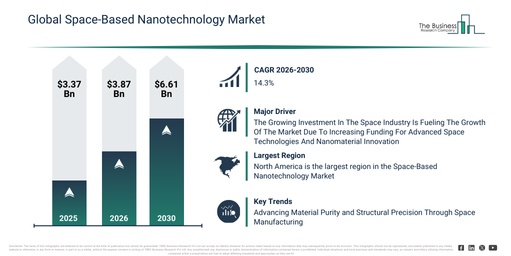
Space-Based Nanotechnology Market Forecast Highlighting Growth From $3.87 Billion To $6.61 Billion
The space-based nanotechnology market is projected for significant expansion in the coming years. Its valuation is set to reach $6.61 billion by 2030, exhibiting a robust compound annual growth rate (CAGR) of 14.3%. This anticipated growth during the forecast timeframe is primarily driven by several factors, including the increasing integration of nano-engineered batteries and enhanced propulsion systems, the spread of autonomous maintenance technologies leveraging nanotechnology, the creation of sophisticated nanosensors for continuous monitoring, the greater deployment of compact devices to lower spacecraft mass and power usage, and strategic partnerships between aerospace companies and nanotechnology firms for future space applications. Key trends anticipated for this period encompass the reduction in size of spacecraft parts, progress in nano-engineered thermal shielding, an increase in materials that boost propulsion through nanotechnology, the broader application of radiation-hardened nanostructures, and the wider uptake of nano-optical instruments for far-space observation.
The escalating financial commitment within the space sector is projected to fuel the expansion of the space-based nanotechnology market. This investment from governments and private entities is directed towards space missions, infrastructure, and sophisticated space technologies. The surge in space industry investment is driven by intensified global competition for space dominance, compelling countries and corporations to increase funding to secure strategic and technological leadership. Such investment supports the growth of space-based nanotechnology through fostering research and development and technological innovation. It enables the application of advanced nanomaterials in spacecraft, thereby enhancing efficiency, durability, and overall mission outcomes. For instance, the World Economic Forum, a Switzerland-based organization, reported in April 2024 that the space economy is forecasted to reach $1.8 trillion by 2035, an increase from $630 billion in 2023, primarily due to advancements in satellite and rocket technologies. Consequently, the increasing investment in the space industry is a primary driver for the growth of the space-based nanotechnology market.
Download A Free Sample Report For Comprehensive Market Insights:
#Space-Based Nanotechnology Market Growth Drivers And Industry Catalysts
Major companies within the space-based nanotechnology market are concentrating on creating sophisticated products, such as microgravity manufacturing modules, to facilitate the production of high-performance nanomaterials and semiconductors with exceptional purity and structural precision unattainable under Earth’s gravity. A microgravity manufacturing module refers to a specialized space-based platform engineered to produce advanced materials and components in the weightless environment of space, where the absence of gravity enhances material purity and structural uniformity. For instance, in June 2025, Space Forge Ltd., a UK-based space technology company, launched ForgeStar-1 aboard SpaceX’s Transporter-14 mission from Vandenberg Space Force Base. This satellite represents the UK’s first in-space manufacturing satellite, developed entirely in Wales. The mission marks a significant milestone for British space innovation, aiming to produce high-performance materials for semiconductor and clean energy applications in microgravity, alongside validating re-entry and recovery technologies for future reusable manufacturing missions.
Space-Based Nanotechnology Market Segment Outlook: Which Categories Are Expanding The Fastest?
The space-based nanotechnology market covered in this report is segmented –
1) By Component: Materials, Devices, Tools, Other Components
2) By Application: Space Exploration, Satellite Communication, Spacecraft Manufacturing, Other Applications
3) By End-User: Government, Commercial, Defense, Other End-Users
Subsegments:
1) By Materials: Nanocomposites, Nanotubes, Nanowires, Quantum Dots, Nanoparticles, Fullerenes, Aerogels
2) By Devices: Nanosensors, Nanoelectromechanical Systems (NEMS), Nano-Actuators, Nano-Antennas, Nanophotonic Devices
3) By Tools: Atomic Force Microscopes (AFM), Scanning Tunneling Microscopes (STM), Nanolithography Tools, Nanoimprint Equipment, Molecular Beam Epitaxy Systems
4) By Other Components: Coatings And Thin Films, Nano-Structured Insulators, Targeted Drug Delivery Module, Smart Materials For Thermal Regulation, Surface Modification Agents
Space-Based Nanotechnology Market Innovation Trends Driving Future Development
Major companies within the space-based nanotechnology market are concentrating on creating sophisticated products, such as microgravity manufacturing modules, to facilitate the production of high-performance nanomaterials and semiconductors with exceptional purity and structural precision unattainable under Earth’s gravity. A microgravity manufacturing module refers to a specialized space-based platform engineered to produce advanced materials and components in the weightless environment of space, where the absence of gravity enhances material purity and structural uniformity. For instance, in June 2025, Space Forge Ltd., a UK-based space technology company, launched ForgeStar-1 aboard SpaceX’s Transporter-14 mission from Vandenberg Space Force Base. This satellite represents the UK’s first in-space manufacturing satellite, developed entirely in Wales. The mission marks a significant milestone for British space innovation, aiming to produce high-performance materials for semiconductor and clean energy applications in microgravity, alongside validating re-entry and recovery technologies for future reusable manufacturing missions.
Space-Based Nanotechnology Market Key Players And Strategic Industry Positioning
Major companies operating in the space-based nanotechnology market are Lockheed Martin, Boeing, Airbus, Northrop Grumman, Toray Industries, L3Harris Technologies, Thales Alenia Space, OHB SE, Blue Canyon Technologies, Pixxel, NanoAvionics, Surrey Satellite Technology Ltd., GomSpace, Nanocomp Technologies, NoPo Nanotechnologies, Exolaunch, LiftPort Group, General Nano, Nanoracks, Raytheon Technologies, Applied Materials, SpaceX, AIST Research Institutes, Quantum Space Systems, Solvay Specialty Polymers
Access The Complete Space-Based Nanotechnology Market Report:
Space-Based Nanotechnology Market Regional Analysis: Which Region Leads By Revenue?
North America was the largest region in the space-based nanotechnology market in 2025. Asia-Pacific is expected to be the fastest-growing region in the forecast period. The regions covered in the space-based nanotechnology market report are Asia-Pacific, South East Asia, Western Europe, Eastern Europe, North America, South America, Middle East, Africa.
Access a Customized Space-Based Nanotechnology Market Report for Deeper Competitive Insights
https://www.thebusinessresearchcompany.com/customise?id=25625&type=smp
The Business Research Company: https://www.thebusinessresearchcompany.com/
Americas: +1 310-496-7795
Asia: +44 7882 955267 & +91 8897263534
Europe: +44 7882 955267
Email us at: marketing@tbrc.info
Follow us on:
LinkedIn: https://in.linkedin.com/company/the-business-research-company
YouTube: https://www.youtube.com/channel/UC24_fI0rV8cR5DxlCpgmyFQ
Global Market Model: https://www.thebusinessresearchcompany.com/global-market-model

Wasay has over a decade of experience in market research, data modelling, and analytics, with prior experience at GlobalData and Decision Tree Consulting Services. At The Business Research Company , he leads research operations across syndicated studies, customized consulting engagements, and the Global Market Model platform. His professional experience includes supporting organizations such as Boston Consulting Group, KPMG, and Ernst & Young. Wasay holds a degree in Electronics and Communications Engineering, postgraduate management qualifications from International Management Institute Belgium and Indian School of Business and Entrepreneurship, and completed the Integrated Program in Business Analytics from Indian Institute of Management Indore.
