Delivering more actionable and strategically valuable research, The Business Research Company’s 2026 market reports feature market attractiveness analysis, total addressable market evaluation, company benchmarking matrices, interactive Excel dashboards, expanded supply chain intelligence, emerging startup coverage, and detailed product insights.
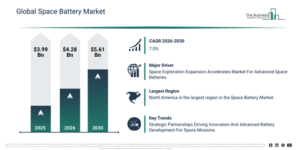
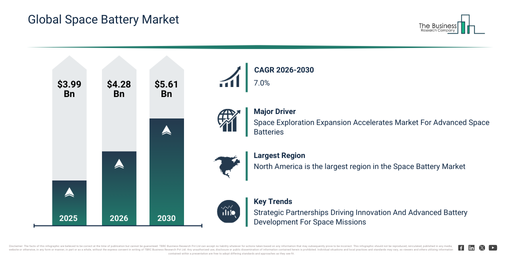
Space Battery Market Expansion From $4.28 Billion In 2026 To $5.61 Billion In 2030
The space battery market is projected to experience substantial expansion over the upcoming years. Its valuation is set to reach $5.61 billion by 2030, exhibiting a compound annual growth rate (CAGR) of 7.0%. This expansion during the forecast period is primarily driven by factors such as the rise of lithium-sulfur batteries, the integration of advanced solid-state batteries, the creation of high-energy-density solutions, their incorporation into deep-space missions, and the expansion of reusable satellite power systems. Key trends anticipated during this period encompass the wider acceptance of radiation-resistant battery chemistries, an increase in long-duration energy storage capabilities for deep-space missions, the growing deployment of modular and lightweight battery systems, enhanced investment in high-power systems designed for launch vehicles, and an expanding demand originating from small satellite constellations.
The expanding demand for space exploration is anticipated to boost the growth of the space battery market in the future. Space exploration entails investigating and unraveling the enigmas of outer space through sophisticated technologies to enhance scientific knowledge and support both human and robotic ventures beyond Earth. The increase in space exploration stems from escalating government and private funding, which stimulates technological progress, making missions more sophisticated and economically viable. Space batteries offer essential energy storage for energizing spacecraft systems and tools during these missions, particularly in areas where solar energy is not accessible. For example, in April 2024, a report from the World Economic Forum, a Switzerland-based non-governmental organization, indicated that the global space economy is forecast to reach $1.8 trillion by 2035, an increase from $630 billion in 2023, demonstrating an average annual growth rate of 9%, significantly surpassing the global GDP growth rate. Consequently, the uptick in space exploration endeavors is propelling the expansion of the space battery market.
Download A Free Sample Report For Comprehensive Market Insights:
Space Battery Market Opportunity Drivers: What Is Creating New Revenue Potential?
Leading companies in the space battery market are establishing strategic partnerships to offer innovative solutions and enhance their technological capabilities, thereby ensuring reliable and efficient power sources for space missions. Strategic partnerships describe a process where companies utilize each other’s strengths and resources to achieve mutual benefits and success. For example, in March 2024, KULR Technology Group, Inc., a US-based provider of advanced thermal-management and battery-systems technologies, collaborated with Nanoracks, a US-based space services company, to develop, test, and produce a specialized space battery designed to improve Voyager’s CubeSat applications. Under this contract, valued at over US$865,000, KULR is expediting the development, testing, and initial production of batteries for CubeSat use, with the first prototype set for delivery by the end of 2023, and implementing a platform based on its lithium-ion battery safety and thermal management technologies.
Space Battery Market Segment Outlook: Which Categories Are Expanding The Fastest?
The space battery market covered in this report is segmented –
1) By Type: Nickel-Based Battery, Lithium-Based Battery, Silver-Zinc Battery, Other Type
2) By Platform: Communication, Earth Observation, Military Surveillance, Science, Navigation, Other Platforms
3) By Energy Type: Less Than 100 Wh/kg, 100–150 Wh/kg, More Than 150 Wh/kg
4) By Orbit Type: Low Earth Orbit (LEO), Medium Earth Orbit (MEO), Geosynchronous Orbit (GEO), Other Orbit Types
5) By Application: Satellite, Launch Vehicle, Other Applications
Subsegments:
1) Nickel-Based Battery: Nickel-Cadmium Battery, Nickel-Metal Hydride Battery
2) Lithium-Based Battery: Lithium-Ion Battery, Lithium-Polymer Battery
3) Silver-Zinc Battery: Primary Silver-Zinc Battery, Rechargeable Silver-Zinc Battery
4) Other Type: Lead-Acid Battery, Solid-State Battery, Flow Battery
Space Battery Market Trends Driving Strategic Industry Expansion
Leading companies in the space battery market are establishing strategic partnerships to offer innovative solutions and enhance their technological capabilities, thereby ensuring reliable and efficient power sources for space missions. Strategic partnerships describe a process where companies utilize each other’s strengths and resources to achieve mutual benefits and success. For example, in March 2024, KULR Technology Group, Inc., a US-based provider of advanced thermal-management and battery-systems technologies, collaborated with Nanoracks, a US-based space services company, to develop, test, and produce a specialized space battery designed to improve Voyager’s CubeSat applications. Under this contract, valued at over US$865,000, KULR is expediting the development, testing, and initial production of batteries for CubeSat use, with the first prototype set for delivery by the end of 2023, and implementing a platform based on its lithium-ion battery safety and thermal management technologies.
Space Battery Market Key Companies And Competitive Benchmarking
Major companies operating in the space battery market are Lockheed Martin Corporation, Airbus SE, Northrop Grumman Corporation, Mitsubishi Electric Corporation, NEC Corporation, Teledyne Technologies Incorporated, GS Yuasa International Ltd., Enersys, Moog Inc., Aerojet Rocketdyne Holdings, Inc., Blue Origin LLC, Saft Groupe S.A., Eagle-Picher Technologies LLC, HBL Power Systems Limited, Arotech Corporation, Lyten Inc., Space Vector Corporation, Nanoavionics Ltd., AAC Clyde Space AB, E-One Moli Energy Corp., Epsilor Electric Fuel Ltd., Berlin Space Technologies GmbH
Access The Complete Space Battery Market Report:
Space Battery Market Largest Region By Revenue And Market Share
North America was the largest region in the space battery market in 2025. The regions covered in the space battery market report are Asia-Pacific, South East Asia, Western Europe, Eastern Europe, North America, South America, Middle East, Africa.
Access a Customized Space Battery Market Report for Deeper Competitive Insights
https://www.thebusinessresearchcompany.com/customise?id=19713&type=smp
The Business Research Company: https://www.thebusinessresearchcompany.com/
Americas: +1 310-496-7795
Asia: +44 7882 955267 & +91 8897263534
Europe: +44 7882 955267
Email us at: marketing@tbrc.info
Follow us on:
LinkedIn: https://in.linkedin.com/company/the-business-research-company
YouTube: https://www.youtube.com/channel/UC24_fI0rV8cR5DxlCpgmyFQ
Global Market Model: https://www.thebusinessresearchcompany.com/global-market-model

Wasay has over a decade of experience in market research, data modelling, and analytics, with prior experience at GlobalData and Decision Tree Consulting Services. At The Business Research Company , he leads research operations across syndicated studies, customized consulting engagements, and the Global Market Model platform. His professional experience includes supporting organizations such as Boston Consulting Group, KPMG, and Ernst & Young. Wasay holds a degree in Electronics and Communications Engineering, postgraduate management qualifications from International Management Institute Belgium and Indian School of Business and Entrepreneurship, and completed the Integrated Program in Business Analytics from Indian Institute of Management Indore.