Market attractiveness scoring, total addressable market sizing, company benchmarking matrices, interactive Excel dashboards, deeper supply chain intelligence, emerging startup tracking, and granular product-level insights are among the key offerings featured in The Business Research Company’s 2026 market reports, designed to deliver more actionable and strategically valuable research.
Space Debris Removal Market Size Overview: From Historical Performance To The 2030 Forecast
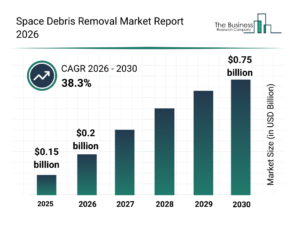
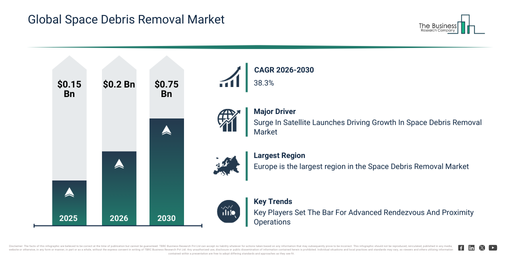
The space debris removal market has experienced substantial growth in recent years. It is projected to expand from $0.15 billion in 2025 to $0.2 billion in 2026, demonstrating a compound annual growth rate (CAGR) of 39.2%. This historical growth can be attributed to several factors, including an escalating number of defunct satellites and spent rocket stages that increase collision risks, the initial development and adoption of systems for tracking and monitoring orbital debris, government initiatives aimed at promoting space sustainability and debris mitigation, technological advancements in active debris removal (ADR) methods, and a growing understanding of the economic and operational risks presented by space debris.
The space debris removal market is anticipated to experience significant expansion over the next few years, with projections indicating it will reach $0.75 billion by 2030, growing at a compound annual growth rate (CAGR) of 38.3%. This growth during the forecast period can be attributed to several factors: the increasing deployment of space TUGs and servicing vehicles for debris removal, the integration of AI and machine learning for precise debris identification and collision prediction, rising investments in end-of-life satellite services and deorbiting modules, the expansion of international collaboration for coordinated space debris management, and the development of cost-effective and scalable ADR technologies for commercial and governmental use. Furthermore, key trends in this period include advancements in orbital debris tracking and monitoring systems, the emergence of active debris removal (ADR) technologies, a rise in space traffic management services, the creation of end-of-life satellite deorbiting solutions, and the integration of multi-technique debris removal operations.
Get A Free Sample Of The Business Research Company’s Space Debris Removal Market Report:
What Factor Is Increasing Demand In The Space Debris Removal Market?
The increasing volume of satellite launches is anticipated to drive the expansion of the space debris removal market in the future. Satellite launches involve sending artificial satellites into orbit using launch vehicles or rockets for various objectives, such as communication, Earth observation, and scientific exploration. This rise in launches is fueled by growing demand for global connectivity, Earth observation, scientific research, and commercial applications, supported by technological advancements, cost reductions, and increasing interest in space exploration. The proliferation of satellites escalates collision risks with space debris, making space debris removal services essential for ensuring the long-term sustainability of space activities. For instance, in June 2024, the Satellite Industry Association, a US-based organization, reported that the commercial satellite industry in 2023 experienced record-breaking growth, with 2,781 satellites launched, a 20% increase from 2022. The space industry also achieved a new milestone with 190 total launches, the highest number ever recorded. By the end of the year, the count of operational satellites reached 9,691, indicating a 361% increase over the past five years. Therefore, the growing number of satellite launches is a key factor propelling the growth of the space debris removal market.
Which Segments Make Up The Space Debris Removal Market?
The space debris removal market covered in this report is segmented –
1) By Debris Size: 1mm To 10mm, 10mm To 100mm, Greater Than 100mm
2) By Technique: Direct Debris Removal, Indirect Debris Removal
3) By Operation: Single Technique, Multiple Technique
4) By Orbit: Low Earth Orbit (LEO), Medium Earth Orbit (MEO), Geostationary Orbit (GEO)
5) By End User: Commercial, Government
Subsegments:
1) By 1mm to 10mm: Small Debris Removal (Micrometeoroid and Orbital Debris), Laser-based Removal Technologies, Electrostatic or Magnetic Capture Methods
2) By 10mm to 100mm: Mid-Size Debris Capture and De-orbiting, Tether-based Debris Removal, Robotic Arm or Gripper Systems for Capture
3) By Greater Than 100mm: Large Debris Removal (e.g., defunct satellites, spent rocket stages), Harpoon or Net-based Capture Systems, Space Tug and Robotic Removal Solutions
Space Debris Removal Market Emerging Trends: What Are Industry Leaders Focusing On?
Companies actively involved in the space debris removal market are concentrating on developing advanced solutions, such as commercial satellites for demonstrating debris inspection, to improve space situational awareness and encourage sustainable space operations. These efforts seek to display cutting-edge technologies for tracking and managing space debris, contributing to the long-term sustainability of space and fostering safer orbital environments. For instance, in February 2024, Astroscale Japan Inc., a Japanese aerospace firm, launched ADRAS-J, recognized as the world’s first active debris removal mission. This mission intends to safely approach, characterize, and survey an existing large debris object through sophisticated rendezvous and proximity operations, focusing on a Japanese H2A upper-stage rocket body. It demonstrates demanding RPO capabilities critical for on-orbit services by executing proximity operations, collecting images, and evaluating the rocket body’s movement and structural state.
Major Companies To Know In The Space Debris Removal Market
Major companies operating in the space debris removal market are Lockheed Martin Corporation, Airbus SE, Northrop Grumman Corporation, Rocket Lab Limited, Astroscale Holdings Inc., Surrey Satellite Technology Limited, BlackSky Global LLC, Rogue Space Systems Corporation, D-Orbit S.p.A., ClearSpace SA, LeoLabs Inc., Metrolaser Inc., Skyrora Limited, Skycorp Inc., NorthStar Earth & Space Inc., Busek Co. Inc., TRL11 Limited, OrbitGuardians Inc., Obruta Space Solutions Inc., Space Logistics LLC, Altius Space Machines Inc
Read The In-Depth Space Debris Removal Market Report:
Space Debris Removal Market Regional Landscape: Largest Region In 2025
Europe was the largest region in the space debris removal market in 2025. North America is expected to be the fastest-growing region in the forecast period. The regions covered in the space debris removal market report are Asia-Pacific, South East Asia, Western Europe, Eastern Europe, North America, South America, Middle East, Africa.
Reach Out To Our Team:
The Business Research Company: https://www.thebusinessresearchcompany.com/
Americas: +1 310-496-7795
Asia: +44 7882 955267 & +91 8897263534
Europe: +44 7882 955267
Email us at: marketing@tbrc.info
Follow us on:
LinkedIn: https://in.linkedin.com/company/the-business-research-company
YouTube: https://www.youtube.com/channel/UC24_fI0rV8cR5DxlCpgmyFQ
Global Market Model: https://www.thebusinessresearchcompany.com/global-market-model

Wasay has over a decade of experience in market research, data modelling, and analytics, with prior experience at GlobalData and Decision Tree Consulting Services. At The Business Research Company , he leads research operations across syndicated studies, customized consulting engagements, and the Global Market Model platform. His professional experience includes supporting organizations such as Boston Consulting Group, KPMG, and Ernst & Young. Wasay holds a degree in Electronics and Communications Engineering, postgraduate management qualifications from International Management Institute Belgium and Indian School of Business and Entrepreneurship, and completed the Integrated Program in Business Analytics from Indian Institute of Management Indore.