Through market attractiveness analysis, total addressable market evaluation, company benchmarking matrices, interactive Excel dashboards, expanded supply chain intelligence, emerging startup coverage, and detailed product insights, The Business Research Company’s 2026 market reports provide more actionable and strategically valuable research.
Space Economy Market Expansion From $468.48 Billion In 2026 To $646.6 Billion In 2030
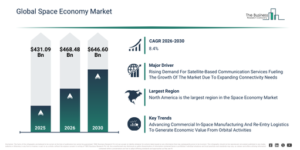
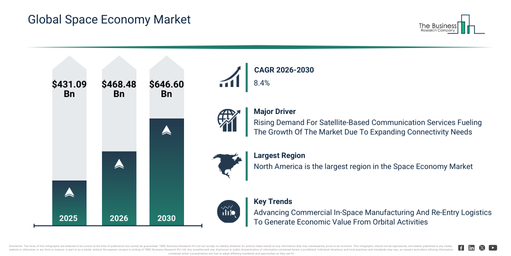
The space economy market size has demonstrated significant expansion in recent years. It is forecast to increase from $431.09 billion in 2025 to $468.48 billion in 2026, exhibiting a compound annual growth rate (CAGR) of 8.7%. This past growth is largely attributable to factors such as an increase in satellite launches, expanding government space budgets, greater demand for earth observation, the proliferation of commercial satellite services, and elevated investment in space infrastructure.
The space economy market size is projected to experience substantial growth in the forthcoming years. It is forecast to reach $646.60 billion in 2030, with a compound annual growth rate (CAGR) of 8.4%. This expansion during the forecast period can be attributed to the increasing adoption of reusable rockets, a rising demand for space-based internet services, growing private sector participation, the proliferation of commercial space tourism activities, and increased investment in deep space missions. Key trends during this period encompass technological advancements in satellite systems, new innovations in reusable launch technologies, developments in space robotics, ongoing research and development in propulsion systems, and enhancements in in-orbit servicing technologies.
Download A Free Sample Report For Comprehensive Market Insights:
Space Economy Market Expansion Drivers: What Is Shaping Future Growth?
The space economy market is anticipated to grow due to the increasing need for satellite-based communication services. These services facilitate the transmission of data, voice, and broadband connectivity through satellites orbiting Earth rather than terrestrial networks, thereby providing global coverage and connecting remote or underserved regions. The demand for satellite-based communication services is rising as individuals, businesses, and governments require dependable high-speed connectivity where ground infrastructure is not feasible, particularly for broadband internet and data services. The space economy supports this rising demand by expanding investments in satellite manufacturing, launch services, and satellite network operations that deliver these communication services. For instance, in May 2025, according to the Satellite Industry Association, a US-based satellite industry trade association, commercial satellite deployments reached 2,781 units in 2023, reflecting a 20% year on year increase, while satellite broadband performance strengthened with revenue rising by 40% and subscriber numbers growing by 27%. Consequently, the increasing demand for satellite-based communication services is driving the growth of the space economy market.
#Space Economy Market Segment Landscape And Growth Potential
The space economy market covered in this report is segmented –
1) By Type: Satellite Industry, Satellite Launch, Satellite Services, Satellite Manufacturing, Satellite Ground Equipment
2) By Sector: Upstream Sector, Downstream Sector, Non-Satellite Sector
3) By Price Range: Low, Medium, Premium
4) By Distribution Channel: Direct Contracts, Online Services And Platforms, Partnerships And Collaborations, Other Distribution Channels
5) By End User: Government, Private Companies, Research Institutes, Educational Institutions, Other End Users
Segmentations:
1) By Satellite Industry: Earth Observation Satellites, Communication Satellites, Navigation Satellites, Scientific Research Satellites, Small Satellite Systems
2) By Satellite Launch: Launch Vehicles, Launch Services, Reusable Rocket Systems, Heavy Lift Launch Systems, Small Payload Launch Solutions
3) By Satellite Services: Remote Sensing Services, Communication And Broadcast Services, Navigation And Positioning Services, Data Analytics Services, Satellite Internet Services
4) By Satellite Manufacturing: Satellite Assembly, Payload Development, Satellite Component Manufacturing, Propulsion System Manufacturing, Spacecraft Structure Manufacturing
5) By Satellite Ground Equipment: Ground Antenna Systems, Control Station Equipment, User Terminal Equipment, Tracking And Telemetry Systems, Ground Communication Infrastructure
Space Economy Market Strategic Trends: What Is Defining The Next Phase Of Growth?
Leading companies within the space economy market are concentrating on developing sophisticated space capabilities, such as orbital manufacturing and reentry testing, to facilitate payload experimentation, materials testing, and in-space manufacturing. Orbital manufacturing and reentry analytics refer to the capacity to produce, analyze, and retrieve payloads from orbit, while collecting high-fidelity data in extreme reentry environments to inform subsequent aerospace solutions. For instance, in January 2025, Varda Space Industries Inc., a US-based space manufacturing and logistics firm, launched its second capsule for orbital processing and reentry, W-2, aboard the Transporter-12 rideshare mission with SpaceX. This capsule transports payloads from partners, including the Air Force Research Laboratory, featuring the Optical Sensing of Plasmas in the Reentry Environment payload, which records the inaugural in situ optical emission measurements of reentry plasma past Mach 15. The W-2 capsule also incorporates an advanced thermal protection system developed with NASA, alongside Varda’s enlarged pharmaceutical reactor for in-orbit manufacturing.
Space Economy Market Competitive Landscape: Who Are The Leading Companies?
Major companies operating in the space economy market are Airbus Defence and Space GmbH, Lockheed Martin Corporation, Northrop Grumman Corporation, Space Exploration Technologies Corp., Blue Origin LLC, Viasat Inc., SES S.A., Eutelsat Communications S.A., Iridium Communications Inc., Arianespace S.A., United Launch Alliance LLC, Virgin Galactic Holdings Inc., Telesat, Sierra Space Corporation, Relativity Space Inc., Rocket Lab Inc., ICEYE Ltd., Planet Labs PBC, Axiom Space Inc., Astroscale Holdings Inc., Spire Global Inc., Firefly Aerospace Inc., BlackSky Global Inc., ispace inc., Capella Space Corp.
Access The Complete Space Economy Market Report:
Space Economy Market Regional Distribution: Which Areas Drive Market Expansion?
North America was the largest region in the space economy market in 2025. Asia-Pacific is expected to be the fastest-growing region in the forecast period. The regions covered in the space economy market report are Asia-Pacific, South East Asia, Western Europe, Eastern Europe, North America, South America, Middle East, Africa.
Get in touch with us:
The Business Research Company: https://www.thebusinessresearchcompany.com/
Americas: +1 310-496-7795
Asia: +44 7882 955267 & +91 8897263534
Europe: +44 7882 955267
Email us at: marketing@tbrc.info
Follow us on:
LinkedIn: https://in.linkedin.com/company/the-business-research-company
YouTube: https://www.youtube.com/channel/UC24_fI0rV8cR5DxlCpgmyFQ
Global Market Model: https://www.thebusinessresearchcompany.com/global-market-model

Wasay has over a decade of experience in market research, data modelling, and analytics, with prior experience at GlobalData and Decision Tree Consulting Services. At The Business Research Company , he leads research operations across syndicated studies, customized consulting engagements, and the Global Market Model platform. His professional experience includes supporting organizations such as Boston Consulting Group, KPMG, and Ernst & Young. Wasay holds a degree in Electronics and Communications Engineering, postgraduate management qualifications from International Management Institute Belgium and Indian School of Business and Entrepreneurship, and completed the Integrated Program in Business Analytics from Indian Institute of Management Indore.