With a focus on actionable insights and strategic value, The Business Research Company’s 2026 market reports include market attractiveness scoring, total addressable market sizing, company benchmarking matrices, interactive Excel dashboards, deeper supply chain intelligence, emerging startup tracking, and granular product-level insights.
How Much Will The Space Electronics Market Be Worth By 2030?
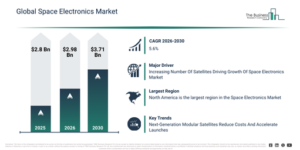
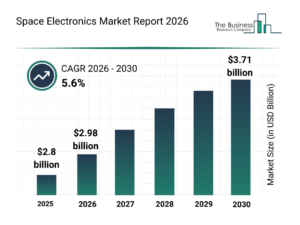
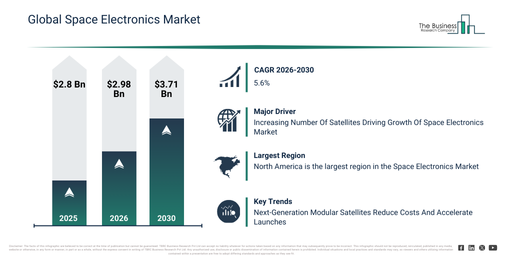
The space electronics market has experienced significant expansion recently. Its size is projected to increase from $2.8 billion in 2025 to $2.98 billion in 2026, demonstrating a compound annual growth rate (CAGR) of 6.6%. Historically, this growth can be ascribed to several factors, including the rising deployment of satellites necessitating radiation-hardened electronic components, an increased need for reliable sensors such as accelerometers and ambient light sensors crucial for spacecraft operations, advancements in space-qualified semiconductor technologies that improve durability under extreme conditions, the expansion of government and commercial space missions which spurred the early adoption of specialized electronics, and the growing demand for precise environmental monitoring systems, encompassing air quality sensors and fan controllers, within spacecraft.
The space electronics market is projected to experience robust expansion over the coming years. This market is forecast to reach $3.71 billion in 2030, exhibiting a compound annual growth rate (CAGR) of 5.6%. Factors driving this growth during the forecast period include increasing investments in compact and high-performance electronics for small satellite networks, a surging need for sophisticated radiation-hardened components for deep space missions, the creation of multi-functional sensor systems to boost spacecraft independence, a greater embrace of modular electronic designs to cut down on integration duration and expenses, and the broadening of commercial space endeavors which boosts demand for scalable space electronics solutions. Key trends anticipated in this period encompass an escalating need for radiation-hardened electronics for deep-space operations, the increasing use of miniaturized sensors in small satellites, a greater incorporation of multi-functional electronic parts into spacecraft, advancements in materials for thermal and radiation protection, and the expansion of commercial satellite constellations necessitating durable electronics.
Get Access To A Free Space Electronics Market Report Sample:
The Key Driver Behind The Space Electronics Market’s 5.6% CAGR
An expanding count of satellites is projected to fuel the advancement of the space electronics market moving ahead. A satellite is defined as any entity orbiting a planet, star, or moon. This surge in satellite numbers stems from the growing need for worldwide communication and interconnectedness. Satellites are susceptible to charging and discharging processes, necessitating space components like space electronics that feature no floating metal. For example, in January 2024, a report by the US-based non-profit organization Space Foundation indicated that global launch activity reached unprecedented levels for the third year in a row, recording 223 launch attempts and 212 successes. Commercial launches experienced a 50% increase compared to 2022. More than 2,800 satellites were deployed into orbit, representing a 23% rise from the prior year. Consequently, the expanding quantity of satellites is fostering the expansion of the space electronics market.
Space Electronics Market Classification: Main Segments And Detailed Subsegments
The space electronics market covered in this report is segmented –
1) By Type: Radiation Hardened, Radiation Tolerant
2) By Component: Microprocessors And Controllers, Sensors, Application Specific Integrated Circuits, Memory Chips, Power Source Cables, Discrete Semiconductors, Other Components
3) By Platform: Satellite, Launch Vehicles, Deep Space Probes
4) By Application: Communication, Earth Observation, Navigation, Global Positioning System (GPS), Technology Development And Education, Other Applications
Subsegments:
1) By Radiation Hardened: Analog Components, Digital Components, Power Management ICs, Mixed-Signal Components
2) By Radiation Tolerant: Microprocessors, FPGAs (Field Programmable Gate Arrays), Memory Devices, Logic Devices
Space Electronics Market Strategic Shifts: What Leading Players Are Prioritizing
Major companies operating in the space electronics market are focusing on developing innovative solutions, such as modular satellite platforms, to accelerate satellite deployment and reduce mission costs. These modular satellite platforms are spacecraft constructed from standardized, interchangeable modules that can be quickly assembled or reconfigured, which helps decrease development time, lower expenses, and enable faster, more flexible satellite missions. For instance, in July 2025, the National Aeronautics and Space Administration (NASA), a U.S.-based government space agency, launched the Athena EPIC satellite aboard a SpaceX Falcon 9 rocket as part of a rideshare mission. This mission tested an innovative scalable satellite architecture that allows multiple payloads to share onboard electronics and resources, thereby reducing costs and enabling quicker deployment of instruments for Earth observation and scientific research. Athena EPIC utilizes Hyper-Integrated Satlets (HISats), which are modular building-block components that can be combined into larger structures called SensorCraft. This allows the satellite to manage routine functions such as heating, power, and control through the HISats, rather than relying on separate systems for each payload. The sensor payload onboard Athena EPIC was constructed using spare parts from previous NASA missions, demonstrating a cost-effective approach to reusing proven technology.
Space Electronics Market Company Analysis: Major Industry Participants
Major companies operating in the space electronics market are BAE Systems PLC, Texas Instruments, Inc., Cobham PLC, Honeywell International Inc., STMicroelectronics, Teledyne e2v (UK) Ltd., TT Electronics, Ruag Group, Infineon Technologies, Onsemi, Renesas Electronics Corporation, Analog Devices Inc., Microchip Technology Inc., NXP Semiconductors, Vishay Intertechnology Inc., Silicon Laboratories Inc., L3Harris Technologies Inc., Lockheed Martin Corporation, Northrop Grumman Corporation, Raytheon Technologies Corporation, Thales Group, Airbus Defence and Space
Get Full Access To The Space Electronics Market Report 2026:
Space Electronics Market Global Regional Breakdown: Key Regions Analyzed
North America was the largest region in the space electronics market in 2025. Asia-Pacific is expected to be the fastest-growing region in the space electronics market report during the forecast period. The regions covered in the space electronics market report are Asia-Pacific, South East Asia, Western Europe, Eastern Europe, North America, South America, Middle East, Africa.
Reach Out To Our Team:
The Business Research Company: https://www.thebusinessresearchcompany.com/
Americas: +1 310-496-7795
Asia: +44 7882 955267 & +91 8897263534
Europe: +44 7882 955267
Email us at: marketing@tbrc.info
Follow us on:
LinkedIn: https://in.linkedin.com/company/the-business-research-company
YouTube: https://www.youtube.com/channel/UC24_fI0rV8cR5DxlCpgmyFQ
Global Market Model: https://www.thebusinessresearchcompany.com/global-market-model

Wasay has over a decade of experience in market research, data modelling, and analytics, with prior experience at GlobalData and Decision Tree Consulting Services. At The Business Research Company , he leads research operations across syndicated studies, customized consulting engagements, and the Global Market Model platform. His professional experience includes supporting organizations such as Boston Consulting Group, KPMG, and Ernst & Young. Wasay holds a degree in Electronics and Communications Engineering, postgraduate management qualifications from International Management Institute Belgium and Indian School of Business and Entrepreneurship, and completed the Integrated Program in Business Analytics from Indian Institute of Management Indore.