The Business Research Company’s 2026 market reports combine market attractiveness scoring, total addressable market sizing, company benchmarking matrices, interactive Excel dashboards, deeper supply chain intelligence, emerging startup tracking, and granular product-level insights to deliver research that is more actionable and strategically valuable.
Space Fuel Production Market Size Trajectory: Key Numbers Every Industry Stakeholder Should Know
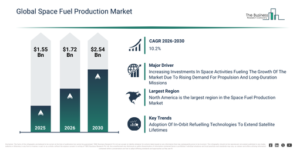
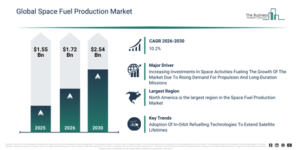
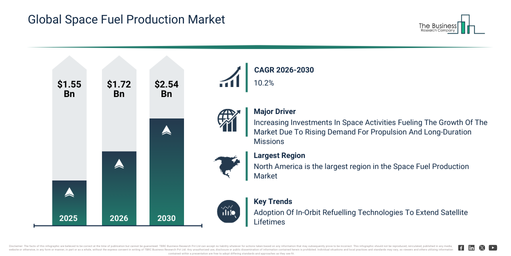
The space fuel production market has experienced rapid expansion in recent years. Its size is projected to increase from $1.55 billion in 2025 to $1.72 billion in 2026, at a compound annual growth rate (CAGR) of 11.0%. This historical growth has been driven by several factors, including pioneering investigations into in-situ resource utilization for creating propellants from lunar and Martian materials, the advancement of cryogenic fuel storage and management solutions for extended duration missions, initial trials of on-orbit refueling techniques employing robotic interfaces, the growing use of electric propulsion systems boosting demand for specialized ionic liquids, and the expanding scope of commercial satellite operations which has amplified interest in fuel depot concepts.
The space fuel production market is anticipated to experience substantial expansion in the coming years, with its size projected to reach $2.54 billion in 2030, demonstrating a compound annual growth rate (CAGR) of 10.2%. This projected expansion is driven by several factors, including the progress in large-scale lunar and asteroid mining projects that facilitate extraterrestrial fuel recovery, the increasing use of space tugs demanding a steady supply of propellants, the growing market for on-orbit refueling solutions for satellites and expeditions into deep space, the creation of advanced cryogenic storage systems offering enhanced thermal stability, and increasing capital into liquid hydrogen and methane production setups for sustainable propulsion beyond Earth. Noteworthy developments anticipated in this forecast timeframe involve the broader application of in-situ resource utilization, improvements in cryogenic fuel storage technologies, the expansion of space tug and fuel depot activities, the creation of fuels for electric propulsion, and the incorporation of ionic liquid and hybrid rocket propellants.
Looking For Reliable Space Fuel Production Market Data? Request A Free Sample:
What Is Behind The Rising Demand In The Space Fuel Production Market?
The space fuel production market is anticipated to expand due to growing investments in space activities. These activities encompass human endeavors to explore and utilize outer space, including satellite launches, mission execution, and delivering space-related services. Investments in this sector are climbing, driven by the increasing need for satellite-based communication and data services. Space fuel production is crucial for these activities, facilitating effective spacecraft propulsion, in-orbit refueling, and extended mission durations. For example, the World Economic Forum, a Switzerland-based non-profit organization, reported in April 2024 that the space economy is projected to surge from $630 billion in 2023 to $1.8 trillion by 2035, indicating an average annual growth rate of 9%. Consequently, the rising financial commitments in space activities are stimulating the expansion of the space fuel production market.
Space Fuel Production Market Segment Coverage And Subsegment Analysis
The space fuel production market covered in this report is segmented –
1) By Fuel Type: Hydrogen, Methane, Nuclear, Solar, Other Fuel Types
2) By Technology: In-Situ Resource Utilization, Chemical Propulsion, Electric Propulsion, Other Technologies
3) By Application: Spacecraft Propulsion, Satellite Power Systems, Space Stations, Other Applications
4) By End-User: Government And Defense, Commercial, Other End-Users
Subsegments:
1) By Hydrogen: Liquid Hydrogen, Compressed Hydrogen Gas, Metal Hydride Storage, Cryo-Compressed Hydrogen
2) By Methane: Liquid Methane, Compressed Methane Gas, Methane-Hydrogen Mix, Renewable Methane
3) By Nuclear: Fission-based Nuclear Fuel, Fusion-based Nuclear Fuel, Radioisotope Thermoelectric Generators (RTGs), Nuclear Thermal Propulsion (NTP)
4) By Solar: Photovoltaic Solar Fuel, Solar Thermal Fuel, Solar Hydrogen Production, Solar Biomass Conversion
5) By Other Fuel Types: Ionic Liquid Fuels, Solid Rocket Fuel, Electrochemical Propellants, Hybrid Rocket Fuels
Space Fuel Production Market Future Trends: Where Is The Industry Heading?
Major companies operating in the space fuel production market are focusing on developing innovative solutions, such as in-orbit refuelling interfaces and propellant depots, to address the increasing demand for extending satellite operational periods, enabling reusable spacecraft operations, and reducing launch mass. An in-orbit refuelling interface permits satellites to acquire propellant while in space, unlike traditional spacecraft that rely solely on pre-loaded fuel at launch, thereby enhancing mission flexibility and longevity. For instance, in July 2025, Orbit Fab, Inc., a US-based space services company, launched the RAFTI (Rapidly Attachable Fluid Transfer Interface) Refuelling Port and Fuel Delivery Service for satellites and space vehicles. The RAFTI system facilitates standardized in-orbit propellant transfer through a compact docking mechanism compatible with multiple fuel types such as hydrazine and xenon. It integrates a lightweight interface for both ground and orbital refuelling, modular depot infrastructure, and mission-planning software to optimize refuelling schedules. This innovation provides greater operational flexibility, extended satellite life, and reduced launch weight compared to traditional single-fuel-load missions.
Space Fuel Production Market Top Players List For 2026
Major companies operating in the space fuel production market are The Boeing Company, Lockheed Martin, Northrop Grumman, SpaceX, Blue Origin, Aerojet Rocketdyne, Sierra Nevada Corporation, United Launch Alliance, Relativity Space, Firefly Aerospace, Firehawk Aerospace, Vaya Space, Astrobotic, Orbit Fab, HyImpulse Technologies, HyPrSpace, bluShift Aerospace, Viridian Space, Momentus, Virgin Galactic, Stoke Space, Impulse Space, Gilmour Space Technologies, Rocket Lab, ISRU Technologies Inc.
Order Your Copy Of The Space Fuel Production Market Report 2026:
How Does The Space Fuel Production Market Vary By Region?
North America was the largest region in the space fuel production market in 2025. The regions covered in the space fuel production market report are Asia-Pacific, South East Asia, Western Europe, Eastern Europe, North America, South America, Middle East, Africa.
Reach Out To Our Team:
The Business Research Company: https://www.thebusinessresearchcompany.com/
Americas: +1 310-496-7795
Asia: +44 7882 955267 & +91 8897263534
Europe: +44 7882 955267
Email us at: marketing@tbrc.info
Follow us on:
LinkedIn: https://in.linkedin.com/company/the-business-research-company
YouTube: https://www.youtube.com/channel/UC24_fI0rV8cR5DxlCpgmyFQ
Global Market Model: https://www.thebusinessresearchcompany.com/global-market-model

Wasay has over a decade of experience in market research, data modelling, and analytics, with prior experience at GlobalData and Decision Tree Consulting Services. At The Business Research Company , he leads research operations across syndicated studies, customized consulting engagements, and the Global Market Model platform. His professional experience includes supporting organizations such as Boston Consulting Group, KPMG, and Ernst & Young. Wasay holds a degree in Electronics and Communications Engineering, postgraduate management qualifications from International Management Institute Belgium and Indian School of Business and Entrepreneurship, and completed the Integrated Program in Business Analytics from Indian Institute of Management Indore.