Featuring market attractiveness scoring, total addressable market sizing, company benchmarking matrices, interactive Excel dashboards, deeper supply chain intelligence, emerging startup tracking, and granular product-level insights, The Business Research Company’s 2026 market reports are built to deliver research that is both more actionable and more strategically valuable.
#Space Habitat Market Poised To Hit $11.54 Billion By 2030 With A 20.8% CAGR#_x000D_
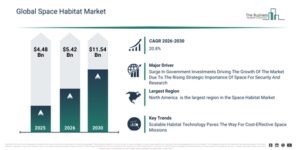
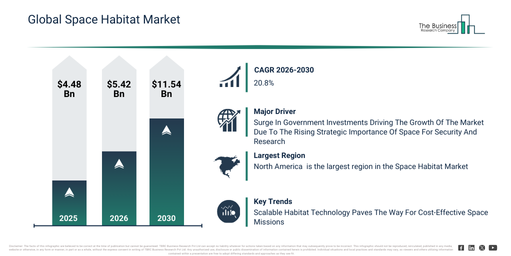
The space habitat market has experienced significant expansion in recent years. It is projected to grow from $4.48 billion in 2025 to $5.42 billion in 2026, achieving a compound annual growth rate (CAGR) of 21.0%. This historical growth can be attributed to factors such as the development of International Space Station modules, advancements in life support systems, the adoption of radiation shielding materials, an increasing focus on long-duration human spaceflight, and the use of robotics and automation for habitat support._x000D_
_x000D_
The space habitat market is projected to experience substantial expansion in the coming years. It is set to reach $11.54 billion by 2030, growing at a compound annual growth rate (CAGR) of 20.8%. This growth during the forecast period can be attributed to several factors, including the increasing number of lunar and mars habitat projects, advancements in sustainable energy and water recycling, the incorporation of advanced psychological well-being systems, flexible modular and expandable habitat designs, and the rising demand from commercial space tourism and research. Significant trends anticipated in the forecast period involve sophisticated life support systems, innovations in radiation shielding, efficient water recycling and waste management technologies, comprehensive psychological and physical well-being support, and adaptable modular and expandable habitat designs._x000D_
_x000D_
#Get A Free Sample Report With In-Depth Market Insights:#_x000D_
_x000D_
#Space Habitat Market Expansion Drivers: What’s Shaping Future Growth?#_x000D_
The future expansion of the space habitat market is anticipated to be driven by rising government spending on space technologies. Such government investments involve the allocation of public funds by national or international agencies to develop, support, and advance spacecraft, satellites, launch systems, and related research for scientific, commercial, and defense purposes. The surge in government funding for space technologies stems from space’s increasing strategic importance for national security, as control over space assets ensures advanced surveillance, defense capabilities, and secure communication networks. Space habitats contribute to government investments in space technologies by offering enduring living and research settings, which facilitate extended missions, scientific investigations, and the creation of advanced aerospace systems. As an illustration, in December 2024, the European Space Agency, a France-based intergovernmental space agency, reported that institutional space budgets (civil and defense) hit an unprecedented high of approximately $139.87 billion (€122 billion) in 2024, marking a 9% rise from 2023. Consequently, the expansion of the space habitat market is projected to be propelled by greater government investments in space technologies._x000D_
_x000D_
#Space Habitat Market Segmentation: How Does The Market Break Down By Category?#_x000D_
The space habitat market covered in this report is segmented – _x000D_
_x000D_
1) By Technology-Based: Modular Habitat Technologies, Inflatable Habitat Technologies, Surface-Based Habitat Technologies, Hybrid (Combining Various Technologies), Autonomous Habitat Systems_x000D_
2) By Purpose-Based: Scientific Research Habitats, Commercial Habitats, Tourism-Focused Habitats, Industrial Habitats, Military Habitats_x000D_
3) By Size-Based: Small-Sized Habitats (For 1-5 People), Medium-Sized Habitats (For 6-20 People), Large-Sized Habitats (For 21-50 People), Extra Large Habitats (For 50+ People)_x000D_
4) By End-User: Government Agencies, Private Enterprises, Non-Governmental Organizations, Research Institutions, Educational Institutions_x000D_
_x000D_
Subsegments:_x000D_
_x000D_
1) By Modular Habitat Technologies: Pre-Assembled Modules, Expandable Modules, Dockable Modules_x000D_
2) By Inflatable Habitat Technologies: Multi-Layer Inflatable Structures, Rigid Frame Inflatable Hybrids, Lightweight Inflatable Units_x000D_
3) By Surface-Based Habitat Technologies: Regolith-Based Construction, 3D Printed Surface Structures, Prefabricated Surface Modules_x000D_
4) By Hybrid Combining Various Technologies: Modular Inflatable Combinations, Surface And Inflatable Hybrids, Multi-Technology Integrated Habitats_x000D_
5) By Autonomous Habitat Systems: Self-Sustaining Life Support Systems, Artificial Intelligence Enabled Control Systems, Remote Monitoring And Operation Systems_x000D_
_x000D_
#Space Habitat Market Strategic Trends: What Defines The Next Growth Phase?#_x000D_
Leading companies in the space habitat market are focusing on technological developments, particularly scalable habitat technology, to facilitate adaptable, lightweight, and cost-effective human living, research, and manufacturing in space. Scalable habitat technology describes space structures designed to increase in size post-deployment, thereby providing scalable, lightweight, and cost-effective living or working areas for humans in space. For instance, in April 2024, Max Space, a US-based aerospace company, launched an innovative expandable space habitat. This advanced inflatable architecture offers unprecedented scalability, ranging from 20 m³ to over 10,000 m³, considerably reduces flight qualification costs, and provides a flexible platform for human exploration, research, manufacturing, and entertainment across LEO, cislunar space, the Moon, and Mars, positioning the company as a frontrunner in the space habitation market._x000D_
_x000D_
#Space Habitat Market Competitive Overview And Top Companies#_x000D_
Major companies operating in the space habitat market are The Boeing Company, Airbus SE, Lockheed Martin Corporation, Mitsubishi Heavy Industries Ltd., National Aeronautics and Space Administration (NASA), Thales S.A., Blue Origin Enterprises L.P., European Space Agency (ESA), Redwire Corporation, Axiom Space Inc., Bigelow Aerospace LLC, Interstellar Lab Inc., Vast Space Inc., Gravitics Inc., Orbital Assembly Corporation, Max Space Inc., ThinkOrbital Inc., Exploration Architecture Corporation, Akashalabdhi Inc., SAGA Space Architects Aps _x000D_
_x000D_
#View The Full Space Habitat Market Report:#_x000D_
_x000D_
#Space Habitat Market Regional Analysis And Top Geography#_x000D_
North America was the largest region in the space habitat market in 2025. Asia-Pacific is expected to be the fastest-growing region in the forecast period. The regions covered in the space habitat market report are Asia-Pacific, South East Asia, Western Europe, Eastern Europe, North America, South America, Middle East, Africa._x000D_
_x000D_
#Reach Out To Our Team:#_x000D_
_x000D_
The Business Research Company: https://www.thebusinessresearchcompany.com/_x000D_
Americas: +1 310-496-7795_x000D_
Asia: +44 7882 955267 & +91 8897263534_x000D_
Europe: +44 7882 955267_x000D_
Email us at: marketing@tbrc.info_x000D_
_x000D_
#Follow us on:#_x000D_
_x000D_
LinkedIn: https://in.linkedin.com/company/the-business-research-company_x000D_
YouTube: https://www.youtube.com/channel/UC24_fI0rV8cR5DxlCpgmyFQ_x000D_
Global Market Model: https://www.thebusinessresearchcompany.com/global-market-model

Wasay has over a decade of experience in market research, data modelling, and analytics, with prior experience at GlobalData and Decision Tree Consulting Services. At The Business Research Company , he leads research operations across syndicated studies, customized consulting engagements, and the Global Market Model platform. His professional experience includes supporting organizations such as Boston Consulting Group, KPMG, and Ernst & Young. Wasay holds a degree in Electronics and Communications Engineering, postgraduate management qualifications from International Management Institute Belgium and Indian School of Business and Entrepreneurship, and completed the Integrated Program in Business Analytics from Indian Institute of Management Indore.