The Business Research Company’s 2026 market reports combine market attractiveness scoring, total addressable market sizing, company benchmarking matrices, interactive Excel dashboards, deeper supply chain intelligence, emerging startup tracking, and granular product-level insights to deliver research that is more actionable and strategically valuable.
Space In-Orbit Refueling Market Value Projected To Grow At A 12.4% Compound Annual Growth Rate Through 2030
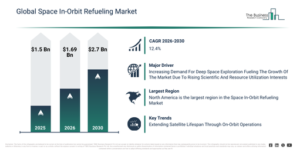
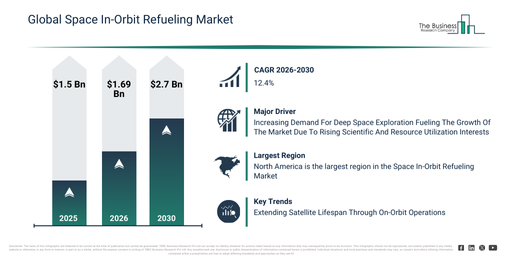
The space in-orbit refueling market has experienced rapid growth in recent years. This market is projected to expand from $1.5 billion in 2025 to $1.69 billion in 2026, at a compound annual growth rate (CAGR) of 12.7%. The historical growth can be attributed to early demonstrations of robotic fuel transfer concepts in orbit, the development of docking systems enabling precise spacecraft alignment for servicing, a rising demand for satellite life extension solutions to reduce replacement costs, initial testing of fluid transfer interfaces for cryogenic and non-cryogenic propellants, and the growth of on-orbit servicing programs supporting repositioning and de-orbiting needs.
The space in-orbit refueling market size is projected for substantial expansion over the next few years. It will grow to $2.7 billion in 2030 at a compound annual growth rate (CAGR) of 12.4%. This growth during the forecast period is primarily driven by the increasing number of commercial refueling spacecraft fleets for routine orbital maintenance, the rising integration of modular fuel delivery systems across satellite platforms, the establishment of standardized docking and transfer interfaces to ensure cross-operator compatibility, a surge in demand for in-orbit refueling to support deep space and lunar missions, and growing investment in propulsion component innovation to enhance refueling efficiency and safety. Key developments anticipated include greater adoption of standardized in-orbit refueling interfaces, an expanding need for satellite life-extension services, the proliferation of commercial on-orbit servicing operations, the evolution of modular refueling spacecraft designs, and enhanced investments in reusable and refillable propulsion technologies.
Evaluate The Space In-Orbit Refueling Market Report Before You Buy With A Free Sample:
Space In-Orbit Refueling Market Growth Driver Analysis For The 2026–2030 Forecast Period
The on-orbit satellite servicing market is poised for growth, fueled by an increase in space exploration activities. These activities involve the pursuit of scientific knowledge, technological breakthroughs, and commercial prospects beyond Earth, carried out through missions, research, and operations in space. Growth in space exploration is attributed to its ability to generate technological innovations with widespread Earth-based applications, which in turn fosters economic expansion and improves daily living. On-orbit satellite servicing facilitates space exploration by prolonging satellite operational periods, mending and upgrading space assets, and making missions more sustainable and cost-effective through in-space refueling, maintenance, and debris elimination. For example, data from Novaspace, a France-based consulting firm specializing in the space industry, indicates that global government expenditures on space exploration amounted to $26 billion in 2023 and are projected to hit $33 billion by 2032. Hence, the surge in space exploration initiatives is a key factor propelling the expansion of the on-orbit satellite servicing market.
Space In-Orbit Refueling Market Segmentation Breakdown: Primary And Secondary Categories
The space in-orbit refueling market covered in this report is segmented –
1) By Service Type: Propellant Refueling, Component Replacement, Satellite Servicing
2) By Refueling Technology: Cryogenic Refueling, Hypergolic Refueling, Green Propellant Refueling, Electric Propellant Refueling
3) By Vehicle Type: Satellites, Spacecraft, Space Stations
4) By Application: Commercial, Military, Government
5) By End-User: Satellite Operators, Space Agencies, Defense Organizations
Subsegments:
1) By Propellant Refueling: Chemical Propellant Refueling, Cryogenic Propellant Refueling, Electric Propellant Refueling
2) By Component Replacement: Battery Replacement, Communication Equipment Replacement, Sensor Replacement
3) By Satellite Servicing: On-orbit Maintenance, Orbital Adjustment Or Relocation Services, Software Upgrades
Space In-Orbit Refueling Market Industry Trends: New Developments From Leading Companies
Major companies active in the space in-orbit refueling market are prioritizing the development of technologically advanced solutions, such as the multi-orbit space mobility platform, to enable in-orbit refueling, satellite servicing, and extended mission durations. This multi-orbit space mobility platform is a versatile spacecraft capable of operating across various orbits to provide satellite refueling, servicing, and repositioning, thereby prolonging mission life and enhancing asset flexibility. For example, in October 2023, Blue Origin Enterprises L.P., an astronautics company based in the US, introduced its Blue Ring. It is engineered to refuel, transport, and host satellites across multiple orbits, making space operations more adaptable and economical. Its significant advantages include supporting payloads exceeding 3,000 kg, enabling in-orbit refueling, and delivering complete logistics and data services for commercial and government missions.
Who Are The Top Competitors In The Space In-Orbit Refueling Market?
Major companies operating in the space in-orbit refueling market are Lockheed Martin Corporation, Northrop Grumman Corporation, Space Exploration Technologies Corp., Blue Origin LLC, Thales Alenia Space S.A.S., Maxar Technologies Inc., Sierra Space Corporation, Relativity Space, National Aeronautics and Space Administration, Astroscale Holdings Inc., ClearSpace SA, Space Systems Loral LLC, Orbit Fab Inc., Tethers Unlimited Inc., Atomos Space Inc., Eta Space LLC, Lúnasa Ltd., Obruta Space Solutions, Orion Space Solutions LLC, OrbitAID Pvt Ltd, Spaceium Inc.
Access The Space In-Orbit Refueling Market Report For Complete Segment-Level Analysis:
Which Region Leads The Space In-Orbit Refueling Market, And Which Regions Are Covered?
North America was the largest region in the space in-orbit refueling market in 2025. Asia-Pacific is expected to be the fastest-growing region in the forecast period. The regions covered in the space in-orbit refueling market report are Asia-Pacific, South East Asia, Western Europe, Eastern Europe, North America, South America, Middle East, Africa.
Reach Out To Our Team:
The Business Research Company: https://www.thebusinessresearchcompany.com/
Americas: +1 310-496-7795
Asia: +44 7882 955267 & +91 8897263534
Europe: +44 7882 955267
Email us at: marketing@tbrc.info
Follow us on:
LinkedIn: https://in.linkedin.com/company/the-business-research-company
YouTube: https://www.youtube.com/channel/UC24_fI0rV8cR5DxlCpgmyFQ
Global Market Model: https://www.thebusinessresearchcompany.com/global-market-model

Wasay has over a decade of experience in market research, data modelling, and analytics, with prior experience at GlobalData and Decision Tree Consulting Services. At The Business Research Company , he leads research operations across syndicated studies, customized consulting engagements, and the Global Market Model platform. His professional experience includes supporting organizations such as Boston Consulting Group, KPMG, and Ernst & Young. Wasay holds a degree in Electronics and Communications Engineering, postgraduate management qualifications from International Management Institute Belgium and Indian School of Business and Entrepreneurship, and completed the Integrated Program in Business Analytics from Indian Institute of Management Indore.