Delivering more actionable and strategically valuable research, The Business Research Company’s 2026 market reports feature market attractiveness analysis, total addressable market evaluation, company benchmarking matrices, interactive Excel dashboards, expanded supply chain intelligence, emerging startup coverage, and detailed product insights.
Space Insurance Market Size Forecast: How Large Could The Market Become By 2030?
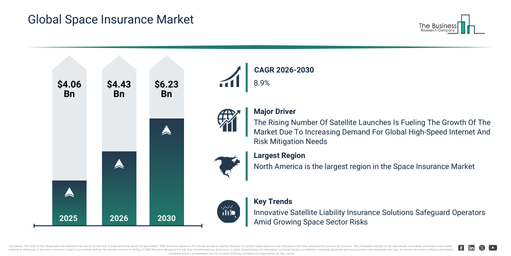
The space insurance market is projected to experience robust expansion over the coming years, with its size anticipated to reach $6.23 billion by 2030, indicating a compound annual growth rate (CAGR) of 8.9%. This growth during the forecast period can be attributed to several factors: the rising deployment of mega-constellations, which increases overall insurance exposure; a growing demand for customized insurance products tailored for on-orbit servicing and refueling missions; the development of advanced actuarial models that incorporate space debris and collision risks; increasing participation from private insurers and reinsurers in high-value space risk portfolios; and the expansion of insurance coverage to include lunar and deep space mission activities. Furthermore, major trends anticipated in this period include an escalating demand for comprehensive in-orbit risk coverage, the development of more insurance products specifically for mega-constellations, a heightened focus on debris-related liability insurance, the extension of insurance solutions for commercial human spaceflight, and a greater adoption of modular and customizable satellite insurance packages.
The increasing volume of satellite launches is anticipated to drive the expansion of the space insurance market in the future. A satellite launch involves deploying a satellite into Earth’s orbit or space using a rocket or launch vehicle. This increase in satellite launches stems from the growing deployment of satellites by both companies and governments, aiming to satisfy the escalating demand for global high-speed internet connectivity. Space insurance protects satellite launches by providing coverage for losses resulting from launch failures, operational problems, or damage during deployment. It offers financial security, assisting investors in mitigating risks associated with costly space endeavors. For instance, as reported by the Satellite Industry Association, a US-based non-profit trade association, it was noted in May 2025 that in 2024, a total of 259 launches occurred, including 224 commercially procured. These activities drove global commercial launch revenues up to $9.3 billion, which was a 30% increase compared with 2023. Consequently, the rising number of satellite launches is propelling the growth of the space insurance market.
Download A Free Sample Report For Comprehensive Market Insights:
Space Insurance Market Development Factors: Which Trends Are Supporting Demand?
Leading companies active in the space insurance market are concentrating on innovative products, such as satellite liability insurance, to shield operators from potential harm inflicted upon third parties during space operations. Satellite liability insurance safeguards satellite operators against financial losses or legal claims stemming from damage to third parties during liftoff, in-orbit activities, or re-entry. For example, in May 2024, Tata AIG, an insurance firm based in India, unveiled India’s inaugural Satellite In-Orbit Third-Party Liability Insurance. This offering delivers vital financial security for satellite builders and operators against physical injury and property damage to third parties caused by events involving satellites in orbit. This coverage, which aligns with international norms, addresses the increasing dangers in India’s quickly expanding space sector, particularly amidst a rise in satellite launches and recent solar storms. It also supports the nation’s aspiration to increase its portion in the global space market.
Space Insurance Market Segment Landscape: Which Areas Lead Market Development?
The space insurance market covered in this report is segmented –
1) By Type Of Insurance: Launch Insurance, In-Orbit Insurance, End-Of-Life Insurance, Satellite Insurance, Spacecraft Insurance
2) By Distribution Channel: Direct Sales, Brokers, Online Platforms, Reinsurance Companies, Insurance Agents
3) By Application: Communication Satellites, Earth Observation Satellites, Navigation Satellites, Scientific And Exploration Missions, Space Stations And Habitats
4) By End-User: Government Space Agencies, Commercial Satellite Operators, Launch Service Providers, Space Tourism Companies, Academic And Research Institutions
Subsegments:
1) By Launch Insurance: Commercial Satellite Launches, Government And Military Launches, Human Spaceflight Launches, Cargo And Resupply Missions, Rideshare Missions
2) By In-Orbit Insurance: Communication Satellites, Earth Observation Satellites, Navigation And Global Positioning System (GPS) Satellites, Scientific And Research Satellites, Defense And Surveillance Satellites
3) By End-Of-Life Insurance: De-Orbiting Services, Satellite Disposal Operations, Passive Decommissioning Coverage, Re-Entry Risk Mitigation, Collision Avoidance During End-Of-Life
4) By Satellite Insurance: Geostationary Orbit (GEO) Satellites, Medium Earth Orbit (MEO) Satellites, Low Earth Orbit (LEO) Satellites, CubeSats And SmallSats, Mega Constellations
5) By Spacecraft Insurance: Crewed Spacecraft, Uncrewed Scientific Probes, Space Station Modules, Interplanetary Spacecraft, Deep Space Missions
Space Insurance Market Strategic Trends: What Is Defining The Next Phase Of Growth?
Leading companies active in the space insurance market are concentrating on innovative products, such as satellite liability insurance, to shield operators from potential harm inflicted upon third parties during space operations. Satellite liability insurance safeguards satellite operators against financial losses or legal claims stemming from damage to third parties during liftoff, in-orbit activities, or re-entry. For example, in May 2024, Tata AIG, an insurance firm based in India, unveiled India’s inaugural Satellite In-Orbit Third-Party Liability Insurance. This offering delivers vital financial security for satellite builders and operators against physical injury and property damage to third parties caused by events involving satellites in orbit. This coverage, which aligns with international norms, addresses the increasing dangers in India’s quickly expanding space sector, particularly amidst a rise in satellite launches and recent solar storms. It also supports the nation’s aspiration to increase its portion in the global space market.
Space Insurance Market Competitive Landscape And Leading Companies
Major companies operating in the space insurance market are Munich Re, Swiss Re, Tokio Marine Holdings Inc., Sompo International Holdings Ltd., SCOR SE, Marsh LLC, Aon plc, Willis Towers Watson, AXA XL, Starr Insurance Companies, Hiscox Ltd., Lockton Companies, TATA AIG, Lloyd’s of London, Global Aerospace, Odyssey Re Holdings Corp., Atrium Underwriting Group, MAPFRE Global Risks , Assure Space LLC, ExpanseInsure
Access The Complete Space Insurance Market Report:
Space Insurance Market Leading Geography: Which Region Generates The Most Revenue?
North America was the largest region in the space insurance market in 2025. The regions covered in the space insurance market report are Asia-Pacific, South East Asia, Western Europe, Eastern Europe, North America, South America, Middle East, Africa.
Access a Customized Space Insurance Market Report for Deeper Competitive Insights
https://www.thebusinessresearchcompany.com/customise?id=25596&type=smp
The Business Research Company: https://www.thebusinessresearchcompany.com/
Americas: +1 310-496-7795
Asia: +44 7882 955267 & +91 8897263534
Europe: +44 7882 955267
Email us at: marketing@tbrc.info
Follow us on:
LinkedIn: https://in.linkedin.com/company/the-business-research-company
YouTube: https://www.youtube.com/channel/UC24_fI0rV8cR5DxlCpgmyFQ
Global Market Model: https://www.thebusinessresearchcompany.com/global-market-model

Wasay has over a decade of experience in market research, data modelling, and analytics, with prior experience at GlobalData and Decision Tree Consulting Services. At The Business Research Company , he leads research operations across syndicated studies, customized consulting engagements, and the Global Market Model platform. His professional experience includes supporting organizations such as Boston Consulting Group, KPMG, and Ernst & Young. Wasay holds a degree in Electronics and Communications Engineering, postgraduate management qualifications from International Management Institute Belgium and Indian School of Business and Entrepreneurship, and completed the Integrated Program in Business Analytics from Indian Institute of Management Indore.