Backed by market attractiveness analysis, total addressable market sizing, company benchmarking matrices, interactive Excel dashboards, wider supply chain intelligence, emerging startup coverage, and detailed product-level insights, The Business Research Company’s 2026 market reports are designed to offer research that is more actionable and strategically valuable than ever.
#Space Propulsion Market Revenue Outlook: What CAGR Lies Ahead Through 2030?#_x000D_
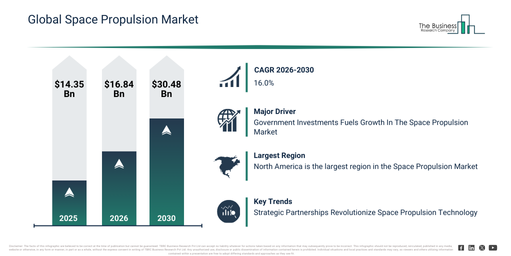
The space propulsion market has seen substantial growth in recent years. It is anticipated to expand from $14.35 billion in 2025 to $16.84 billion in 2026, demonstrating a compound annual growth rate (CAGR) of 17.3%. This historical growth can be attributed to factors such as the increasing deployment of electric propulsion systems for satellite station-keeping and orbit-raising, advancements in plasma and ion thruster technologies that enhance mission efficiency, the expansion of global satellite constellations requiring reliable in-orbit propulsion, heightened government and commercial investment in propulsion research for deep-space missions, and early experimentation with propellant-less concepts to reduce spacecraft mass and complexity._x000D_
_x000D_
The space propulsion market is projected to experience substantial expansion over the coming years. Its valuation is set to reach $30.48 billion by 2030, demonstrating a compound annual growth rate (CAGR) of 16.0%. This growth during the forecast period is driven by several factors, including a heightened need for efficient propulsion for extended and interplanetary missions, the expansion of electric propulsion for larger spacecraft and increased power, the growing commercialization of LEO operations necessitating regular orbital corrections, developments in advanced propellant-less propulsion concepts, and an increase in public-private collaborations aimed at fostering sustainable space propulsion infrastructure. Key trends anticipated in this period encompass the creation of highly efficient electric propulsion systems, the utilization of nuclear and solar propulsion for deep space exploration, the introduction of compact propulsion units for smaller satellites and CubeSats, the incorporation of propulsion with sophisticated thermal and power management, and the emergence of propellant-less technologies to prolong mission lifespans._x000D_
_x000D_
#Get A Free Sample Report With In-Depth Market Insights:#_x000D_
_x000D_
#Space Propulsion Market Industry Drivers: What’s Behind The Revenue Growth?#_x000D_
Growing governmental financial commitments to space technology are anticipated to boost the expansion of the space propulsion market in the future. These investments represent funds allocated by national authorities for the advancement, investigation, and implementation of space initiatives, infrastructure, and capacities. This increase in funding is largely propelled by heightened geopolitical rivalry and worries regarding national security, as nations strive for strategic independence and stronger sovereign space capabilities to address new threats and preserve technological advantage. Such governmental backing for space technology aids space propulsion through financing the research, development, and production of sophisticated rocket engines, ion thrusters, and advanced propulsion systems. These are essential for satellite launches, interplanetary expeditions, upholding space defense, and enabling both crewed and uncrewed vehicles to reach orbit and venture further. For example, a report from the government of the United Kingdom in April 2024 indicated that in the 2022-23 financial year, 79% of funding went through ESA programs, with 20% allocated to national efforts like the National Space Innovation Programme (active until 2027/28). This agency funding is projected to elevate revenues to £1.2 billion, alongside £733 million in private investment. Consequently, a rise in space technology investments is set to propel the space propulsion market moving forward._x000D_
_x000D_
#Space Propulsion Market Segment Performance And Emerging Opportunities#_x000D_
The space propulsion market covered in this report is segmented – _x000D_
_x000D_
1) By Type: Chemical Propulsion, Non-chemical Propulsion_x000D_
2) By Platform: Satellites, Capsules\Cargos, Interplanetary Spacecraft And Probes, Rovers/Spacecraft Landers, Launch Vehicles_x000D_
3) By System Component: Chemical Propulsion Thrusters, Electric Propulsion Thrusters, Propellant Feed Systems, Rocket Motors, Nozzles, Propulsion Thermal Control, Power Processing Units_x000D_
4) By Orbit: Low Earth Orbit (LEO), Medium Earth Orbit (MEO), Geostationary Earth Orbit (GEO), Beyond Geosynchronous Orbit_x000D_
5) By End User: Commercial, Government And Defense_x000D_
_x000D_
Subsegments:_x000D_
1) By Chemical Propulsion: Solid Propulsion, Liquid Propulsion, Hybrid Propulsion_x000D_
2) By Non-Chemical Propulsion: Electric Propulsion, Solar Propulsion, Nuclear Propulsion, Electromagnetic Propulsion_x000D_
_x000D_
#Space Propulsion Market Growth Trends: What’s Shaping The Future Outlook?_x000D_
Leading entities within the space propulsion sector are embracing strategic partnerships as a method to propel technological progress and minimize expenses associated with development. Such partnerships involve organizations utilizing one another’s distinct capabilities and assets to attain shared advantages and successful outcomes. An illustrative case occurred in August 2023 when Pulsar Fusion, a UK-based producer of nuclear fusion rocket engines, formed a collaboration with the University of Michigan, a US-based public educational body. Through this alliance, they intend to establish connections with the plasma dynamics and electric propulsion laboratory at the University of Michigan, in conjunction with Hall thruster enterprises like Pulsar Fusion (UK) and Starlight Engines (US), and the University of Southampton. Funding for this collaboration is slated to originate from the initial phase of the UK Space Agency’s £20 million international bilateral fund._x000D_
_x000D_
#Space Propulsion Market Key Players: Which Companies Lead Industry Competition?#_x000D_
Major companies operating in the space propulsion market are OHB SE, Accion Systems Inc., The Boeing Company, Northrop Grumman Corporation, Maxar Technologies Inc., Thales Alenia Space, Airbus SE, VACCO Industries Inc., Moog Inc., Cobham Mission Systems Wimborne Limited., Safran S.A., NPO Splav, BAE Systems plc, Hanwha Group, Avibras Indústria Aeroespacial S.A., Blue Origin LLC, The Aerospace Corporation, Aerojet Rocketdyne Holdings Inc., Astrobotic Technology Inc., ArianeGroup, IHI Corporation, Mitsubishi Heavy Industries Ltd., Honeybee Robotics Ltd., Bluestaq LLC, Aurora Flight Sciences Corporation., Planet Labs Inc., Sierra Nevada Corporation, Avio SpA, Beta Technologies Inc. _x000D_
_x000D_
#View The Full Space Propulsion Market Report:#_x000D_
_x000D_
#Space Propulsion Market Geographic Analysis: Where Is Demand Accelerating Fastest?#_x000D_
North America was the largest region in the space propulsion market in 2025. North America is expected to be the fastest-growing region in the space propulsion market share during the forecast period. The regions covered in the space propulsion market report are Asia-Pacific, South East Asia, Western Europe, Eastern Europe, North America, South America, Middle East, Africa._x000D_
_x000D_
#Reach Out To Our Team:#_x000D_
_x000D_
The Business Research Company: https://www.thebusinessresearchcompany.com/_x000D_
Americas: +1 310-496-7795_x000D_
Asia: +44 7882 955267 & +91 8897263534_x000D_
Europe: +44 7882 955267_x000D_
Email us at: marketing@tbrc.info_x000D_
_x000D_
#Follow us on:#_x000D_
_x000D_
LinkedIn: https://in.linkedin.com/company/the-business-research-company_x000D_
YouTube: https://www.youtube.com/channel/UC24_fI0rV8cR5DxlCpgmyFQ_x000D_
Global Market Model: https://www.thebusinessresearchcompany.com/global-market-model

Wasay has over a decade of experience in market research, data modelling, and analytics, with prior experience at GlobalData and Decision Tree Consulting Services. At The Business Research Company , he leads research operations across syndicated studies, customized consulting engagements, and the Global Market Model platform. His professional experience includes supporting organizations such as Boston Consulting Group, KPMG, and Ernst & Young. Wasay holds a degree in Electronics and Communications Engineering, postgraduate management qualifications from International Management Institute Belgium and Indian School of Business and Entrepreneurship, and completed the Integrated Program in Business Analytics from Indian Institute of Management Indore.