Built to provide research that’s more actionable and strategically valuable, The Business Research Company’s 2026 market reports include market attractiveness analysis, total addressable market sizing, company benchmarking matrices, interactive Excel dashboards, broader supply chain intelligence, emerging startup tracking, and in-depth product insights.
#Space Solar Cells Market Size, Value And Growth Trajectory Through 2030#_x000D_
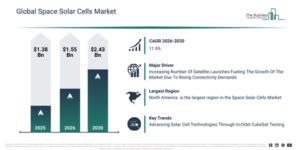
The space solar cells market size has seen rapid growth in recent years. It is anticipated to expand from $1.38 billion in 2025 to $1.55 billion in 2026, achieving a compound annual growth rate (CAGR) of 12.3%. The historical increase in this market can be attributed to advancements in photovoltaic efficiency, the progress in radiation-hardened solar cell development, their widespread adoption in satellite and spacecraft power systems, the standardization of space-grade panels, and their integration with power management electronics._x000D_
_x000D_
The space solar cells market is anticipated to experience significant expansion over the next few years. It is projected to reach $2.43 billion by 2030, demonstrating a compound annual growth rate (CAGR) of 11.9%. This growth in the forecast period stems from the advancement of flexible and lightweight solar panels, the increasing deployment of mega satellite constellations, the rising power demands of deep-space missions, the incorporation of energy storage systems, and the widespread adoption of advanced tracking and optimization technologies. Noteworthy trends during this period include innovations in high-efficiency photovoltaics, the development of radiation-resistant solar technologies, the integration of power management systems, stringent space-grade solar cell testing and qualification, and improvements in onboard energy storage and thermal management._x000D_
_x000D_
#Get A Free Sample Report With In-Depth Market Insights:#_x000D_
_x000D_
#Space Solar Cells Market Development Factors: What’s Supporting Demand?#_x000D_
The space solar cells market is anticipated to expand due to the rising volume of satellite launches. These launches involve deploying artificial satellites into space via launch vehicles or rockets. The growing need for these launches stems from increasing connectivity requirements, as more areas seek dependable internet access through satellite broadband. Space solar cells are crucial for satellite launches because they deliver consistent and reliable power in the challenging space environment, thus facilitating extended missions. They improve satellite capabilities by energizing onboard systems, communication equipment, and instruments, leading to greater mission efficiency and operational dependability. For example, data from the US-based trade association, the Satellite Industry Association (SIA), indicated that in May 2025, 259 launches occurred in 2024 (224 commercially procured among them), with global commercial launch revenues climbing to $9.3 billion, marking a 30 percent increase over 2023. Consequently, the expanding volume of satellite launches is a key factor propelling the space solar cells market’s growth._x000D_
_x000D_
#Space Solar Cells Market Segment Performance And Emerging Opportunities#_x000D_
The space solar cells market covered in this report is segmented – _x000D_
_x000D_
1) By Type: Monocrystalline Solar Cells, Polycrystalline Solar Cells, Thin-Film Solar Cells, Multi-Junction Solar Cells, Concentrated Photovoltaic Cells (CPV)_x000D_
2) By Technology: Silicon-Based Technology, Gallium Arsenide Technology, Organic Photovoltaic Technology, Perovskite Solar Cells_x000D_
3) By Functionality: Power Generation, Power Storage Integration, Energy Efficiency Solutions, Thermal Management Systems_x000D_
4) By Application: Satellite Power Systems, Spacecraft Power Systems, Space Stations, Robotic Missions, Planetary Exploration_x000D_
5) By End-User: Government And Defense Agencies, Aerospace Manufacturers, Research Institutions, Private Space Exploration Companies_x000D_
_x000D_
Subsegments:_x000D_
1) By Monocrystalline Solar Cells: High Efficiency, Standard Efficiency, Flexible_x000D_
2) By Polycrystalline Solar Cells: High Efficiency, Standard Efficiency, Bifacial_x000D_
3) By Thin-Film Solar Cells: Cadmium Telluride, Copper Indium Gallium Selenide, Amorphous Silicon_x000D_
4) By Multi-Junction Solar Cells: Two Layer, Three Layer, Four Layer_x000D_
5) By Concentrated Photovoltaic Cells: Fresnel Lens, Parabolic Reflector, Micro Concentrator_x000D_
_x000D_
#Space Solar Cells Market Transformation Trends: What Innovations Are Driving Change?#_x000D_
Major companies active in the space solar cells market are concentrating on developing innovative products, such as CubeSats for in-orbit testing. This focus aims to provide reliable validation of solar cell technologies, enhance efficiency, and expand their footprint in the growing space solar power segment. CubeSats are small, modular spacecraft designed to transport experimental photovoltaic (PV) cells, deployable solar arrays, and wireless power systems into orbit, thereby offering an efficient and cost-effective method to evaluate solar technologies under real space conditions. For instance, in January 2023, the California Institute of Technology (Caltech), a US-based company focused on technology for harnessing solar power in space, launched the 50-kg Space Solar Power Demonstrator (SSPD) aboard a Momentus Vigoride spacecraft via a SpaceX Transporter-6 mission. The SSPD tested deployable structures (DOLCE), 32 types of photovoltaic cells (ALBA), and a flexible microwave power array (MAPLE) for wireless energy transmission in orbit. These demonstrations allow companies and research institutes to assess efficiency, durability, deployment mechanics, and power transmission, positioning CubeSats as a critical instrument for advancing space solar cell technologies and enabling scalable deployment in future space missions._x000D_
_x000D_
#Space Solar Cells Market Key Players: Which Companies Lead Industry Competition?#_x000D_
Major companies operating in the space solar cells market are The Boeing Company, Airbus Group, Northrop Grumman Corporation, Mitsubishi Electric Corporation, Thales Group, Bharat Electronics Ltd., Hanergy Thin Film Power Group Ltd., Redwire Corporation, 5N Plus Inc., Aetherflux Inc., SoliTek Cell, EnduroSat AD, MicroLink Devices Inc., DHV Technology, Solestial Inc., MMA Design LLC, Caelux Inc., Space Solar (UK) Ltd., Stion Corporation, Ascent Solar Technologies Inc. _x000D_
_x000D_
#View The Full Space Solar Cells Market Report:#_x000D_
_x000D_
#Space Solar Cells Market Top Region By Revenue And Market Share#_x000D_
North America was the largest region in the space solar cells market in 2025. Asia-Pacific is expected to be the fastest-growing region in the forecast period. The regions covered in the space solar cells market report are Asia-Pacific, South East Asia, Western Europe, Eastern Europe, North America, South America, Middle East, Africa._x000D_
_x000D_
#Reach Out To Our Team:#_x000D_
_x000D_
The Business Research Company: https://www.thebusinessresearchcompany.com/_x000D_
Americas: +1 310-496-7795_x000D_
Asia: +44 7882 955267 & +91 8897263534_x000D_
Europe: +44 7882 955267_x000D_
Email us at: marketing@tbrc.info_x000D_
_x000D_
#Follow us on:#_x000D_
_x000D_
LinkedIn: https://in.linkedin.com/company/the-business-research-company_x000D_
YouTube: https://www.youtube.com/channel/UC24_fI0rV8cR5DxlCpgmyFQ_x000D_
Global Market Model: https://www.thebusinessresearchcompany.com/global-market-model

Wasay has over a decade of experience in market research, data modelling, and analytics, with prior experience at GlobalData and Decision Tree Consulting Services. At The Business Research Company , he leads research operations across syndicated studies, customized consulting engagements, and the Global Market Model platform. His professional experience includes supporting organizations such as Boston Consulting Group, KPMG, and Ernst & Young. Wasay holds a degree in Electronics and Communications Engineering, postgraduate management qualifications from International Management Institute Belgium and Indian School of Business and Entrepreneurship, and completed the Integrated Program in Business Analytics from Indian Institute of Management Indore.