
Delivering more actionable and strategically valuable research, The Business Research Company’s 2026 market reports feature market attractiveness analysis, total addressable market evaluation, company benchmarking matrices, interactive Excel dashboards, expanded supply chain intelligence, emerging startup coverage, and detailed product insights.
Space-Weather Monitoring Satellite Market Revenue Growth Supported By A CAGR Of $3.23 Through 2030
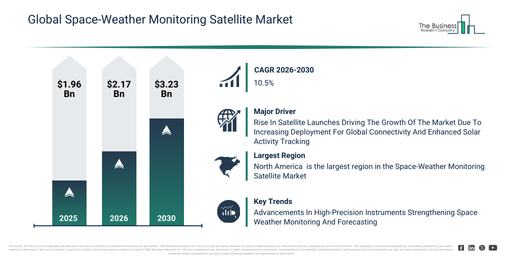
The space-weather monitoring satellite market is projected to experience swift expansion in the coming years. By 2030, its value is anticipated to reach $3.23 billion, demonstrating a compound annual growth rate (CAGR) of 10.5%. This anticipated growth during the forecast timeframe stems from several factors, including an increase in real-time space weather monitoring services, the implementation of predictive AI analytics for solar storms, the expansion of satellite constellations to ensure uninterrupted coverage, the integration with protective measures for terrestrial critical infrastructure, and the creation of miniaturized, high-precision payloads. Key trends during this period are expected to encompass the miniaturization of space-weather sensors, an escalating need for ongoing solar storm surveillance, innovations in radiation-hardened satellite components, a growing rollout of constellation-based monitoring systems, and increased cooperation between defense and scientific organizations.
The increasing volume of satellite deployments is anticipated to drive expansion within the space-weather monitoring satellite market in the future. A satellite refers to an object, either artificial or natural, that orbits a planet or other celestial body along a regular trajectory. The rise in satellite launches stems from the growing need for worldwide internet access, with both private firms and governmental bodies deploying more satellites to deliver rapid internet services to distant and unserved areas. This surge in satellite launches improves space-weather monitoring by enabling a greater number of specialized satellites to continuously observe solar activity and its effects on Earth’s magnetosphere, consequently refining prediction and alert systems. For instance, in January 2025, according to the Space Foundation, a US-based non-profit organization, a total of 259 launches took place in 2024, averaging one launch every 34 hours, occurring five hours sooner on average than in 2023. Consequently, the expanding volume of satellite launches is fueling the growth of the space-weather monitoring satellite market.
Download A Free Sample Report For Comprehensive Market Insights:
#Space-Weather Monitoring Satellite Market Growth Factors: Which Forces Are Supporting Market Expansion?
Companies within the space-weather monitoring satellite Market are increasingly concentrating on utilizing advanced products, such as high-precision magnetometers, to boost the accuracy of solar wind detection and enhance early warning systems for geomagnetic storms. These sensitive high-precision magnetometers measure subtle shifts in magnetic fields, aiding in the identification and analysis of changes in the Sun’s magnetic activity to predict and lessen space-weather impacts on Earth. For example, in September 2025, Southwest Research Institute (SwRI), a U.S.-based non-profit research and development organization, integrated its Space Weather Follow-On Magnetometer (SWFO-MAG) and Solar Wind Plasma Sensor (SWiPS) onto NOAA’s Space Weather Follow-On Lagrange 1 (SWFO-L1) satellite, which was launched via a SpaceX Falcon 9 rocket as a rideshare with NASA’s Interstellar Mapping and Acceleration Probe (IMAP) mission. Operating from the Lagrange Point 1 (L1), nearly 1.5 million kilometers from Earth, these SwRI-built instruments deliver continuous, real-time monitoring of solar wind and magnetic field variations, thereby improving the precision of space weather forecasts issued by NOAA’s Space Weather Prediction Center. This initiative reflects a broader industry trend focused on deploying next-generation instruments featuring higher sensitivity and better data capabilities to strengthen early-warning mechanisms and protect crucial technologies like power grids, communication networks, and satellites from the detrimental effects of solar and geomagnetic activity.
Space-Weather Monitoring Satellite Market Segmentation Trends And Revenue Drivers
The space-weather monitoring satellite market covered in this report is segmented –
1) By Satellite Type: Low Earth Orbit, Medium Earth Orbit, Geostationary Orbit
2) By Instrument Type: Magnetometers, Particle Detectors, Plasma Analyzers, Solar Telescopes, Others Instrument Types
3) By Application: Space Weather Forecasting, Communication, Navigation, Scientific Research, Others Applications
4) By End-User: Government And Defense, Commercial, Research Institutes, Other End-Users
Subsegments:
1) By Low Earth Orbit: Scientific Research Satellites, Earth Observation Satellites, Remote Sensing Satellites, Small Satellites
2) By Medium Earth Orbit: Navigation Satellites, Communication Satellites, Weather Monitoring Satellites, Science And Exploration Satellites
3) By Geostationary Orbit: Weather Forecasting Satellites, Communication Satellites, Defense And Security Satellites, Broadcasting Satellites
Space-Weather Monitoring Satellite Market Growth Trends Influencing Competitive Dynamics
Companies within the space-weather monitoring satellite Market are increasingly concentrating on utilizing advanced products, such as high-precision magnetometers, to boost the accuracy of solar wind detection and enhance early warning systems for geomagnetic storms. These sensitive high-precision magnetometers measure subtle shifts in magnetic fields, aiding in the identification and analysis of changes in the Sun’s magnetic activity to predict and lessen space-weather impacts on Earth. For example, in September 2025, Southwest Research Institute (SwRI), a U.S.-based non-profit research and development organization, integrated its Space Weather Follow-On Magnetometer (SWFO-MAG) and Solar Wind Plasma Sensor (SWiPS) onto NOAA’s Space Weather Follow-On Lagrange 1 (SWFO-L1) satellite, which was launched via a SpaceX Falcon 9 rocket as a rideshare with NASA’s Interstellar Mapping and Acceleration Probe (IMAP) mission. Operating from the Lagrange Point 1 (L1), nearly 1.5 million kilometers from Earth, these SwRI-built instruments deliver continuous, real-time monitoring of solar wind and magnetic field variations, thereby improving the precision of space weather forecasts issued by NOAA’s Space Weather Prediction Center. This initiative reflects a broader industry trend focused on deploying next-generation instruments featuring higher sensitivity and better data capabilities to strengthen early-warning mechanisms and protect crucial technologies like power grids, communication networks, and satellites from the detrimental effects of solar and geomagnetic activity.
Space-Weather Monitoring Satellite Market Industry Leaders And Market Competition
Major companies operating in the space-weather monitoring satellite market are The Boeing Company, Airbus SE, Raytheon Technologies Corporation, Lockheed Martin Corporation, Northrop Grumman Corporation, BAE Systems, National Aeronautics and Space Administration (NASA), Thales Group, L3Harris Technologies, National Oceanic and Atmospheric Administration (NOAA), Sierra Nevada Corporation, Southwest Research Institute (SwRI), European Space Agency (ESA), Japan Aerospace Exploration Agency (JAXA), University Corporation for Atmospheric Research (UCAR), Astroscale Holdings Inc., Spire Global Inc., EnduroSat, Muon Space, Mission Space, China Academy of Space Technology.
Access The Complete Space-Weather Monitoring Satellite Market Report:
#Space-Weather Monitoring Satellite Market Largest Region: Which Geography Holds The Highest Market Share?
North America was the largest region in the space-weather monitoring satellite market in 2025. Asia-Pacific is expected to be the fastest-growing region in the forecast period. The regions covered in the space-weather monitoring satellite market report are Asia-Pacific, South East Asia, Western Europe, Eastern Europe, North America, South America, Middle East, Africa.
Access a Customized Space-Weather Monitoring Satellite Market Report for Deeper Competitive Insights
https://www.thebusinessresearchcompany.com/customise?id=25638&type=smp
The Business Research Company: https://www.thebusinessresearchcompany.com/
Americas: +1 310-496-7795
Asia: +44 7882 955267 & +91 8897263534
Europe: +44 7882 955267
Email us at: marketing@tbrc.info
Follow us on:
LinkedIn: https://in.linkedin.com/company/the-business-research-company
YouTube: https://www.youtube.com/channel/UC24_fI0rV8cR5DxlCpgmyFQ
Global Market Model: https://www.thebusinessresearchcompany.com/global-market-model

Wasay has over a decade of experience in market research, data modelling, and analytics, with prior experience at GlobalData and Decision Tree Consulting Services. At The Business Research Company , he leads research operations across syndicated studies, customized consulting engagements, and the Global Market Model platform. His professional experience includes supporting organizations such as Boston Consulting Group, KPMG, and Ernst & Young. Wasay holds a degree in Electronics and Communications Engineering, postgraduate management qualifications from International Management Institute Belgium and Indian School of Business and Entrepreneurship, and completed the Integrated Program in Business Analytics from Indian Institute of Management Indore.
