Through market attractiveness analysis, total addressable market evaluation, company benchmarking matrices, interactive Excel dashboards, expanded supply chain intelligence, emerging startup coverage, and detailed product insights, The Business Research Company’s 2026 market reports provide more actionable and strategically valuable research.
Spacecraft Market Expansion Outlook: What Revenue Opportunities Lie Ahead?
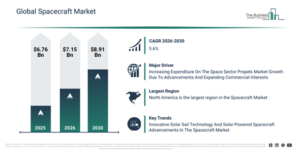
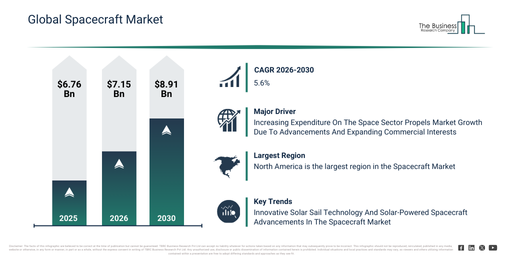
The spacecraft market is projected to experience substantial expansion in the coming years. By 2030, its valuation is forecast to reach $8.91 billion, demonstrating a compound annual growth rate (CAGR) of 5.6%. This projected expansion during the forecast period is driven by factors such as the advancement of reusable and economically efficient spacecraft technologies, increased involvement of the private sector in space missions, a rising need for deep space and interplanetary exploration, the incorporation of artificial intelligence and autonomous systems into spacecraft operations, and the broadening of space tourism and commercial orbital stations. Key developments expected during this time comprise the miniaturization of satellites and smaller spacecraft, a greater uptake of reusable spacecraft and cargo modules, the incorporation of AI-based navigation and autonomous control systems, the creation of probes and rovers for interplanetary exploration, and the growth of commercial satellite constellations and related services.
Rising spending within the space sector is anticipated to drive the future expansion of the spacecraft market. This sector encompasses various industries and pursuits focused on developing, exploring, and commercializing space, such as satellite operations, launch technologies, and space missions. This surge in space sector spending stems from progress in technology, increased commercial engagement, national security imperatives, and the prospective economic advantages derived from space-related endeavors. Spacecraft are pivotal to the heightened expenditure in the space sector, primarily due to the significant research, development, and manufacturing expenses involved, coupled with the rising need for space exploration and the deployment of satellites. As an illustration, in July 2025, data from the Space Foundation—a US-based nonprofit organization committed to fostering the global space ecosystem through education, research, and advocacy—showed that worldwide government space spending climbed by 6.7% to reach $132 billion. This increase was predominantly driven by the United States, which allocated $77 billion to its national security and civil space initiatives. Consequently, the expanding financial outlay in the space sector is a key catalyst for the growth of the spacecraft market.
Download A Free Sample Report For Comprehensive Market Insights:
Spacecraft Market Expansion Supported By Key Demand Factors
Major entities operating within the spacecraft market are prioritizing the development of innovative technologies, such as advanced solar sail technology, to improve propulsion efficiency, decrease fuel usage, and facilitate longer-duration space missions. Solar sail technology serves as a propulsion method for spacecraft, employing large, reflective sails to capture and utilize the pressure exerted by sunlight (photons) to generate thrust. For instance, in April 2024, the National Aeronautics and Space Administration, a US-based government agency, launched a solar-powered spacecraft designed to harness solar energy for its systems and operations in space. This spacecraft is equipped with highly efficient solar panels, allowing it to generate power even in the low-light environments of deep space. Its lightweight construction, alongside advanced electric propulsion systems, enables it to traverse greater distances and operate more efficiently compared to traditional chemically powered spacecraft.
Spacecraft Market Segment Analysis And Revenue Opportunities
The spacecraft market covered in this report is segmented –
1) By Type: Manned Spacecraft, Unmanned Spacecraft
2) By Component: Power Systems, Thermal Control Systems, Propulsion Systems, Payloads, Communication Systems, Guidance And Navigation Systems
3) By End User: Military, Commercial, Defense
Subsegments:
1) By Manned Spacecraft: Space Capsules, Spaceplanes, Space Stations
2) By Unmanned Spacecraft: Satellites, Probes, Landers, Rovers, Cargo Spacecraft
Spacecraft Market Transformation Trends: Which Innovations Are Driving Change?
Major entities operating within the spacecraft market are prioritizing the development of innovative technologies, such as advanced solar sail technology, to improve propulsion efficiency, decrease fuel usage, and facilitate longer-duration space missions. Solar sail technology serves as a propulsion method for spacecraft, employing large, reflective sails to capture and utilize the pressure exerted by sunlight (photons) to generate thrust. For instance, in April 2024, the National Aeronautics and Space Administration, a US-based government agency, launched a solar-powered spacecraft designed to harness solar energy for its systems and operations in space. This spacecraft is equipped with highly efficient solar panels, allowing it to generate power even in the low-light environments of deep space. Its lightweight construction, alongside advanced electric propulsion systems, enables it to traverse greater distances and operate more efficiently compared to traditional chemically powered spacecraft.
#Spacecraft Market Industry Leaders: Which Organizations Are Driving Competition?
Major companies operating in the spacecraft market are Boeing Defense, Space & Security, Airbus SE, RTX Corporation, Lockheed Martin Space Systems Company, Northrop Grumman Corporation, Mitsubishi Heavy Industries Ltd., Space Exploration Technologies Corporation, Israel Aerospace Industries Ltd., Thales Alenia Space S.A.S., Maxar Technologies Inc., Blue Origin LLC, RUAG Space AB, Sierra Nevada Corporation, OHB SE, Rocket Lab USA Inc., Planet Labs PBC, Firefly Aerospace Inc., Astroscale Holdings Inc., Korea Aerospace Research Institute, Indian Space Research Organisation, NanoAvionics LLC, Virgin Galactic Holdings Inc., Ball Aerospace & Technologies Corp.
Access The Complete Spacecraft Market Report:
Spacecraft Market Geographic Analysis: Where Is Demand Growing The Fastest?
North America was the largest region in the spacecraft market in 2025. The regions covered in the spacecraft market report are Asia-Pacific, South East Asia, Western Europe, Eastern Europe, North America, South America, Middle East, Africa.
Access a Customized Spacecraft Market Report for Deeper Competitive Insights
https://www.thebusinessresearchcompany.com/customise?id=23854&type=smp
The Business Research Company: https://www.thebusinessresearchcompany.com/
Americas: +1 310-496-7795
Asia: +44 7882 955267 & +91 8897263534
Europe: +44 7882 955267
Email us at: marketing@tbrc.info
Follow us on:
LinkedIn: https://in.linkedin.com/company/the-business-research-company
YouTube: https://www.youtube.com/channel/UC24_fI0rV8cR5DxlCpgmyFQ
Global Market Model: https://www.thebusinessresearchcompany.com/global-market-model

Wasay has over a decade of experience in market research, data modelling, and analytics, with prior experience at GlobalData and Decision Tree Consulting Services. At The Business Research Company , he leads research operations across syndicated studies, customized consulting engagements, and the Global Market Model platform. His professional experience includes supporting organizations such as Boston Consulting Group, KPMG, and Ernst & Young. Wasay holds a degree in Electronics and Communications Engineering, postgraduate management qualifications from International Management Institute Belgium and Indian School of Business and Entrepreneurship, and completed the Integrated Program in Business Analytics from Indian Institute of Management Indore.