
Enhanced with market attractiveness analysis, total addressable market evaluation, company benchmarking matrices, interactive Excel dashboards, expanded supply chain intelligence, emerging startup coverage, and detailed product insights, The Business Research Company’s 2026 market reports deliver more actionable and strategically valuable research.
Suborbital Flight Market Growth Potential: How Will Market Size Change Through 2030?
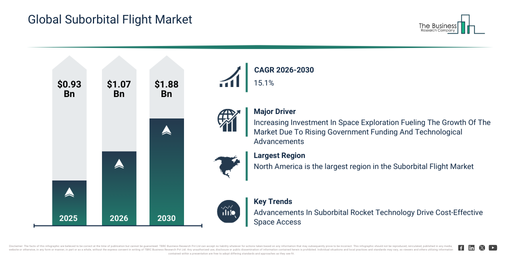
The suborbital flight market is anticipated to experience significant expansion over the coming years. This market is projected to reach $1.88 billion by 2030, demonstrating a compound annual growth rate (CAGR) of 15.1%. Key drivers for this growth during the forecast period include increasing demand for commercial space tourism and expedited payload delivery, the proliferation of reusable suborbital flight systems, the integration of advanced flight control and simulation software, the innovation of next-generation recovery and reusability technologies, and enhanced cooperation between aerospace companies and defense organizations for suborbital testing and validation. Significant trends anticipated over the forecast timeframe encompass a rising need for reusable launch vehicles, the expansion of suborbital space tourism offerings, progress in radiation shielding to ensure human safety, improvements in flight safety protocols and simulation instruments, and the broadening scope of microgravity experiment applications.
The rising financial commitment to space exploration is anticipated to drive the expansion of the suborbital flight market. Space exploration encompasses the discovery and study of outer space through the use of both crewed and uncrewed spacecraft, satellites, and advanced technologies. This increasing investment in space exploration is largely propelled by government funding, which supports national security, scientific progress, and technological innovation. Such investment significantly aids suborbital flight development by accelerating technological advancements, leading to more efficient and cost-effective launches. It also broadens research prospects via frequent low-orbit missions, thereby fostering scientific innovation and commercial access to space. For instance, in March 2024, the National Aeronautics and Space Administration, a US-based independent agency, projected NASA’s budget to increase from $25.383 billion in 2024 to $27.476 billion in 2029. Therefore, the escalating investment in space exploration is a primary factor driving the growth of the suborbital flight market.
Download A Free Sample Report For Comprehensive Market Insights:
#Suborbital Flight Market Demand Drivers Creating New Revenue Opportunities
Key companies in the suborbital flight market are concentrating on developing sophisticated products, such as suborbital rockets, to provide more economical options for space-related missions. A suborbital rocket is defined as a vehicle that journeys into space without achieving the necessary speed to maintain orbit, instead following a high-arching path that momentarily takes it into space before returning to Earth. As an illustration, in October 2023, PLD Space, a Spain-based aerospace company, launched its Miura 1 rocket. This is a suborbital, reusable launch vehicle designed to transport payloads of up to 100 kilograms to suborbital altitudes, offering short durations of microgravity for scientific research and technology testing. This rocket incorporates advanced propulsion systems and reusable components, aiming to decrease launch costs and improve accessibility to space for both research and commercial applications.
Suborbital Flight Market Segment Analysis And Revenue Opportunities
The suborbital flight market covered in this report is segmented –
1) By Launch Type: Reusable Suborbital Rockets, Single-Use Suborbital Rockets, Captive Carry Systems
2) By Type: One Person, Six People, Eight People, Other Types
3) By Altitude Range: Low Altitude (100 Kilometer To 500 Kilometer), High Altitude (500 Kilometer To 1000 Kilometer), Beyond High Altitude (1000 Kilometer And Above)
4) By Technology: Propulsion Technologies, Avionics And Navigation Systems, Vehicle Design And Materials, Flight Safety Mechanisms, Payload Capacity Technologies
5) By Application: Space Tourism, Scientific Research, Technology Demonstrations, Microgravity Experiments, High-Altitude Research
Subsegments:
1) By Reusable Suborbital Rockets: Vertical Takeoff Vertical Landing, Horizontal Takeoff Horizontal Landing, Hybrid Propulsion Reusables, Partial Reusables
2) By Single-Use Suborbital Rockets: Solid Propellant Rockets, Liquid Propellant Rockets, Hybrid Propellant Rockets, Sounding Rockets
3) By Captive Carry Systems: Air-Launched Vehicles, Balloon-Assisted Launch Systems, Drop-Test Vehicles, Rocket-Gliders
Suborbital Flight Market Strategic Trends: What Is Defining The Next Phase Of Growth?
Key companies in the suborbital flight market are concentrating on developing sophisticated products, such as suborbital rockets, to provide more economical options for space-related missions. A suborbital rocket is defined as a vehicle that journeys into space without achieving the necessary speed to maintain orbit, instead following a high-arching path that momentarily takes it into space before returning to Earth. As an illustration, in October 2023, PLD Space, a Spain-based aerospace company, launched its Miura 1 rocket. This is a suborbital, reusable launch vehicle designed to transport payloads of up to 100 kilograms to suborbital altitudes, offering short durations of microgravity for scientific research and technology testing. This rocket incorporates advanced propulsion systems and reusable components, aiming to decrease launch costs and improve accessibility to space for both research and commercial applications.
#Suborbital Flight Market Industry Leaders: Which Organizations Are Driving Competition?
Major companies operating in the suborbital flight market are Space Exploration Technologies Corp., Blue Origin LLC, Rocket Lab USA Inc., Avio S.p.A., Scaled Composites LLC, SpinLaunch Inc., Dawn Aerospace B.V., X-Bow Launch Systems Inc., Payload Aerospace S.L., Skyrora Ltd., Excalibur Almaz Limited, Copenhagen Suborbitals, Exos Aerospace Systems And Technologies Inc., Masten Space Systems Inc., SpaceForest, T-Minus Engineering B.V., ARCA Space Corporation, BluShift Aerospace Inc., Virgin Galactic Holdings Inc., UP Aerospace Inc.
Access The Complete Suborbital Flight Market Report:
Suborbital Flight Market Largest Region By Revenue And Market Share
North America was the largest region in the suborbital flight market in 2025. Asia-Pacific is expected to be the fastest-growing region in the forecast period. The regions covered in the suborbital flight market report are Asia-Pacific, South East Asia, Western Europe, Eastern Europe, North America, South America, Middle East, Africa.
Access a Customized Suborbital Flight Market Report for Deeper Competitive Insights
https://www.thebusinessresearchcompany.com/customise?id=3665&type=smp
The Business Research Company: https://www.thebusinessresearchcompany.com/
Americas: +1 310-496-7795
Asia: +44 7882 955267 & +91 8897263534
Europe: +44 7882 955267
Email us at: marketing@tbrc.info
Follow us on:
LinkedIn: https://in.linkedin.com/company/the-business-research-company
YouTube: https://www.youtube.com/channel/UC24_fI0rV8cR5DxlCpgmyFQ
Global Market Model: https://www.thebusinessresearchcompany.com/global-market-model

Wasay has over a decade of experience in market research, data modelling, and analytics, with prior experience at GlobalData and Decision Tree Consulting Services. At The Business Research Company , he leads research operations across syndicated studies, customized consulting engagements, and the Global Market Model platform. His professional experience includes supporting organizations such as Boston Consulting Group, KPMG, and Ernst & Young. Wasay holds a degree in Electronics and Communications Engineering, postgraduate management qualifications from International Management Institute Belgium and Indian School of Business and Entrepreneurship, and completed the Integrated Program in Business Analytics from Indian Institute of Management Indore.
