
Featuring market attractiveness scoring, total addressable market sizing, company benchmarking matrices, interactive Excel dashboards, deeper supply chain intelligence, emerging startup tracking, and granular product-level insights, The Business Research Company’s 2026 market reports are built to deliver research that is both more actionable and more strategically valuable.
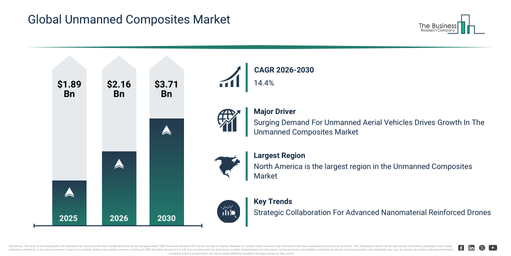
Unmanned Composites Market Growth From $2.16 Billion In 2026 To $3.71 Billion By 2030 At A CAGR Of 14.4%
The market size for unmanned composites has experienced rapid expansion over recent years. This market is projected to expand from $1.89 billion in 2025 to $2.16 billion by 2026, demonstrating a compound annual growth rate (CAGR) of 14.6%. Historically, this growth can be linked to several factors: the rising acceptance of unmanned aerial vehicles that need lightweight composite airframes, an increase in defense-initiated drone programs which boosts the need for high-strength composite parts, advancements in composite propellers for better endurance and maneuverability, the broadening of commercial drone uses that require robust composite payload enclosures, and an increase in manufacturing capacity for sophisticated resin-matrix composite structures for unmanned systems.
The unmanned composites market is anticipated to experience substantial expansion over the coming years, with its size projected to reach $3.71 billion by 2030, demonstrating a compound annual growth rate (CAGR) of 14.4%. This projected growth during the forecast period is propelled by several factors, including the increasing demand for long-endurance unmanned systems, which is driving the use of next-generation composite materials. Further contributors include the growing integration of composite armor to enhance the survivability of military drones, the rising adoption of high-performance composite fairings to bolster aerodynamic efficiency, the expansion of autonomous logistics and delivery drones boosting the need for lightweight composite designs, and the development of sustainable and recyclable composite materials specifically tailored for unmanned platforms. Key trends expected in this period encompass lightweight multi-material hybridization, advanced resin systems designed for extreme environments, innovations in high-temperature composites, the customization of composite airframes for mission-specific drones, and the increasing use of composite payload enclosures for optimizing endurance.
Get A Free Sample Report With In-Depth Market Insights:
Unmanned Composites Market Growth Factors: What’s Supporting Expansion?
The rising need for unmanned aerial vehicles is projected to drive the expansion of the unmanned composites market in the future. An unmanned aerial vehicle (UAV), frequently referred to as a drone, functions as an aircraft operating without a human pilot or operator. These UAVs possess the capability to fly independently or be operated remotely. By utilizing the advantages of unmanned composites, drones can achieve improved performance, greater payload capacity, extended flight endurance, better aerodynamics, and increased durability. For example, in June 2025, the Ministry of Defence, a UK-based government body, announced that the UK is allocating an unprecedented £350 million (approximately $473 million USD) in 2025 to bolster Ukraine’s drone provisions, intending to elevate the quantity of drones dispatched from 10,000 in 2024 to 100,000 in 2025. Consequently, the escalating demand for unmanned aerial vehicles is fueling the expansion of the unmanned composites market.
Unmanned Composites Market Segmentation: How Does The Market Break Down By Category?
The unmanned composites market covered in this report is segmented –
1) By Type: Carbon Fiber Reinforced Polymer (CFRP), Glass Fiber Reinforced Polymer (GFRP), Aramid Fiber Reinforced Polymer (AFRP), Boron Fiber Reinforced Polymer (BFRP)
2) By Platform: Unmanned Aerial Vehicles, Unmanned Ground Vehicles, Unmanned Surface Vehicles, Autonomous Underwater Vehicles, Remotely Operated Vehicles, Autonomous Ship, Passenger Drone
3) By Application: Interior, Exterior
Subsegments:
1) By Carbon Fiber Reinforced Polymer (CFRP): Continuous Carbon Fiber Reinforced Composites, Short Carbon Fiber Reinforced Composites, Hybrid Carbon Fiber Composites
2) By Glass Fiber Reinforced Polymer (GFRP): Continuous Glass Fiber Reinforced Composites, Short Glass Fiber Reinforced Composites, Hybrid Glass Fiber Composites
3) By Aramid Fiber Reinforced Polymer (AFRP): Continuous Aramid Fiber Reinforced Composites, Short Aramid Fiber Reinforced Composites, Hybrid Aramid Fiber Composites
4) By Boron Fiber Reinforced Polymer (BFRP): Continuous Boron Fiber Reinforced Composites, Short Boron Fiber Reinforced Composites, Hybrid Boron Fiber Reinforced Composites
Unmanned Composites Market Industry Trends: What’s Reshaping Demand?
Leading firms in the unmanned composites market are increasingly employing strategic partnerships to deliver sophisticated nanomaterial-reinforced drones. Such a partnership denotes a mutually advantageous alliance between organizations, designed to achieve common objectives through synchronized efforts and shared resources. For example, during August 2023, Carborundum Universal Ltd., an Indian manufacturer and developer of abrasives and industrial ceramics, partnered with IdeaForge Technology, an Indian drone manufacturer, to engineer drones utilizing advanced nanomaterial-reinforced composite components. This joint effort sought to produce drones that are lighter, more robust, and resilient, capitalizing on the advantages of nanomaterial composite materials, which include superior mechanical strength, enhanced toughness, and improved electrical and thermal conductivity.
Unmanned Composites Market Competitive Overview And Top Companies
Major companies operating in the unmanned composites market are Mitsubishi Rayon, The Boeing Company, Lockheed Martin, Mitsubishi Chemical Corporation, NVIDIA, Evonic Industries AG, Toray Industries Inc., Solvay S.A., Dupont Inc., Owens Corning, Formosa Plastics Corporation, Teijin Limited, Elbit Systems, Teledyne Technologies Incorporated, Leonardo DRS, Aerojet Rocketdyne, Hexcel Corporation, Materion Corporation, SGL Carbon SE, Stratasys Ltd., Gurit Holding AG, AeroVironment, ZOLTEK Corp., Unitech Aerospace, Cytec Engineered Materials Inc., Quantum Composites Inc., DowAksa Advanced Composites Holdings B.V., Tencate Advanced Composites, Renegade Materials Corporation.
View The Full Unmanned Composites Market Report:
Unmanned Composites Market Leading Geography: Which Region Contributes The Most Revenue?
North America was the largest region in the unmanned composites market in 2025. Asia-Pacific is expected to be the fastest-growing region in the forecast period. The regions covered in the unmanned composites market report are Asia-Pacific, South East Asia, Western Europe, Eastern Europe, North America, South America, Middle East, Africa.
Reach Out To Our Team:
The Business Research Company: https://www.thebusinessresearchcompany.com/
Americas: +1 310-496-7795
Asia: +44 7882 955267 & +91 8897263534
Europe: +44 7882 955267
Email us at: marketing@tbrc.info
Follow us on:
LinkedIn: https://in.linkedin.com/company/the-business-research-company
YouTube: https://www.youtube.com/channel/UC24_fI0rV8cR5DxlCpgmyFQ
Global Market Model: https://www.thebusinessresearchcompany.com/global-market-model

Wasay has over a decade of experience in market research, data modelling, and analytics, with prior experience at GlobalData and Decision Tree Consulting Services. At The Business Research Company , he leads research operations across syndicated studies, customized consulting engagements, and the Global Market Model platform. His professional experience includes supporting organizations such as Boston Consulting Group, KPMG, and Ernst & Young. Wasay holds a degree in Electronics and Communications Engineering, postgraduate management qualifications from International Management Institute Belgium and Indian School of Business and Entrepreneurship, and completed the Integrated Program in Business Analytics from Indian Institute of Management Indore.


