With a focus on actionable insights and strategic value, The Business Research Company’s 2026 market reports include market attractiveness scoring, total addressable market sizing, company benchmarking matrices, interactive Excel dashboards, deeper supply chain intelligence, emerging startup tracking, and granular product-level insights.
How Large Could The Biological Crop Protection Market Become By 2030 At A 12.2% CAGR?
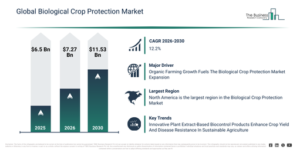
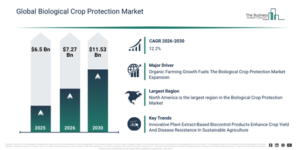
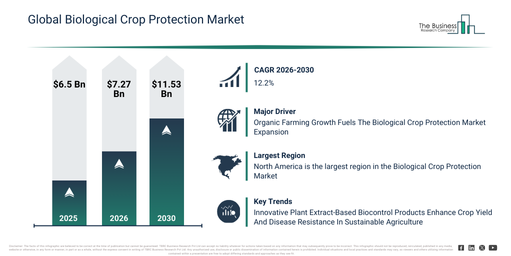
The biological crop protection market has seen rapid expansion in recent years. Its valuation is expected to rise from $6.5 billion in 2025 to $7.27 billion in 2026, reflecting a compound annual growth rate (CAGR) of 11.8%. This historical growth can be linked to several factors, including increasing worries about chemical pesticide residues, the early adoption of microbial pest control agents, growing awareness of ecological farming practices, regulatory pressure against synthetic pesticides, and the expansion of integrated pest management programs.
The biological crop protection market is projected to experience substantial expansion in the coming years, reaching a valuation of $11.53 billion by 2030, demonstrating a compound annual growth rate (CAGR) of 12.2%. This anticipated growth during the forecast period is primarily driven by factors such as the escalating demand for crops free of chemical residues, the ongoing expansion of organic agricultural practices, increased funding for research and development in microbial biocontrol, advancements in biological formulation technologies, and a stronger focus on farming methods resilient to climate change. Key trends anticipated during this period encompass the greater embrace of pest management strategies utilizing natural predators, the proliferation of microbial and biochemical solutions for crop protection, the increasing creation of biological pest control products tailored for specific crops, expanded application of biological treatments for post-harvest protection, and breakthroughs in soil-integrated biological approaches to pest management.
Get A Free Biological Crop Protection Market Sample With 2030 Forecast Insights:
Biological Crop Protection Market Outlook: Key Driver Supporting Long-Term Growth
The expanding organic farming sector is anticipated to boost the biological crop protection market going forward. This agricultural system prioritizes natural processes and materials, avoiding synthetic fertilizers and pesticides to enhance biodiversity, soil health, and sustainability. The sector’s growth stems from factors such as increased demand for healthier food options, environmental concerns, and sustainable agricultural practices. Biological crop protection utilizes natural strategies for controlling pests and diseases, aligning with organic farming’s emphasis on sustainability, biodiversity, and ecological balance. For instance, in February 2024, according to the IFOAM (International Federation of Organic Agriculture Movements), a Germany-based international organization, the global area under organic farming expanded by 2.5 million hectares in 2023, bringing the total to nearly 99 million hectares. Concurrently, global sales of organic food rose to approximately 136 billion euros that same year. Therefore, the growing organic farming sector is driving the growth of the biological crop protection market.
Segmentation Of The Biological Crop Protection Market: Key Categories Explained
The biological crop protection market covered in this report is segmented –
1) By Product Type: Microbial Pesticides, Plant-Incorporated Protectants, Biochemical Pesticides
2) By Crop Type: Cereals And Grains, Oilseeds And Pulses, Fruits And Vegetables, Other Crop Types
3) By Formulation: Liquid, Dry
4) By Application: Foliar Spray, Seed Treatment, Soil Treatment, Post-Harvest
Subsegments:
1) By Microbial Pesticides: Bacterial Pesticides, Fungal Pesticides, Viral Pesticides
2) By Plant-Incorporated Protectants: Genetically Modified Crops With Built-In Pest Resistance, Plant-Derived Insecticides
3) By Biochemical Pesticides: Natural Compounds, Semiochemicals, Insect Growth Regulators (IGRs)
Biological Crop Protection Market Evolving Trends: What Businesses Should Know
Leading firms within the biological crop protection market are concentrating on creating novel solutions, like bio-fungicides, to boost crop productivity and strengthen resistance to diseases. Specifically, a bio-fungicide is a category of biological crop protection item that leverages natural organisms or their derivatives to manage fungal ailments impacting crops. Such bio-fungicides commonly originate from living microbes, including bacteria, fungi, or viruses, possessing the ability to inhibit or eradicate disease-causing fungi that afflict crops. As an illustration, in August 2023, ADAMA Ltd., a crop protection firm based in Israel, announced the official registration of its product, ACTAVAN, in Peru. This initial bio-fungicide from ADAMA works to prevent fruit rot in crops such as grapes, berries, and specific vegetables, concurrently improving the sugar concentration, peel firmness, size, and overall weight of berries. It also stimulates the plant’s inherent immune response, ensuring consistent outcomes, and permits adaptable crop treatment timelines without requiring any pre-harvest waiting interval. ACTAVAN is well-suited for organic cultivation and integrated pest management (IPM), thereby supporting sustainable agricultural methods. While currently registered in Peru, ADAMA intends to broaden its application across Latin America, Asia-Pacific, and Europe.
Who Competes In The Biological Crop Protection Market? Major Companies Listed
Major companies operating in the biological crop protection market are BASF SE, Bayer AG, Syngenta AG, Corteva Agriscience, FMC Corporation, ADAMA Ltd., UPL Limited, Coromandel International Limited, Novozymes A/S, Nufarm Limited, Koppert Biological Systems Ltd., Certis USA L.L.C, Valent BioSciences LLC, AgriLife (India) Pvt Ltd., Jaivik Crop Care LLP, Andermatt Biocontrol, BioSafe Systems LLC, Seipasa, Futureco Bioscience, KN Biosciences India Pvt. Ltd., IPL Biologicals Limited
Read The Complete Biological Crop Protection Market Forecast Report Through 2030:
Biological Crop Protection Market Regional Ranking: Which Geography Comes First?
North America was the largest region in the biological crop protection market in 2025. Europe is expected to be the fastest-growing region in the forecast period. The regions covered in the biological crop protection market report are Asia-Pacific, South East Asia, Western Europe, Eastern Europe, North America, South America, Middle East, Africa.
Reach Out To Our Team:
The Business Research Company: https://www.thebusinessresearchcompany.com/
Americas: +1 310-496-7795
Asia: +44 7882 955267 & +91 8897263534
Europe: +44 7882 955267
Email us at: marketing@tbrc.info
Follow us on:
LinkedIn: https://in.linkedin.com/company/the-business-research-company
YouTube: https://www.youtube.com/channel/UC24_fI0rV8cR5DxlCpgmyFQ
Global Market Model: https://www.thebusinessresearchcompany.com/global-market-model

Wasay has over a decade of experience in market research, data modelling, and analytics, with prior experience at GlobalData and Decision Tree Consulting Services. At The Business Research Company , he leads research operations across syndicated studies, customized consulting engagements, and the Global Market Model platform. His professional experience includes supporting organizations such as Boston Consulting Group, KPMG, and Ernst & Young. Wasay holds a degree in Electronics and Communications Engineering, postgraduate management qualifications from International Management Institute Belgium and Indian School of Business and Entrepreneurship, and completed the Integrated Program in Business Analytics from Indian Institute of Management Indore.