Backed by market attractiveness analysis, total addressable market sizing, company benchmarking matrices, interactive Excel dashboards, wider supply chain intelligence, emerging startup coverage, and detailed product-level insights, The Business Research Company’s 2026 market reports are designed to offer research that is more actionable and strategically valuable than ever.
Carbon Credit For Agriculture, Forestry, And Land Use Market Value Analysis: What Growth Lies Ahead Over The Forecast Period?
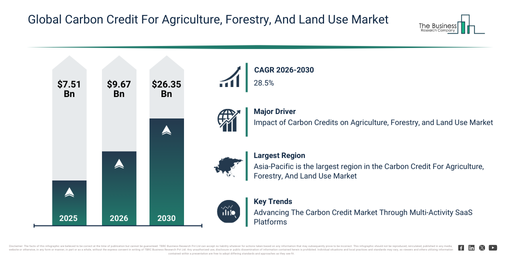
The market size for carbon credits in agriculture, forestry, and land use has expanded significantly in recent years. This sector is projected to increase from $7.51 billion in 2025 to $9.67 billion in 2026, exhibiting a compound annual growth rate (CAGR) of 28.8%. Historically, this growth can be attributed to the early promotion of reforestation initiatives, increasing awareness regarding climate change impacts, the initial adoption of voluntary carbon markets, government-led afforestation and conservation programs, and the expansion of sustainable agriculture practices.
The carbon credit for agriculture, forestry, and land use market is poised for significant growth in the coming years. Its valuation is predicted to climb to $26.35 billion by 2030, achieving a compound annual growth rate (CAGR) of 28.5%. This expansion is driven by various factors, such as the increasing number of corporate net-zero pledges, a rising demand for high-quality removal credits, the proliferation of digital mrv (measurement, reporting, verification) tools, growing investments in regenerative farming, and global policy initiatives supporting transparency in carbon markets. Noteworthy trends for the forecast period include a wider adoption of nature-based carbon removal projects, the expansion of regenerative agriculture for soil carbon sequestration, increased participation from farmers and landowners in carbon credit programs, the continued development of standardized measurement and verification protocols, and the greater integration of carbon credits into corporate sustainability strategies.
Get A Free Sample Report With In-Depth Market Insights:
Carbon Credit For Agriculture, Forestry, And Land Use Market Growth Drivers: What’s Behind The Acceleration?
The increasing need to decrease carbon emissions is anticipated to drive expansion in the carbon credit for agriculture, forestry, and land use market in the coming period. Carbon emissions are defined as the discharge of carbon dioxide (CO2) and other greenhouse gases into the atmosphere. This necessity to curb carbon emissions is stimulating advancements and investigations in fields like renewable energy, battery storage, carbon capture and storage (CCS), and sustainable agriculture, aiming for enduring and sustainable outcomes. Carbon credits help mitigate emissions by encouraging actions that either eliminate carbon dioxide or avert its release, thereby balancing the carbon footprint across agriculture, forestry, and land use. For example, in November 2023, data from the United Nations Environment Programme, an environmental body located in Kenya, indicated that as of 25 September 2023, a total of 97 Parties, representing approximately 81% of worldwide GHG emissions, had committed to net-zero targets: with 27 enshrined in law, 54 documented in policy, and 16 declared by public officials. This number represents an increase from 88 parties reported in the previous year. Commitments set for 2050 or before encompass 37% of emissions, whereas declarations extending past 2050 account for 44%. Consequently, the increasing need to decrease carbon emissions is fueling the expansion of the carbon credit for agriculture, forestry, and land use.
Carbon Credit For Agriculture, Forestry, And Land Use Market Segment Analysis Spotlighting Growth Areas
The carbon credit for agriculture, forestry, and land use market covered in this report is segmented –
1) By Type: Voluntary, Compliance
2) By Project Type: Forestry And Land Use, Agriculture
3) By Application: Avoidance Projects, Removal Projects, Combination Projects
Subsegments:
1) By Voluntary: Carbon Offset Projects, Carbon Credit Trading
2) By Compliance: Cap-And-Trade Systems, Emission Reduction Programs
Carbon Credit For Agriculture, Forestry, And Land Use Market Trends: What’s Defining The Industry’s Next Phase?
Key companies within the carbon credit for agriculture forestry and land use market are prioritizing the development of cutting-edge technological solutions, such as multi-activity carbon credit SaaS platforms, to aid global decarbonization objectives. A multi-activity carbon credit SaaS platform is a software application designed to generate premium carbon offsets from various mitigation efforts by utilizing diverse data sources and technologies. As an illustration, in September 2023, CERO Technologies, an India-based software firm, introduced a carbon credit generation SaaS platform. This technology, identified as the digital measurement, reporting, and verification (dMRV) platform, addresses existing market issues like supply limitations, inefficiencies, and credibility concerns. The platform accelerates carbon credit calculation and verification processes by engaging with high-quality data to deliver high-quality carbon credits in real-time.
Carbon Credit For Agriculture, Forestry, And Land Use Market Leading Companies: Who Holds The Strongest Market Presence?
Major companies operating in the carbon credit for agriculture, forestry, and land use market are Cargill Incorporated, Bayer AG, WGL Holdings Inc., Conservation International, Indigo AG Inc., Green Mountain Energy, The Carbon Trust, 3Degrees Group Inc., Terra Global Capital LLC, EcoAct, Verra, American Carbon Registry, Carbon Credit Capital LLC, Land Life Company, Allcot Group, Enking International, natureOffice GmbH, South Pole, Ecosystem Services Market Consortium, Sterling Planet Inc., Finite Carbon Corporation, GreenTrees LLC, Gold Standard, Nori Inc.
View The Full Carbon Credit For Agriculture, Forestry, And Land Use Market Report:
Carbon Credit For Agriculture, Forestry, And Land Use Market Largest Region: Which Geography Holds The Highest Market Share?
Asia-Pacific was the largest region in the carbon credit for agriculture, forestry, and land use market in 2025. The regions covered in the carbon credit for agriculture, forestry, and land use market report are Asia-Pacific, South East Asia, Western Europe, Eastern Europe, North America, South America, Middle East, Africa.
Reach Out To Our Team:
The Business Research Company: https://www.thebusinessresearchcompany.com/
Americas: +1 310-496-7795
Asia: +44 7882 955267 & +91 8897263534
Europe: +44 7882 955267
Email us at: marketing@tbrc.info
Follow us on:
LinkedIn: https://in.linkedin.com/company/the-business-research-company
YouTube: https://www.youtube.com/channel/UC24_fI0rV8cR5DxlCpgmyFQ
Global Market Model: https://www.thebusinessresearchcompany.com/global-market-model

Wasay has over a decade of experience in market research, data modelling, and analytics, with prior experience at GlobalData and Decision Tree Consulting Services. At The Business Research Company , he leads research operations across syndicated studies, customized consulting engagements, and the Global Market Model platform. His professional experience includes supporting organizations such as Boston Consulting Group, KPMG, and Ernst & Young. Wasay holds a degree in Electronics and Communications Engineering, postgraduate management qualifications from International Management Institute Belgium and Indian School of Business and Entrepreneurship, and completed the Integrated Program in Business Analytics from Indian Institute of Management Indore.