The Business Research Company’s 2026 market reports combine market attractiveness scoring, total addressable market sizing, company benchmarking matrices, interactive Excel dashboards, deeper supply chain intelligence, emerging startup tracking, and granular product-level insights to deliver research that is more actionable and strategically valuable.
Closed-Loop Crop Protection Logistics Market Revenue Forecast: $4 Billion In 2026 Rising To $5.88 Billion In 2030
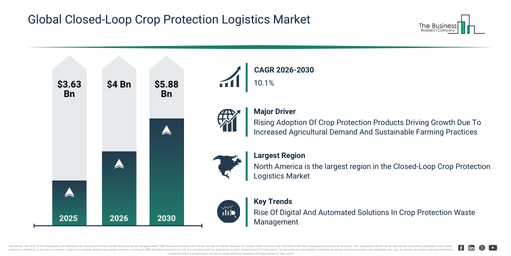
The closed-loop crop protection logistics market has shown significant growth in recent years. This market’s size is anticipated to expand from $3.63 billion in 2025 to $4 billion in 2026, achieving a compound annual growth rate (CAGR) of 10.3%. The historical increase can be ascribed to factors such as an initial focus on regulatory compliance in agrochemical handling, the rising volume of pesticide and herbicide waste, heightened awareness of environmental risks in agricultural logistics, the constraints on efficiency posed by manual tracking systems, and the early establishment of reverse logistics models.
The closed-loop crop protection logistics market size is projected to experience substantial expansion over the upcoming years. This market is predicted to reach $5.88 billion by 2030, demonstrating a compound annual growth rate (CAGR) of 10.1%. This anticipated growth during the forecast period is attributable to several factors, including the increasing demand for transparent supply chains, the greater adoption of automated return and recycling systems, stricter sustainability requirements for agrochemical producers, the broadening use of digital monitoring tools, and the expansion of agricultural services centered on the circular economy. Key trends foreseen for this period encompass a heightened emphasis on closed-loop recovery systems, the increased implementation of storage practices that comply with hazardous material regulations, the enhanced integration of traceable return and recovery initiatives, the spread of eco-efficient recycling and disposal approaches, and the reinforcement of regulatory frameworks governing logistics compliance.
Free Sample Report: Closed-Loop Crop Protection Logistics Market Size, Trends And Forecast To 2030:
Closed-Loop Crop Protection Logistics Market Growth Catalyst: What Is Creating New Demand?
The expanding use of crop protection products is anticipated to fuel the growth of the closed-loop crop protection logistics market. These products are defined as chemical or biological agents, including pesticides, herbicides, and fungicides, employed to safeguard crops from pests. The increased uptake of crop protection products is propelled by the rising demand for higher agricultural yields, the necessity to protect crops from pests, diseases, and weeds, and a growing awareness among farmers regarding sustainable farming practices and methods to improve crop quality. Closed-loop crop protection logistics plays a crucial role by ensuring the safe collection, transport, cleaning, and recycling of containers, which in turn reduces chemical waste, maintains environmental safety, enhances resource efficiency, and supports sustainable agricultural practices. For example, CropLife International, a trade organization located in Belgium, disclosed in February 2024 that expenditure on research and development for biological crop protection products climbed by 64.7% to $26.0 million in 2024, while spending on chemical crop protection products increased by 84.1% to $370.4 million during the same year. Thus, the increasing adoption of crop protection products is a primary driver for the closed-loop crop protection logistics market.
Closed-Loop Crop Protection Logistics Market Segment Overview: Categories Covered In The 2026 Report
The closed-loop crop protection logistics market covered in this report is segmented –
1) By Service Type: Transportation, Warehousing, Reverse Logistics, Recycling, Other Service Types
2) By Crop Type: Cereals And Grains, Fruits And Vegetables, Oilseeds And Pulses, Other Crop Types
3) By Application: Pesticides, Herbicides, Fungicides, Other Applications
4) By End-User: Agricultural Producers, Agrochemical Companies, Distributors, Other End Users
Subsegments:
1) By Transportation: Road Transportation, Rail Transportation, Air Transportation, Maritime Transportation
2) By Warehousing: Dedicated Warehousing, Shared Warehousing, Cold Chain Warehousing, Hazardous Material Warehousing
3) By Reverse Logistics: Collection Services, Sorting Services, Refurbishment Services, Return Processing Services
4) By Recycling: Mechanical Recycling, Chemical Recycling, Energy Recovery Recycling, Composting And Biodegradation
5) By Other Service Types: Consulting Services, Training And Compliance Services, Inventory Management Services, Tracking And Monitoring Services
How Are Leading Companies Shaping Closed-Loop Crop Protection Logistics Market Trends?
Leading companies involved in the closed-loop crop protection logistics sector are concentrating on advancements such as automated collection systems, digital tracking, and sustainable recycling solutions to improve safety, operational effectiveness, and environmental adherence. Automated collection systems are sophisticated logistics answers crafted to guarantee the secure, efficient, and consistent retrieval of crop protection product containers from farms, distributors, and designated collection points, thereby cutting down chemical waste and backing sustainable agricultural methods. For instance, in April 2025, the European Business Association (EBA), a business advocacy group based in Ukraine, inaugurated Agro Varta, marking a new phase in digital hazardous waste management for crop protection. The platform allows farmers and agro-holdings to submit requests for the pickup of used crop protection product containers, which are then handled by licensed waste management companies. Agro Varta guarantees the secure collection, transportation, storage, and reprocessing of these containers while adhering to ecological, technical, legal, and safety standards, furthering a circular economy and bolstering sustainability within the agricultural domain.
Closed-Loop Crop Protection Logistics Market Players: Key Companies Shaping Competition
Major companies operating in the closed-loop crop protection logistics market are BASF SE, Sumitomo Chemical, Corteva Agriscience, UPL Corporation Ltd., FMC Corporation, Nufarm, Helena Agri-Enterprises LLC, Nissan Chemical Corporation, Albaugh LLC, Kumiai Chemical Industry Co. Ltd., PI Industries, Bayer CropScience, Helm AG, Gowan Company, Tata Rallis Ltd., Insecticides Ltd., Meghmani Organics, Dhanuka Agritech Ltd., Sharda Cropchem, Aimco Pesticides Ltd.
Access Complete Closed-Loop Crop Protection Logistics Market Data, Forecasts And Competitive Insights:
Closed-Loop Crop Protection Logistics Market Regional Performance And Geographic Coverage
North America was the largest region in the closed-loop crop protection logistics market in 2025. Asia-Pacific is expected to be the fastest-growing region in the forecast period. The regions covered in the closed-loop crop protection logistics market report are Asia-Pacific, South East Asia, Western Europe, Eastern Europe, North America, South America, Middle East, Africa.
Reach Out To Our Team:
The Business Research Company: https://www.thebusinessresearchcompany.com/
Americas: +1 310-496-7795
Asia: +44 7882 955267 & +91 8897263534
Europe: +44 7882 955267
Email us at: marketing@tbrc.info
Follow us on:
LinkedIn: https://in.linkedin.com/company/the-business-research-company
YouTube: https://www.youtube.com/channel/UC24_fI0rV8cR5DxlCpgmyFQ
Global Market Model: https://www.thebusinessresearchcompany.com/global-market-model

Wasay has over a decade of experience in market research, data modelling, and analytics, with prior experience at GlobalData and Decision Tree Consulting Services. At The Business Research Company , he leads research operations across syndicated studies, customized consulting engagements, and the Global Market Model platform. His professional experience includes supporting organizations such as Boston Consulting Group, KPMG, and Ernst & Young. Wasay holds a degree in Electronics and Communications Engineering, postgraduate management qualifications from International Management Institute Belgium and Indian School of Business and Entrepreneurship, and completed the Integrated Program in Business Analytics from Indian Institute of Management Indore.