
Delivering more actionable and strategically valuable research, The Business Research Company’s 2026 market reports feature market attractiveness analysis, total addressable market evaluation, company benchmarking matrices, interactive Excel dashboards, expanded supply chain intelligence, emerging startup coverage, and detailed product insights.
#Forestry Market Size And Revenue Forecast Through 2030
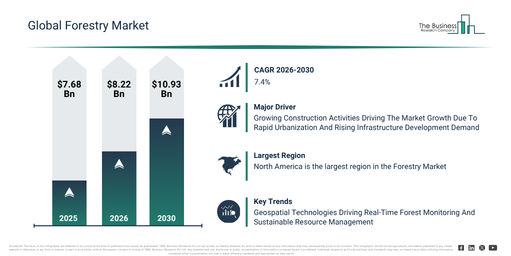
The forestry market has shown significant growth over recent years. It is anticipated to expand from $7.68 billion in 2025 to $8.22 billion in 2026, achieving a compound annual growth rate (CAGR) of 7.1%. This historical growth can be attributed to factors such as increased industrial demand for timber, higher consumption of paper and pulp, ongoing traditional logging and harvesting operations, a rise in construction material utilization, and the establishment of organized forestry plantations.
The forestry market is projected to experience substantial expansion in the coming years. Its valuation is anticipated to reach $10.93 billion by the year 2030, exhibiting a compound annual growth rate (CAGR) of 7.4%. This growth during the forecast period can be attributed to an increasing appetite for sustainable and certified wood products, the proliferation of carbon credit and offset forestry initiatives, the integration of intelligent forest monitoring solutions, a surge in the utilization of biomass as an energy source, and more rigorous global regulations aimed at preventing deforestation. Key trends expected within this timeframe encompass the broadening of sustainable forest management and certification methods, the increasing embrace of remote sensing and satellite-based systems for forest surveillance, a heightened need for certified timber and supply chains that allow wood traceability, the advancement of biomass-derived energy and renewable wood fuel uses, and a movement towards carbon offset projects centered on reforestation and afforestation efforts.
Download A Free Sample Report For Comprehensive Market Insights:
https://www.thebusinessresearchcompany.com/sample_request?id=59797450&type=smp
Forestry Market Demand Drivers: What Is Fueling Industry Growth?
The expansion of construction projects is anticipated to boost the growth of the forestry market going forward. Construction activities encompass all processes involved in the planning, building, and completion of structures and infrastructure, including buildings, roads, and bridges. The increase in these activities is primarily driven by rapid urbanization, which generates a greater demand for housing, commercial spaces, and infrastructure development to support growing populations and economic expansion. Forestry supports construction by supplying timber and wood-based materials utilized in structural, framing, and finishing applications, ensuring a steady flow of raw materials for sustainable building development. For instance, in August 2024, according to Eurostat, a Luxembourg-based government agency, the seasonally adjusted production in construction increased by 1.7% in the euro area and by 1.4% in the EU in June 2024, compared to May 2024. Therefore, the expanding construction activities are significantly driving the growth of the forestry market.
Forestry Market Segment Analysis: What Are The Major Market Categories?
The forestry market covered in this report is segmented –
1) By Product Type: Timber Logs, Sawn Wood, Pulpwood, Wood Chips, Fuelwood, Bamboo, Resin
2) By Forest Type: Natural Forests, Plantation Forests
3) By Harvest Method: Selective Logging, Clear-Cutting Operations, Sustainable Regeneration
4) By Distribution Channel: Direct Sales To Downstream Processors, Wholesalers And Specialized Timber Distributors, Retailers And Industrial Supply Outlets, International Trade And Export Channels
5) By End User: Construction Industry, Paper And Packaging Industry, Furniture Industry, Energy Industry, Agriculture Industry, Chemical Industry
Subsegments:
1) By Timber Logs: Softwood Timber Logs, Hardwood Timber Logs, Pine Timber Logs, Spruce Timber Logs, Eucalyptus Timber Logs
2) By Sawn Wood: Softwood Sawn Wood, Hardwood Sawn Wood, Rough Sawn Wood, Finished Sawn Wood, Pressure Treated Sawn Wood
3) By Pulpwood: Softwood Pulpwood, Hardwood Pulpwood, Chemical Grade Pulpwood, Mechanical Grade Pulpwood, Mixed Species Pulpwood
4) By Wood Chips: Hardwood Wood Chips, Softwood Wood Chips, Biomass Wood Chips, Paper Grade Wood Chips, Landscape Wood Chips
5) By Fuelwood: Hardwood Fuelwood, Softwood Fuelwood, Split Fuelwood, Kiln Dried Fuelwood, Compressed Fuelwood
6) By Bamboo: Construction Grade Bamboo, Furniture Grade Bamboo, Paper Grade Bamboo, Decorative Bamboo, Industrial Bamboo
7) By Resin: Pine Resin, Natural Resin, Synthetic Resin, Adhesive Grade Resin, Industrial Grade Resin
Forestry Market Innovation Trends: Which Developments Are Transforming The Industry?
Companies operating significantly within the forestry market are focusing on the development of inventive solutions, such as geospatial forest monitoring systems. These initiatives are designed to enable real-time tracking of forest resources, improve sustainable management practices, and enhance the detection of deforestation along with compliance monitoring. A geospatial forest monitoring system functions as a digital platform, employing spatial data gathered from satellites and various mapping tools to monitor forest conditions, changes, and sustainability over time. For instance, in February 2025, Olam Agri Holdings Pte. Ltd., a food, feed, and agribusiness company headquartered in Singapore, introduced a Digital Forestry Solution. This paperless system uses tablets and smartphones to capture harvest data instantly across its forest concessions in the Republic of Congo. The solution enhances timber traceability, reduces manual errors, and supports compliance, transparency, and sustainable forest management.
Forestry Market Leading Companies Driving Competitive Growth
Major companies operating in the forestry market are Deere & Company, Komatsu Ltd., International Paper Company, Sumitomo Forestry Co. Ltd., Oji Holdings Corporation, UPM-Kymmene Corporation, BTG Pactual Timberland Investment Group, Nippon Paper Industries Co. Ltd., Mondi Group, Suzano S.A., Weyerhaeuser Company, West Fraser Timber Co. Ltd., Canfor Corporation, Holmen AB, Metsä Group, Mercer International Inc., Svenska Cellulosa Aktiebolaget (SCA), Sierra Pacific Industries, Rayonier Inc., Ponsse Plc, Södra, Green Diamond Resource Company, New Forests Pty Limited, Stora Enso Oyj, Tigercat International Inc.
Access The Complete Forestry Market Report:
https://www.thebusinessresearchcompany.com/report/forestry-market-report
Forestry Market Geographic Landscape: Which Region Dominates Industry Growth?
North America was the largest region in the forestry market in 2025. Asia-Pacific is expected to be the fastest-growing region in the forecast period. The regions covered in the forestry market report are Asia-Pacific, South East Asia, Western Europe, Eastern Europe, North America, South America, Middle East, Africa.
Get in touch with us:
The Business Research Company: https://www.thebusinessresearchcompany.com/
Americas: +1 310-496-7795
Asia: +44 7882 955267 & +91 8897263534
Europe: +44 7882 955267
Email us at: marketing@tbrc.info
Follow us on:
LinkedIn: https://in.linkedin.com/company/the-business-research-company
YouTube: https://www.youtube.com/channel/UC24_fI0rV8cR5DxlCpgmyFQ
Global Market Model: https://www.thebusinessresearchcompany.com/global-market-model

Wasay has over a decade of experience in market research, data modelling, and analytics, with prior experience at GlobalData and Decision Tree Consulting Services. At The Business Research Company , he leads research operations across syndicated studies, customized consulting engagements, and the Global Market Model platform. His professional experience includes supporting organizations such as Boston Consulting Group, KPMG, and Ernst & Young. Wasay holds a degree in Electronics and Communications Engineering, postgraduate management qualifications from International Management Institute Belgium and Indian School of Business and Entrepreneurship, and completed the Integrated Program in Business Analytics from Indian Institute of Management Indore.