The Business Research Company’s 2026 market reports combine market attractiveness scoring, total addressable market sizing, company benchmarking matrices, interactive Excel dashboards, deeper supply chain intelligence, emerging startup tracking, and granular product-level insights to deliver research that is more actionable and strategically valuable.
Hemp Fiber Market Value Projected To Grow At A 34.5% Compound Annual Growth Rate Through 2030
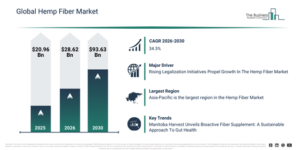
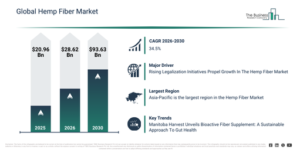
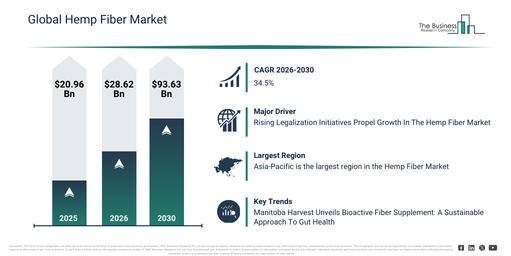
The hemp fiber market has experienced substantial growth in recent years. It is projected to increase from $20.96 billion in 2025 to $28.62 billion in 2026, at a compound annual growth rate (CAGR) of 36.5%. This historic expansion can be attributed to its traditional use in textiles, early adoption in rope and industrial materials, a rising interest in natural fibers, the expansion of hemp cultivation, and demand from the paper and insulation industries.
The hemp fiber market is projected to experience substantial growth in the coming years, reaching $93.63 billion by 2030, exhibiting a compound annual growth rate (CAGR) of 34.5%. This expansion during the forecast period is primarily driven by an increasing demand for environmentally friendly materials, the expanded application of hemp composites within the automotive industry, a heightened focus on biodegradable packaging solutions, the broader adoption of sustainable construction methods, and a rising preference for organic fibers. Key trends projected for this period encompass the increasing integration of hemp fiber into sustainable fashion, a surge in demand for packaging derived from biodegradable hemp, the enhanced incorporation of hemp fiber in automotive composite applications, the broadened deployment of hemp fiber in building materials, and a developing inclination towards the manufacturing of organic hemp fiber.
Evaluate The Hemp Fiber Market Report Before You Buy With A Free Sample:
Hemp Fiber Market Growth Driver Analysis For The 2026–2030 Forecast Period
The expanding legal approval for growing industrial hemp is anticipated to boost the future expansion of the hemp fiber market. Derived from the Cannabis sativa plant species, industrial hemp has been utilized worldwide to create numerous industrial and consumer goods. Its cultivation is primarily for its fibers and seeds, both essential for manufacturing hemp fiber. Consequently, greater legality surrounding industrial hemp contributes to a rise in hemp fiber production. For example, data from February 2024, released by the Australian Institute of Health and Welfare, an Australian government body, indicated that in 2022–2023, public support for cannabis legalization reached 45%. This marked the first instance where the percentage of individuals favoring legalization exceeded the 39% who advocated for harsher penalties for cannabis sale or supply. Thus, the growing legal acceptance of industrial hemp cultivation is a key driver for the expansion of the hemp fiber market.
Hemp Fiber Market Segmentation Breakdown: Primary And Secondary Categories
The hemp fiber market covered in this report is segmented –
1) By Type: Long (Bast) Fibers, Short (Core) Fibers
2) By Source: Organic, Conventional
3) By Application: Personal Care Products, Textiles, Pharmaceuticals, Other Applications
Subsegments:
1) By Long (Bast) Fibers: Used In Textiles, Ropes, And Composite Materials, Known For Strength And Durability, Applications Include Apparel, Upholstery, And Industrial Textiles
2) By Short (Core) Fibers: Used In Insulation, Paper, And Biodegradable Plastics, Softer And Less Strong Compared To Long Fibers, Applications Include Animal Bedding, Insulation Materials, And Biocomposites
Hemp Fiber Market Industry Trends: New Developments From Leading Companies
Leading companies operating in the hemp fiber market are developing new products, such as organic supplements, to meet the growing demand for health-focused and sustainable food options. Organic supplements refer to dietary products made from ingredients grown without synthetic fertilizers, pesticides, or genetically modified organisms (GMOs), ensuring a natural and environmentally friendly approach to health and wellness. For instance, in May 2024, Manitoba Harvest, a Canada-based company, launched a Bioactive Fiber Supplement Featuring Brightseed’s Upcycled Hemp Hulls. Manitoba Harvest’s Bioactive Fiber Supplement, crafted with upcycled hemp hulls, provides 6 grams of fiber per serving to support gut health and digestion. Available exclusively at Whole Foods, this organic, non-GMO, and vegan product promotes wellness through innovative bioactive ingredients.
Who Are The Top Competitors In The Hemp Fiber Market?
Major companies operating in the hemp fiber market are Shenyang Beijiang, BaFa Holding, Plains Industrial Hemp Processing, Industrial Hemp Manufacturing, Hemp Planet, Konoplex, Kingdom Holdings, Ecofibre, CanvaLoop Fibre, HempFlax, Dunagro, Envirotextiles, Hempfortex, Parkland Industrial Hemp Growers, Hemp Inc., Natural Fiber Technologies, HempAge, Hempro Int., Hempy’s, Shanxi Greenland Textile, Hempline.
Access The Hemp Fiber Market Report For Complete Segment-Level Analysis:
Which Region Leads The Hemp Fiber Market, And Which Regions Are Covered?
Asia-Pacific was the largest region in the hemp fiber market in 2025. The regions covered in the hemp fiber market report are Asia-Pacific, South East Asia, Western Europe, Eastern Europe, North America, South America, Middle East, Africa.
Reach Out To Our Team:
The Business Research Company: https://www.thebusinessresearchcompany.com/
Americas: +1 310-496-7795
Asia: +44 7882 955267 & +91 8897263534
Europe: +44 7882 955267
Email us at: marketing@tbrc.info
Follow us on:
LinkedIn: https://in.linkedin.com/company/the-business-research-company
YouTube: https://www.youtube.com/channel/UC24_fI0rV8cR5DxlCpgmyFQ
Global Market Model: https://www.thebusinessresearchcompany.com/global-market-model

Wasay has over a decade of experience in market research, data modelling, and analytics, with prior experience at GlobalData and Decision Tree Consulting Services. At The Business Research Company , he leads research operations across syndicated studies, customized consulting engagements, and the Global Market Model platform. His professional experience includes supporting organizations such as Boston Consulting Group, KPMG, and Ernst & Young. Wasay holds a degree in Electronics and Communications Engineering, postgraduate management qualifications from International Management Institute Belgium and Indian School of Business and Entrepreneurship, and completed the Integrated Program in Business Analytics from Indian Institute of Management Indore.