Backed by market attractiveness analysis, total addressable market sizing, company benchmarking matrices, interactive Excel dashboards, wider supply chain intelligence, emerging startup coverage, and detailed product-level insights, The Business Research Company’s 2026 market reports are designed to offer research that is more actionable and strategically valuable than ever.
Integrated Pest Management (IPM) Market Size Forecast: How Big Could The Market Get By 2030?
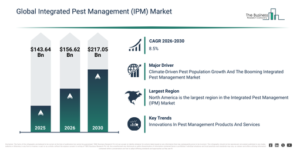
The integrated pest management (IPM) market has seen substantial growth in its size over recent years. It is anticipated to increase from $143.64 billion in 2025 to $156.62 billion in 2026, achieving a compound annual growth rate (CAGR) of 9.0%. The historical growth can be linked to factors such as an increasing dependence on chemical pesticides, the emergence of pest resistance challenges, the expansion of monoculture farming, elevated crop losses caused by pests, and early regulatory demands for sustainable pest management.
The integrated pest management (IPM) market is anticipated to experience robust expansion over the next few years, projected to reach $217.05 billion by 2030, growing at a compound annual growth rate (CAGR) of 8.5%. This growth during the forecast period is primarily driven by an increasing demand for environmentally safe agricultural practices, the rising adoption of biological methods for pest control, greater investment in cultural and habitat management, advancements in developing resistant cultivar varieties, and expanding regulatory incentives that encourage IPM adoption. Notable trends expected in this period include a growing preference for eco-friendly pest management solutions, a wider embrace of resistant crop varieties, the broadening of habitat and cultural control techniques, an increase in the utilization of biological predators and beneficial organisms, and the development of integrated multi-method programs for pest suppression.
Get A Free Sample Report With In-Depth Market Insights:
Integrated Pest Management (IPM) Market Growth Drivers: What’s Behind The Acceleration?
The future expansion of the integrated pest management market is projected to be driven by a rise in the pest population, which is attributed to climate change. Temperature plays a crucial role in governing the physiology and metabolic processes of insects. Higher temperatures lead to an elevated metabolic rate in insects due to intensified physiological activity. Consequently, insect herbivores consume greater quantities and mature faster, as increased food intake is necessary for their survival. Integrated pest management employs both chemical and nonchemical strategies to hinder and manage pest populations, preventing them from achieving economically damaging levels. As an illustration, the United States Department of Agriculture, a US-based government agency, reported in February 2023 that pests account for an annual loss of 20% to 40% of crop production. Annually, plant diseases incur costs of approximately $220 billion, with invasive insects contributing an additional $70 billion. Furthermore, weeds considerably affect global food production. Thus, an expected surge in insect populations due to rising temperatures is set to stimulate the expansion of the integrated pest management market.
Integrated Pest Management (IPM) Market Segment Landscape: Which Areas Lead Development?
The integrated pest management (ipm) market covered in this report is segmented –
1) By Pest Type: Weeds, Invertebrates, Pathogens, Vertebrates
2) By Control Method: Biological Control, Chemical Control, Cultural Controls, Mechanical and Physical Controls, Other Control Methods
3) By Application: Agriculture, Commercial buildings, Industrial, Residential, Other Applications
Subsegments:
1) By Weeds: Annual Weeds, Perennial Weeds
2) By Invertebrates: Insects, Nematodes
3) By Pathogens: Bacterial Pathogens, Fungal Pathogens, Viral Pathogens
4) By Vertebrates: Rodents, Birds, Other Vertebrates
Integrated Pest Management (IPM) Market Trends: What’s Defining The Industry’s Next Phase?
Major companies in the integrated pest management market are developing innovative products, such as professional pest management solutions, to cater to larger customer bases, increase sales, and boost revenue. A professional pest management solution refers to a comprehensive and specialized service delivered by trained and certified pest control professionals or companies to address and manage pest infestations in residential, commercial, agricultural, or industrial environments. For instance, in September 2023, Neogen Corporation, a US-based food safety company, introduced SureKill Evolve SC. SureKill Evolve SC is a suspension concentrate insecticide noted for its excellent performance in swiftly eliminating a wide array of targeted pests and providing extended residual control. These pests include ants, bedbugs, cockroaches, fleas, flies, silverfish, spiders, and various others. This remarkable product features the industry-standard active ingredient, deltamethrin, making it suitable for extensive outdoor applications. Notably, SureKill Evolve SC delivers an impressive up to 90 days of sustained control over the mentioned pests in both residential and commercial structures. SureKill Evolve SC is a flexible and user-friendly solution, making it a top choice for pest control experts. The product’s labeling allows applications in a broad range of settings, including residential structures and buildings, even in sensitive areas such as kitchens and facilities involved in food and feed management.
Integrated Pest Management (IPM) Market Industry Leaders And Competitive Landscape
Major companies operating in the integrated pest management (IPM) market are BASF SE, Integrated Pest Management Inc., Bayer CropScience Limited, Ecolab Inc., Hercon Environmental Corporation, Suterra LLC, AgBiTech Pty Ltd., Russell IPM Ltd., AgrichemBio, Atlas Agro Products Pvt Ltd, Laboratorio Agrochem SRL, Atgc Biotech Private Limited, Agrisense BCS Ltd., Syngenta Group Co. Ltd., Corteva Agriscience, FMC Corporation, Sumitomo Chemical Co. Ltd., ADAMA India Pvt Ltd., Nufarm Limited, Valent BioSciences LLC, Certis USA LLC, BioWorks Inc., Koppert Biological Systems, ISCA Technologies Inc., BioTEPP Inc., Vestaron Corporation, Andermatt Biocontrol AG, Marrone Bio Innovations Inc., BioSafe Systems LLC
View The Full Integrated Pest Management (IPM) Market Report:
Integrated Pest Management (IPM) Market Regional Analysis And Leading Geography
North America was the largest region in the integrated pest management (IPM) market in 2025. Asia-Pacific is expected to be the fastest-growing region in the forecast period. The regions covered in the integrated pest management (IPM) market report are Asia-Pacific, South East Asia, Western Europe, Eastern Europe, North America, South America, Middle East, Africa.
Reach Out To Our Team:
The Business Research Company: https://www.thebusinessresearchcompany.com/
Americas: +1 310-496-7795
Asia: +44 7882 955267 & +91 8897263534
Europe: +44 7882 955267
Email us at: marketing@tbrc.info
Follow us on:
LinkedIn: https://in.linkedin.com/company/the-business-research-company
YouTube: https://www.youtube.com/channel/UC24_fI0rV8cR5DxlCpgmyFQ
Global Market Model: https://www.thebusinessresearchcompany.com/global-market-model

Wasay has over a decade of experience in market research, data modelling, and analytics, with prior experience at GlobalData and Decision Tree Consulting Services. At The Business Research Company , he leads research operations across syndicated studies, customized consulting engagements, and the Global Market Model platform. His professional experience includes supporting organizations such as Boston Consulting Group, KPMG, and Ernst & Young. Wasay holds a degree in Electronics and Communications Engineering, postgraduate management qualifications from International Management Institute Belgium and Indian School of Business and Entrepreneurship, and completed the Integrated Program in Business Analytics from Indian Institute of Management Indore.