
Delivering more actionable and strategically valuable research, The Business Research Company’s 2026 market reports feature market attractiveness analysis, total addressable market evaluation, company benchmarking matrices, interactive Excel dashboards, expanded supply chain intelligence, emerging startup coverage, and detailed product insights.
Microbial Agricultural Inoculants Market Expected To Reach $8.42 Billion By 2030 At 11.2% CAGR
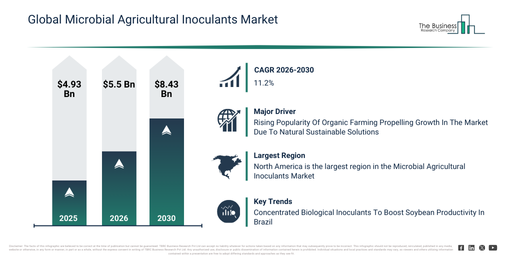
The microbial agricultural inoculants market size has witnessed rapid expansion over recent years. Forecasts predict its value will increase from $4.93 billion in 2025 to $5.5 billion in 2026, achieving a compound annual growth rate (CAGR) of 11.6. The historical growth of this market is attributable to factors such as growing awareness of soil degradation issues, rising demand for eco-friendly fertilizers, the early adoption of inoculants in organic farming, increasing crop production pressures, and the expanding use of biological pest control.
The microbial agricultural inoculants market is anticipated to experience substantial expansion in the coming years. Projections indicate it will reach $8.43 billion by 2030, exhibiting a compound annual growth rate (CAGR) of 11.2. This projected growth is driven by several factors, including a growing emphasis on regenerative agriculture, the increasing application of biofertilizers in mainstream farming, greater investment in microbial product r&d, a rising need for residue-free crop inputs, and the wider integration of microbial solutions in high-value crops. Key developments expected during this timeframe encompass a heightened demand for natural growth-enhancing solutions, increased utilization of microbial inoculants in sustainable farming, the broadening of microbial formulations for diverse crop types, an expanding deployment of soil-health-oriented agricultural inputs, and a stronger emphasis on disease-resistant crop management practices.
Download A Free Sample Report For Comprehensive Market Insights:
#Microbial Agricultural Inoculants Market Demand Drivers Creating New Revenue Opportunities
The expanding adoption of organic farming is projected to fuel the expansion of the microbial agricultural inoculants market moving ahead. Organic farming is defined as an agricultural method that shuns the application of synthetic pesticides, herbicides, fertilizers, and genetically modified organisms (GMOs). This surge in organic farming’s appeal stems from a growing consumer desire for food that is healthier, ecologically sound, and ethically sourced, alongside increased understanding of the negative impacts associated with traditional farming methods. Microbial agricultural inoculants bolster the appeal of organic farming by offering natural approaches to boost soil health, stimulate plant development, and shield crops from pests and illnesses, thus diminishing the reliance on artificial fertilizers and pesticides and adhering to organic farming guidelines. For example, data from IFOAM Organics Europe, a Europe-based nonprofit organization, indicates that organic farmland within the EU grew to 17.7 million hectares in 2023, and the count of organic producers saw a 4 increase from 2022, reaching 434,577. Consequently, the increasing embrace of organic farming is propelling the growth of the microbial agricultural inoculants market.
Microbial Agricultural Inoculants Market Segment Performance And Strategic Opportunities
The microbial agricultural inoculants market covered in this report is segmented –
1) By Type: Plant Growth-Promoting Microorganisms, Biocontrol Agents, Stimulants
2) By Source: Fungal Inoculants, Bacterial Inoculants
3) By Crop Type: Oilseeds And Pulses, Fruits And Vegetables, Cereals And Grains
4) By Application: Soil Inoculation, Seed Inoculation
Subsegments:
1) By Plant Growth-Promoting Microorganisms: Nitrogen-Fixing Bacteria, Phosphate-Solubilizing Bacteria, Potassium-Solubilizing Bacteria, Mycorrhizal Fungi
2) By Biocontrol Agents: Bacterial Biocontrol Agents, Fungal Biocontrol Agents, Viral Biocontrol Agents
3) By Stimulants: Biofertilizers, Biostimulants, Soil Conditioners
Microbial Agricultural Inoculants Market Industry Trends: What Changes Are Reshaping Demand?
Major companies operating in the microbial agricultural inoculants market are focusing on developing innovative solutions, such as a concentrated biological inoculant, to gain a competitive advantage. This type of concentrated biological inoculant aims to enhance soybean productivity by improving nitrogen fixation, a process crucial for plant growth. For instance, in July 2024, Novonesis, a Denmark-based biotechnology company, introduced LeguMax Plus, a biological inoculant based on Bradyrhizobium japonicum, which contains up to five billion CFU/ml. This product boosts biological nitrogen fixation (BNF) and provides a more concentrated solution, thereby reducing transport and application volumes. It remains stable for 12 months and requires a dosage of 60 ml/ha for every 50 kg of seeds. Compared to traditional products typically containing 1-3 billion CFU/ml, LeguMax Plus optimizes logistics and offers better germination when utilized for in-furrow inoculation. It is important to avoid mixing it with chemicals to ensure the survival of the beneficial bacteria. For maximum efficiency, the product should be applied on the same day it is prepared.
Microbial Agricultural Inoculants Market Key Players: Which Companies Shape Industry Competition?
Major companies operating in the microbial agricultural inoculants market are BASF SE, Bayer AG, Nutrien Ltd., Syngenta International AG, Sumitomo Chemical Co. Ltd., Corteva Inc., UPL Ltd., FMC Corporation, Novozymes A/S, Kemin Industries Inc., Bioceres Crop Solutions Corp., BioWorks Inc., Chr. Hansen Holding A/S, Lallemand Plant Care, Valent BioSciences LLC, Verdesian Life Sciences, Pivot Bio, Rizobacter Argentina, Agrinos AS, Ginkgo Bioworks BioAg, Indigo Ag Inc., Marrone Bio Innovations, T.Stanes & Company, TerraMax Inc., Mycorrhizal Applications LLC
Access The Complete Microbial Agricultural Inoculants Market Report:
Microbial Agricultural Inoculants Market Geographic Distribution And Regional Opportunities
North America was the largest region in the microbial agricultural inoculants market in 2025. The regions covered in the microbial agricultural inoculants market report are Asia-Pacific, South East Asia, Western Europe, Eastern Europe, North America, South America, Middle East, Africa.
Access a Customized Microbial Agricultural Inoculants Market Report for Deeper Competitive Insights
Get in touch with us:
The Business Research Company: https://www.thebusinessresearchcompany.com/?utm_source=BlogsPR&utm_medium=Paid&utm_campaign=home_page_test
Americas: +1 310-496-7795
Asia: +44 7882 955267 & +91 8897263534
Europe: +44 7882 955267
Email us at: marketing@tbrc.info
Follow us on:
LinkedIn: https://in.linkedin.com/company/the-business-research-company
YouTube: https://www.youtube.com/channel/UC24_fI0rV8cR5DxlCpgmyFQ
Global Market Model: https://www.thebusinessresearchcompany.com/global-market-model

Wasay has over a decade of experience in market research, data modelling, and analytics, with prior experience at GlobalData and Decision Tree Consulting Services. At The Business Research Company , he leads research operations across syndicated studies, customized consulting engagements, and the Global Market Model platform. His professional experience includes supporting organizations such as Boston Consulting Group, KPMG, and Ernst & Young. Wasay holds a degree in Electronics and Communications Engineering, postgraduate management qualifications from International Management Institute Belgium and Indian School of Business and Entrepreneurship, and completed the Integrated Program in Business Analytics from Indian Institute of Management Indore.
