
Delivering more actionable and strategically valuable research, The Business Research Company’s 2026 market reports feature market attractiveness analysis, total addressable market evaluation, company benchmarking matrices, interactive Excel dashboards, expanded supply chain intelligence, emerging startup coverage, and detailed product insights.
Organic Vegetable Farming Market Value Expansion And Long-Term Growth Outlook
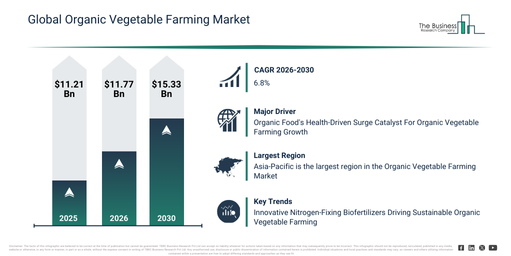
The market for organic vegetable farming has shown consistent growth over recent years. This market is projected to expand from $11.21 billion in 2025 to $11.77 billion by 2026, exhibiting a compound annual growth rate (CAGR) of 4.9. Historically, this expansion has been driven by increased environmental consciousness, a surge in demand for vegetables free from pesticides, the early advocacy of organic farming practices, a greater embrace of traditional composting, and the proliferation of smaller organic vegetable farms.
The organic vegetable farming market is projected to experience substantial expansion in the coming years, anticipated to reach $15.33 billion by 2030, exhibiting a compound annual growth rate (CAGR) of 6.8. Several factors are expected to drive this growth during the forecast period, including increased investment in organic farming technologies, a noticeable consumer preference for clean-label food products, the expansion of protected and climate-resilient organic farming practices, heightened demand from both retail and food-service industries, and enhanced regulatory backing for organic certification. Key trends identified for this period encompass a greater adoption of chemical-free methods for vegetable cultivation, an increasing inclination towards soil regeneration and natural fertility techniques, a rising need for a broader array of organic vegetable varieties, the proliferation of polyculture and integrated organic farming approaches, and a reinforcement of adherence to organic certification standards.
Download A Free Sample Report For Comprehensive Market Insights:
Organic Vegetable Farming Market Development Factors: Which Trends Are Supporting Demand?
The escalating requirement for organic produce is predicted to be a primary catalyst for the expansion of the organic vegetable farming market over the specified timeframe. The health advantages associated with organic food, including its high nutritional content, non-GMO status, and absence of synthetic pesticides and fertilizers, are a crucial element contributing to the increased consumer desire for organic food, specifically organic vegetables. As an illustration, in February 2025, the U.S. Department of Agriculture (USDA), a US-based government agency, reported that in 2024, sales are projected to reach $50.8 billion (€49.2 billion), up from $50.4 billion (€48.8 billion) in 2023, which marked a 10.5 increase from the previous year. Given the advantageous effects on the well-being of organic growers, assistants, their families, and customers, stemming from reduced exposure to detrimental chemicals, combined with evolving consumer inclinations towards organic produce, these factors are anticipated to stimulate greater demand for expansion within the organic vegetable farming market throughout the projected timeframe.
Organic Vegetable Farming Market Segment Analysis: What Are The Major Market Categories?
The organic vegetable farming market covered in this report is segmented –
1) By Type: Pure Organic Farming, Integrated organic farming
2) By Method: Composting, Crop Rotation, Cutting, Mulching, Polyculture, Soil Management, Weed Management
3) By Crop: Protected Crops, Salads, Green Veg, Root Crops, Potatoes, Other Crops
Subsegments:
1) By Pure Organic Farming: Crop Rotation, Green Manure And Cover Crops, No Synthetic Pesticides Or Fertilizers, Organic Certification
2) By Integrated Organic Farming: Crop Diversification, Agroecology Practices, Reduced Use Of Synthetic Inputs, Integrated Pest Management (IPM)
#Organic Vegetable Farming Market Trends Influencing Long-Term Demand
Leading companies in the organic vegetable farming market are prioritizing the creation of innovative solutions, such as next-generation nitrogen-fixing biofertilizer seed treatments, to lessen dependence on synthetic fertilizers, enhance soil health, and support sustainable production. These treatments utilize beneficial microbes, often improved through gene-editing, to fix atmospheric nitrogen directly for crops, providing an eco-friendly alternative to synthetic fertilizers that contribute to water pollution, greenhouse gas emissions, and soil degradation. For instance, in August 2025, BioConsortia, Inc., a U.S.-based agricultural microbial technology company, secured financing to accelerate the global launch of its Always-N™ nitrogen-fixing seed treatment for row crops. The Always-N™ coating combines advanced microbial gene-editing with over two years of shelf stability, enabling farmers to maintain yields while significantly reducing synthetic nitrogen use.
Organic Vegetable Farming Market Leading Companies Driving Competitive Growth
Major companies operating in the organic vegetable farming market are Terramera PlantHealth, Back to the Roots Inc., MycoSolutions AG, Atlántica Agrícola, Agroloop, Ductor, NextProtein, Midwestern BioAg, JH Biotech, Bio Huma Netics, Ag Concepts Corporation, Elephant Vert, Grower’s Secret, Azotic, ILSA S.p.A, Picks Organic Farms, Organic Farmers Co., The Indian Organic Farmers Producer Company Limited (IOFPCL), Umgibe Farming Organics, New Sprout Organic Farms, Olivette Farm by Joe & Daniel, A & A Organic Farms, Earl’s Organic Produce, Earthbound Farm, Organic Valley, Driscoll’s, Cascadian Farm, WhiteWave Foods, Nature’s Path, Amy’s Kitchen, Clif Bar & Company, Lundberg Family Farms
Access The Complete Organic Vegetable Farming Market Report:
Organic Vegetable Farming Market Global Footprint: Which Region Holds Market Leadership?
Asia-Pacific was the largest region in the organic vegetable farming market in 2025. Western Europe was the second largest region in the organic vegetable farming market. The regions covered in the organic vegetable farming market report are Asia-Pacific, South East Asia, Western Europe, Eastern Europe, North America, South America, Middle East, Africa.
Access a Customized Organic Vegetable Farming Market Report for Deeper Competitive Insights
Get in touch with us:
The Business Research Company: https://www.thebusinessresearchcompany.com/?utm_source=BlogsPR&utm_medium=Paid&utm_campaign=home_page_test
Americas: +1 310-496-7795
Asia: +44 7882 955267 & +91 8897263534
Europe: +44 7882 955267
Email us at: marketing@tbrc.info
Follow us on:
LinkedIn: https://in.linkedin.com/company/the-business-research-company
YouTube: https://www.youtube.com/channel/UC24_fI0rV8cR5DxlCpgmyFQ
Global Market Model: https://www.thebusinessresearchcompany.com/global-market-model

Wasay has over a decade of experience in market research, data modelling, and analytics, with prior experience at GlobalData and Decision Tree Consulting Services. At The Business Research Company , he leads research operations across syndicated studies, customized consulting engagements, and the Global Market Model platform. His professional experience includes supporting organizations such as Boston Consulting Group, KPMG, and Ernst & Young. Wasay holds a degree in Electronics and Communications Engineering, postgraduate management qualifications from International Management Institute Belgium and Indian School of Business and Entrepreneurship, and completed the Integrated Program in Business Analytics from Indian Institute of Management Indore.
