Enhanced with market attractiveness analysis, total addressable market evaluation, company benchmarking matrices, interactive Excel dashboards, expanded supply chain intelligence, emerging startup coverage, and detailed product insights, The Business Research Company’s 2026 market reports deliver more actionable and strategically valuable research.
Precision Harvesting Market Size Outlook: How Fast Will Revenue Grow Through 2030?
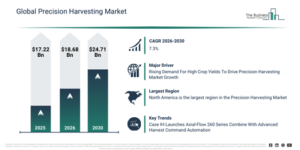
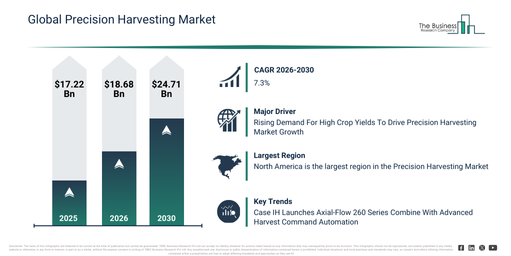
The precision harvesting market has demonstrated significant expansion in recent years. Its valuation is projected to increase from $17.22 billion in 2025 to $18.68 billion in 2026, achieving a compound annual growth rate (CAGR) of 8.4. This historical growth can be attributed to several factors including the rising acceptance of mechanized harvesting, an increasing necessity for enhanced crop recovery rates, the initial deployment of GPS-enabled combine harvesters, escalating labor deficits in agriculture, and the incorporation of semi-automated tools for fruit picking.
The precision harvesting market is projected to see substantial growth over the next few years, with its size expected to reach $24.71 billion by 2030, expanding at a compound annual growth rate (CAGR) of 7.3. This anticipated growth during the forecast period is fueled by several factors, including advancements in AI-driven crop maturity prediction, the increasing adoption of autonomous harvesting robots, the wider application of big data analytics for harvest planning, the growing integration of smart sensors into harvesting systems, and a rising demand for sustainable and low-waste harvesting practices. Significant trends expected in the forecast period include the increasing adoption of automated harvesting machinery, the expanded use of sensor-based crop readiness assessment, the broader implementation of GPS-enabled harvest optimization, the growing incorporation of real-time yield monitoring tools, and a higher demand for techniques that reduce harvesting waste.
Download A Free Sample Report For Comprehensive Market Insights:
Precision Harvesting Market Growth Drivers: What Factors Are Accelerating Expansion?
The future expansion of the precision harvesting market is anticipated, driven by the increasing need for high crop yields. High crop yield refers to the quantity of agricultural produce harvested per unit of cultivated land area, typically measured in weight or volume. This demand is influenced by various factors, including urbanization, climate change, food security, rising incomes, shifting dietary habits, global trade, and overall market requirements. Precision harvesting technologies and practices empower farmers to maximize crop yields by enhancing efficiency, minimizing losses, improving quality, and enabling informed decisions based on real-time data and analytics. For instance, a UK-based report from the Department for Environment, Food & Rural Affairs (UK) in July 2024 revealed that the value of fruit production saw a 2.2 increase, reaching just over $1.25 billion (£1.0 billion). Additionally, barley exports grew to 937 thousand tonnes in 2023 from 898 tonnes in 2022. Sugar beet production also surged by 39 to 7.7 million tonnes, with its production value rising by 82 to $460 million (£368 million), and prices increasing by 31 to $59.38 USD (£47.5) per tonne per hectare. Consequently, the escalating demand for high crop yields is a primary driver for the growth of the precision harvesting market.
Precision Harvesting Market Segmentation: How Is The Market Structured Across Key Categories?
The precision harvesting market covered in this report is segmented –
1) By Product: Combine Harvesters, Harvesting Robots, Self-propelled Forage Harvesters
2) By Offering: Hardware, Software, Services
3) By Application: Crop Harvesting, Greenhouse, Horticulture, Other Applications
Subsegments:
1) By Combine Harvesters: Grain Combine Harvesters, Corn Combine Harvesters, Rice Combine Harvesters, Multi-Crop Combine Harvesters
2) By Harvesting Robots: Fruit-Picking Robots, Vegetable-Picking Robots, Automated Grape Harvesters, Autonomous Berry Harvesters
3) By Self-Propelled Forage Harvesters: Corn Forage Harvesters, Grass Forage Harvesters, Sugarcane Forage Harvesters, Whole-Crop Forage Harvesters
Precision Harvesting Market Transformation Trends: Which Innovations Are Driving Change?
Leading companies in the precision harvesting sector are concentrating on developing advanced products, such as automated harvesting systems, to assist farmers in boosting productivity and financial returns during the intense harvest period. An automated harvesting system involves using sophisticated technologies and machinery to carry out harvesting tasks with minimal human involvement. These systems employ robotics, sensors, artificial intelligence, and other technologies to efficiently and accurately gather crops. For instance, in June 2024, Case IH, a US-based agricultural machinery manufacturer, launched its new Axial-Flow 260 series combine, featuring integrated, subscription-free technology designed to cater to the specific needs of growers. The Axial-Flow 260 series includes harvest command combine automation, which automatically adjusts settings to optimize throughput and grain quality. It comes with high-resolution Pro 1200 Dual Displays, allowing operators to readily monitor machine metrics, field performance, and grain quality in real time. The 260 series offers dual Pro1200 displays that provide intuitive Harvest Command automation technology, advanced guidance, mapping capabilities, and connectivity with other Pro700-enabled machines. The premium technology incorporated within the combine maximizes throughput and grain handling using single-rotor Case IH harvesting technology.
Precision Harvesting Market Competitive Landscape: Who Are The Leading Companies?
Major companies operating in the precision harvesting market are Deere & Company, CNH Industrial NV, KUBOTA Corporation, AGCO Corporation, Trimble Inc., Topcon Corporation, Raven Industries Inc., Precision Planting LLC, TeeJet Technologies, CLAAS KGAA mbH, Kinze Manufacturing Inc., Ag Leader Technology, FarmWise Labs Inc., Clearpath Robotics Inc., Sentera Inc., Farmers Edge Inc., DICKEY-john Corporation, Taranis Visual Ltd., senseFly SA, PrecisionHawk Inc., Octinion NV, VineView Sciences Inc.
Access The Complete Precision Harvesting Market Report:
Precision Harvesting Market Regional Analysis: Which Region Leads By Revenue?
North America was the largest region in the precision harvesting market in 2025. The regions covered in the precision harvesting market report are Asia-Pacific, South East Asia, Western Europe, Eastern Europe, North America, South America, Middle East, Africa.
Access a Customized Precision Harvesting Market Report for Deeper Competitive Insights
Get in touch with us:
The Business Research Company: https://www.thebusinessresearchcompany.com/?utm_source=BlogsPR&utm_medium=Paid&utm_campaign=home_page_test
Americas: +1 310-496-7795
Asia: +44 7882 955267 & +91 8897263534
Europe: +44 7882 955267
Email us at: marketing@tbrc.info
Follow us on:
LinkedIn: https://in.linkedin.com/company/the-business-research-company
YouTube: https://www.youtube.com/channel/UC24_fI0rV8cR5DxlCpgmyFQ
Global Market Model: https://www.thebusinessresearchcompany.com/global-market-model

Wasay has over a decade of experience in market research, data modelling, and analytics, with prior experience at GlobalData and Decision Tree Consulting Services. At The Business Research Company , he leads research operations across syndicated studies, customized consulting engagements, and the Global Market Model platform. His professional experience includes supporting organizations such as Boston Consulting Group, KPMG, and Ernst & Young. Wasay holds a degree in Electronics and Communications Engineering, postgraduate management qualifications from International Management Institute Belgium and Indian School of Business and Entrepreneurship, and completed the Integrated Program in Business Analytics from Indian Institute of Management Indore.