
Delivering more actionable and strategically valuable research, The Business Research Company’s 2026 market reports feature market attractiveness analysis, total addressable market evaluation, company benchmarking matrices, interactive Excel dashboards, expanded supply chain intelligence, emerging startup coverage, and detailed product insights.
Soil Fertility Testing Market Growth From $1.37 Billion In 2026 To $1.76 Billion By 2030 At A CAGR Of 6.4%
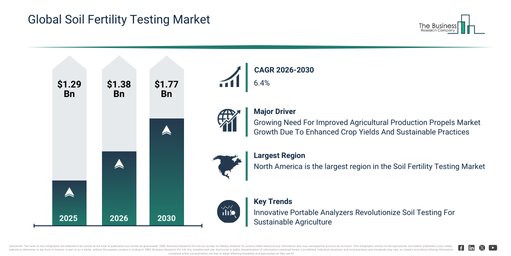
The size of the soil fertility testing market has experienced robust expansion in recent years. This market is projected to expand from $1.29 billion in 2025 to $1.38 billion in 2026, demonstrating a compound annual growth rate (CAGR) of 6.9. Historically, this growth can be ascribed to several factors, including the traditional dependence on manual soil testing, restricted availability of laboratory-based fertility assessments, a growing imperative to enhance crop yield, the initial integration of chemical nutrient testing, and a heightened understanding of soil degradation.
The soil fertility testing market is anticipated to show significant expansion in the coming years. It is projected to increase to $1.77 billion by 2030, achieving a compound annual growth rate (CAGR) of 6.4. This expected growth within the forecast period stems from factors such as the increasing demand for regenerative agriculture practices, the growing adoption of AI-enabled soil analytics, the greater integration of IoT-based soil monitoring tools, a broadened focus on biological soil fertility testing, and heightened investment in predictive soil health management. Key developments during this period are set to include an escalating demand for comprehensive nutrient profiling, the rising use of rapid onsite soil testing kits, advancements in soil health monitoring for regenerative agriculture, the expansion of precision soil mapping across farmlands, and an increased application of soil biological activity assessment.
Download A Free Sample Report For Comprehensive Market Insights:
Soil Fertility Testing Market Industry Drivers: What Is Driving Revenue Growth?
The anticipated expansion of the soil fertility testing market is linked to the increasing demand for enhanced agricultural output. This enhancement in agricultural production denotes greater efficiency and yield in both crops and livestock, attained through modern techniques, technologies, and sustainable approaches. Several factors contribute to this escalating requirement for better agricultural yield, including a surging global population, higher food consumption, reduction in cultivable land due to urban growth, and climate change issues necessitating robust crop types. Soil fertility testing plays a crucial role in boosting agricultural output by providing vital information on soil conditions and nutrient levels, enabling farmers to refine fertilizer use, increase crop yields, and adopt sustainable methods that enhance productivity while minimizing environmental impact. As an illustration, the International Food Security Assessment (IFSA), published by the USDA’s Economic Research Service (ERS), a key US agency, projected in October 2024 that global food demand would increase by an average of 2.8 annually over the next ten years, with Sub-Saharan Africa experiencing the highest growth at 3.9 per year. Consequently, the increased imperative for enhanced agricultural production is stimulating the soil fertility testing market.
Soil Fertility Testing Market Segmentation: How Is The Market Structured Across Key Categories?
The soil fertility testing market covered in this report is segmented –
1) By Product Type: Physical Testing, Chemical Testing, Biological Testing
2) By Method: Onsite, Offsite Or Laboratory
3) By Application: Structure Of Soil, Aeration In Soil, Drainage In Soil, Chemical Fertility Of Soil
4) By End-Use Industry: Agriculture And Horticulture, Forestry, Environmental Monitoring And Research
Subsegments:
1) By Physical Testing: Soil Texture Analysis, Bulk Density Measurement, Water Retention Capacity Test, Soil Compaction Assessment
2) By Chemical Testing: pH Level Testing, Nutrient Content Analysis (NPK Testing), Organic Matter Analysis, Salinity And Electrical Conductivity Testing
3) By Biological Testing: Microbial Biomass Analysis, Soil Respiration Test, Enzyme Activity Assessment, Nematode And Beneficial Microorganism Analysis
Soil Fertility Testing Market Innovation Trends Driving Future Development
Companies active in the soil fertility testing market are concentrating on creating innovative products, such as portable soil nutrient analyzers, to provide farmers with immediate soil health insights for improved nutrient management and sustainable agricultural methods. A portable soil nutrient analyzer is a compact tool designed to quickly measure and analyze the nutrient content of soil in real time, frequently utilizing technologies like near-infrared spectroscopy or smartphone applications for ease of use and instant results. For instance, in November 2024, the Indian Institute of Technology Kanpur (IIT-K), an India-based engineering and technology institute, launched the Soil Nutrient Sensing Device, a compact, smartphone-compatible device that supports up to 250 tests on a single charge. This device addresses the gap in timely soil testing for Indian farmers and was made accessible through a technology transfer MoU with ScaNxt Scientific Technologies Private Limited. This innovative device employs near-infrared (NIR) spectroscopy to deliver real-time soil health data on a smartphone, removing the necessity for chemical reagents and complicated testing methods. By facilitating accurate nutrient management, the technology has the potential to revolutionize agriculture, boosting crop yields, minimizing fertilizer waste, and promoting both higher farmer incomes and environmental sustainability.
Soil Fertility Testing Market Competitive Landscape: Who Are The Leading Companies?
Major companies operating in the soil fertility testing market are Yara International ASA, SGS SA, Eurofins Scientific SE, Intertek Group plc, ALS Ltd., A&L Great Lakes, AgroLab Group, Activation Laboratories Ltd. (Actlabs), Midwest Laboratories, AgSource, Deveron, Spectrum Analytic Inc., Waters Agricultural Laboratories Inc., Agvise Laboratories Inc., Waypoint Analytics, Anacon Laboratories, Polytest Laboratories, Crop Nutrition Laboratory Services Ltd., Ward Laboratories Inc., Tamilnadu Test House Pvt. Ltd., Kinsey Agricultural Services, AgroCares, Logan Labs, Brookside Laboratories Inc.
Access The Complete Soil Fertility Testing Market Report:
Soil Fertility Testing Market Global Footprint: Which Region Holds Market Leadership?
North America was the largest region in the soil fertility testing market in 2025. The regions covered in the soil fertility testing market report are Asia-Pacific, South East Asia, Western Europe, Eastern Europe, North America, South America, Middle East, Africa.
Access a Customized Soil Fertility Testing Market Report for Deeper Competitive Insights
Get in touch with us:
The Business Research Company: https://www.thebusinessresearchcompany.com/?utm_source=BlogsPR&utm_medium=Paid&utm_campaign=home_page_test
Americas: +1 310-496-7795
Asia: +44 7882 955267 & +91 8897263534
Europe: +44 7882 955267
Email us at: marketing@tbrc.info
Follow us on:
LinkedIn: https://in.linkedin.com/company/the-business-research-company
YouTube: https://www.youtube.com/channel/UC24_fI0rV8cR5DxlCpgmyFQ
Global Market Model: https://www.thebusinessresearchcompany.com/global-market-model

Wasay has over a decade of experience in market research, data modelling, and analytics, with prior experience at GlobalData and Decision Tree Consulting Services. At The Business Research Company , he leads research operations across syndicated studies, customized consulting engagements, and the Global Market Model platform. His professional experience includes supporting organizations such as Boston Consulting Group, KPMG, and Ernst & Young. Wasay holds a degree in Electronics and Communications Engineering, postgraduate management qualifications from International Management Institute Belgium and Indian School of Business and Entrepreneurship, and completed the Integrated Program in Business Analytics from Indian Institute of Management Indore.