With a focus on actionable insights and strategic value, The Business Research Company’s 2026 market reports include market attractiveness scoring, total addressable market sizing, company benchmarking matrices, interactive Excel dashboards, deeper supply chain intelligence, emerging startup tracking, and granular product-level insights.
Space-Based Precision Agriculture Market Size Forecast Points To $9.16 Billion In Revenue By 2030
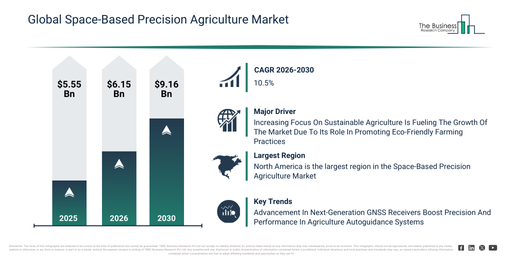
The space-based precision agriculture market has shown significant growth in recent years. Its value is expected to rise from $5.55 billion in 2025 to $6.15 billion in 2026, achieving a compound annual growth rate (CAGR) of 10.8%. This historical expansion can be attributed to the initial embrace of remote sensing for agricultural purposes, a growing necessity for monitoring large land areas, increased understanding of climate variability’s impact, reliance on satellite-based mapping systems, and the increase in government-supported geospatial programs.
The space-based precision agriculture market is projected for significant expansion over the coming years, reaching $9.16 billion by 2030, exhibiting a compound annual growth rate (CAGR) of 10.5%. This anticipated growth during the forecast period is fueled by several factors, including increasing demand for optimized precision agriculture, greater investment in satellite constellations, the expanding integration of AI-based geospatial analytics, the broadening of global food security initiatives, and enhanced cooperation between the space and agriculture industries. Key developments expected during this period involve a surge in the application of high-resolution satellite data for crop analysis, an increase in space-derived weather and soil information, wider adoption of satellite-enabled variable rate applications, greater incorporation of satellite connectivity into farm machinery, and a heightened emphasis on space-supported climate risk mitigation.
Get A Free Space-Based Precision Agriculture Market Sample Covering Drivers, Trends And Key Players:
Space-Based Precision Agriculture Market Driver Analysis: Key Factor Supporting Revenue Growth
A heightened emphasis on sustainable agricultural practices is anticipated to fuel the expansion of the space-based precision agriculture market in the future. This agricultural approach involves cultivating food to meet current needs without jeopardizing the long-term well-being of natural resources and ecosystems. The adoption of sustainable agriculture is increasing because of escalating environmental worries, given that traditional farming methods lead to issues like soil erosion, water shortages, and climate change, thus encouraging a move to environmentally conscious methods. Through the use of satellite imagery and remote sensing, space-based precision agriculture accurately monitors the state of crops, soil, and water. Such capabilities enable farmers to optimize resource utilization, reduce waste, and enhance productivity, contributing to more sustainable cultivation. For example, in December 2023, the World Bank Group, a US-based international financial institution, announced an initiative planned over the next five years that will support 30,000 farming households in implementing climate-smart, water-efficient methods, alongside offering specific training and creating approximately 12,000 jobs. Consequently, the growing emphasis on sustainable agricultural techniques is fueling the expansion of the space-based precision agriculture market.
Space-Based Precision Agriculture Market Segmentation Framework: Major Segments At A Glance
The space-based precision agriculture market covered in this report is segmented –
1) By Component: Hardware, Software, Services
2) By Technology: Remote Sensing, Global Positioning System (GPS), Geographic Information System (GIS), Satellite Imagery, Other Technologies
3) By Application: Crop Monitoring, Soil Health Monitoring, Yield Mapping, Irrigation Management, Other Applications
4) By End-User: Farmers, Agribusinesses, Research Institutions, Other End-Users
Subsegments:
1) By Hardware: Global Navigation Satellite System (GNSS) Or Global Positioning System (GPS) Devices, Satellite Sensors, Remote Sensing Equipment, Yield Monitors, Variable Rate Technology (VRT) Equipment, Control Systems, Display Devices, Drones With Satellite Connectivity, Soil And Weather Sensors
2) By Software: Data Management Software, Imaging And Mapping Software, Farm Management Software, Geospatial Analytics Tools, Variable Rate Application Software, Remote Monitoring And Diagnostic Tools, Artificial Intelligence (AI)-Based Predictive Analytics Platforms
3) By Services: Satellite Imagery And Mapping Services, Data Analytics And Advisory Services, Installation And Integration Services, Maintenance And Support Services, Consulting And Training Services, Data-As-A-Service (DaaS), Cloud-Based Crop Monitoring Services
Latest Space-Based Precision Agriculture Market Developments And Emerging Trends
Leading firms in the space-based precision agriculture market are concentrating on creating sophisticated product innovations, including global navigation satellite system (GNSS) receivers, to improve the accuracy of field mapping and increase yields while simultaneously lowering input expenses. A global navigation satellite system (GNSS) receiver functions by acquiring satellite signals to determine precise location and time, thereby offering the accurate navigation and positioning crucial for uses like precision agriculture. As an illustration, PTx Trimble, a US-based company supplying connected precision farming solutions, launched NAV-960, a next-generation guidance controller, in April 2025. This controller is engineered for precise autoguidance in agricultural settings, providing substantial improvements compared to its forerunner, the NAV-900. These enhancements include greater processing power, better positioning accuracy (with vehicle positioning and line following improved by up to 50%), and dependable operation in challenging conditions. Its principal characteristics encompass advanced inertial sensors, the newest GNSS engine, integrated Trimble ProPoint and IonoGuard technology for countering solar interference, centimeter-level accuracy achievable with correction signals, and complete compatibility with current PTx Trimble steering systems and GFX displays.
Which Companies Are Shaping The Space-Based Precision Agriculture Market?
Major companies operating in the space-based precision agriculture market are Airbus SE, John Deere, CNH Industrial, Maxar Technologies Inc., Planet Labs Inc., ICEYE Ltd., Spire Global Inc., BlackSky Technology Inc., AG Leader Technology, Taranis Inc, CropX Inc., SatSure, OneSoil, Satelligence, Agremo, Gamaya SA, AgriEdge, GeoOptics Inc., Eos Data Analytics, Climate FieldView, Farmonaut Technologies Pvt. Ltd.
Dive Deeper Into The Space-Based Precision Agriculture Market With The Full Report:
Space-Based Precision Agriculture Market Regional Distribution: Where Is Revenue Concentrated?
North America was the largest region in the space-based precision agriculture market in 2025. Asia-Pacific is expected to be the fastest-growing region in the forecast period. The regions covered in the space-based precision agriculture market report are Asia-Pacific, South East Asia, Western Europe, Eastern Europe, North America, South America, Middle East, Africa.
Reach Out To Our Team:
The Business Research Company: https://www.thebusinessresearchcompany.com/
Americas: +1 310-496-7795
Asia: +44 7882 955267 & +91 8897263534
Europe: +44 7882 955267
Email us at: marketing@tbrc.info
Follow us on:
LinkedIn: https://in.linkedin.com/company/the-business-research-company
YouTube: https://www.youtube.com/channel/UC24_fI0rV8cR5DxlCpgmyFQ
Global Market Model: https://www.thebusinessresearchcompany.com/global-market-model

Wasay has over a decade of experience in market research, data modelling, and analytics, with prior experience at GlobalData and Decision Tree Consulting Services. At The Business Research Company , he leads research operations across syndicated studies, customized consulting engagements, and the Global Market Model platform. His professional experience includes supporting organizations such as Boston Consulting Group, KPMG, and Ernst & Young. Wasay holds a degree in Electronics and Communications Engineering, postgraduate management qualifications from International Management Institute Belgium and Indian School of Business and Entrepreneurship, and completed the Integrated Program in Business Analytics from Indian Institute of Management Indore.