
Enhanced with market attractiveness analysis, total addressable market evaluation, company benchmarking matrices, interactive Excel dashboards, expanded supply chain intelligence, emerging startup coverage, and detailed product insights, The Business Research Company’s 2026 market reports deliver more actionable and strategically valuable research.
Synthetic Biology In Agriculture Market Value Analysis: What Growth Is Expected Over The Forecast Period?
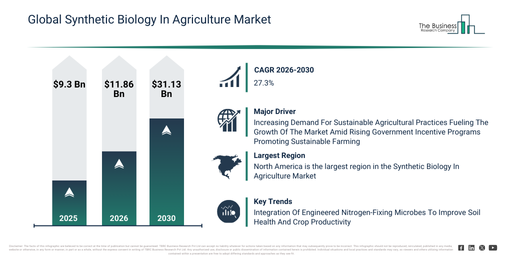
The synthetic biology in agriculture market has seen considerable expansion in recent years. It is anticipated to grow from $9.3 billion in 2025 to $11.86 billion in 2026, achieving a compound annual growth rate (CAGR) of 27.6. The historical growth of this market is attributable to advancements in traditional genetic modification research, a rising demand for high-yield crops, intensified pressure from pests and diseases, the initial integration of biotech into farming, and an increase in agricultural R&D investments.
The synthetic biology in agriculture market is projected to experience substantial growth in the coming years. It is forecast to expand to $31.13 billion by 2030, achieving a compound annual growth rate (CAGR) of 27.3. This projected growth can be attributed to an increasing need for climate-resilient agriculture, the rising adoption of genome editing tools, the broadening applications of synthetic microbes, a growing demand for sustainable farming inputs, and the escalating commercialization of advanced biotech products. Significant trends during the forecast period include the increasing development of pest-resistant crops, wider adoption of synthetic microbes for soil health, the expansion of gene-edited livestock to boost productivity, an increased reliance on synthetic biology for climate-resilient crops, and the ongoing commercialization of bioengineered agricultural inputs.
Download A Free Sample Report For Comprehensive Market Insights:
Synthetic Biology In Agriculture Market Opportunity Drivers: What Is Creating New Revenue Potential?
The future expansion of the synthetic biology in agriculture market is anticipated to be fueled by the rising need for sustainable agricultural practices. These practices are defined as farming techniques designed to fulfill present food and textile requirements without hindering future generations’ capacity to meet their own needs, achieved through resource conservation, soil fertility upkeep, and reducing environmental harm. Their adoption is predominantly increasing because of government initiatives that offer financial incentives to farmers for adopting environmentally sound and resource-efficient cultivation methods. In this context, synthetic biology in agriculture aids sustainable farming by facilitating the creation of bioengineered crops and microorganisms, which boost nutrient efficiency, cut down on chemical usage, and improve soil vitality, leading to increased yields with reduced environmental footprints. An illustration of this trend is seen in England, where active Sustainable Farming Incentive (SFI) agreements reached 32,200 in January 2025, marking a 23 rise from October 2024, as reported in February 2025 by the Department for Environment, Food and Rural Affairs (DEFRA), a UK-based government agency. Consequently, the expanding demand for sustainable agricultural practices is a key driver for the growth of the synthetic biology in agriculture market.
Synthetic Biology In Agriculture Market Segment Outlook: Which Categories Are Expanding The Fastest?
The synthetic biology in agriculture market covered in this report is segmented –
1) By Product Type: Crops, Livestock, Microbes, Other Product Types
2) By Technology: Genome Editing, Pathway Engineering, Deoxyribonucleic Acid (DNA) Synthesis, Other Technologies
3) By Application: Crop Improvement, Pest And Disease Control, Soil Health Management, Livestock Production, Other Applications
4) By End-User: Agricultural Biotechnology Companies, Research Institutes, Farmers, Other End-Users
Subsegments:
1) By Crops: Cereal Crops, Fruit Crops, Vegetable Crops, Oilseed Crops, Fiber Crops, Forage Crops
2) By Livestock: Cattle, Poultry, Swine, Sheep, Goats, Aquaculture Species
3) By Microbes: Bacteria, Yeast, Fungi, Algae, Cyanobacteria, Protozoa
4) By Other Product Types: Insect Cells, Plant Cells, Enzymes, Synthetic Seeds, Biofertilizers, Biopesticides
Synthetic Biology In Agriculture Market Growth Trends Influencing Competitive Dynamics
Leading companies in the synthetic biology in agriculture market are concentrating on developing advanced solutions, such as engineered nitrogen-fixing microbes, to improve soil fertility, enhance nutrient use efficiency, and ensure sustainable yield performance. Engineered nitrogen-fixing microbes refer to microorganisms selected and optimized through synthetic biology tools and microbial engineering to fix atmospheric nitrogen and associate with plant roots, enabling capabilities like nitrogen conversion in the rhizosphere, root colonization, and fertilizer displacement. For instance, in December 2024, BioConsortia, a US-based microbial biotech company, introduced Always-N, a seed-applied microbial nitrogen-fixing treatment designed to reduce synthetic fertilizer use while maintaining or improving yields in crops such as corn and wheat. This product features a shelf life of over two years, on-seed stability, and sustained colonization of plant roots. Always-N aims to enhance nutrient efficiency, lower fertilizer costs, and promote environmental sustainability, demonstrating how synthetic biology is being applied to practical agricultural solutions.
Synthetic Biology In Agriculture Market Key Players: Which Companies Shape Industry Competition?
Major companies operating in the synthetic biology in agriculture market are BASF SE, Bayer AG, Corteva Agriscience LLC, KWS Saat Societas Europaea, Twist Bioscience Corporation, Ginkgo Bioworks Incorporated, Benson Hill Incorporated, Pivot Bio Incorporated, Cibus Incorporated, Inari Agriculture Incorporated, Tropic Biosciences United Kingdom Limited, Pairwise Plants Incorporated, Ansa Biotechnologies Incorporated, Arzeda Corporation, GreenLight Biosciences Incorporated, Evogene Limited, Aromyx Corporation, Arcadia Biosciences Incorporated, AquaBounty Technologies Incorporated, Yield10 Bioscience Incorporated.
Access The Complete Synthetic Biology In Agriculture Market Report:
Synthetic Biology In Agriculture Market Regional Distribution: Which Areas Drive Market Expansion?
North America was the largest region in the synthetic biology in agriculture market in 2025. Asia-Pacific is expected to be the fastest-growing region in the forecast period. The regions covered in the synthetic biology in agriculture market report are Asia-Pacific, South East Asia, Western Europe, Eastern Europe, North America, South America, Middle East, Africa.
Access a Customized Synthetic Biology In Agriculture Market Report for Deeper Competitive Insights
Get in touch with us:
The Business Research Company: https://www.thebusinessresearchcompany.com/?utm_source=BlogsPR&utm_medium=Paid&utm_campaign=home_page_test
Americas: +1 310-496-7795
Asia: +44 7882 955267 & +91 8897263534
Europe: +44 7882 955267
Email us at: marketing@tbrc.info
Follow us on:
LinkedIn: https://in.linkedin.com/company/the-business-research-company
YouTube: https://www.youtube.com/channel/UC24_fI0rV8cR5DxlCpgmyFQ
Global Market Model: https://www.thebusinessresearchcompany.com/global-market-model

Wasay has over a decade of experience in market research, data modelling, and analytics, with prior experience at GlobalData and Decision Tree Consulting Services. At The Business Research Company , he leads research operations across syndicated studies, customized consulting engagements, and the Global Market Model platform. His professional experience includes supporting organizations such as Boston Consulting Group, KPMG, and Ernst & Young. Wasay holds a degree in Electronics and Communications Engineering, postgraduate management qualifications from International Management Institute Belgium and Indian School of Business and Entrepreneurship, and completed the Integrated Program in Business Analytics from Indian Institute of Management Indore.