
Delivering more actionable and strategically valuable research, The Business Research Company’s 2026 market reports feature market attractiveness analysis, total addressable market evaluation, company benchmarking matrices, interactive Excel dashboards, expanded supply chain intelligence, emerging startup coverage, and detailed product insights.
Vertical Farming Market Size Forecast: How Large Could The Market Become By 2030?
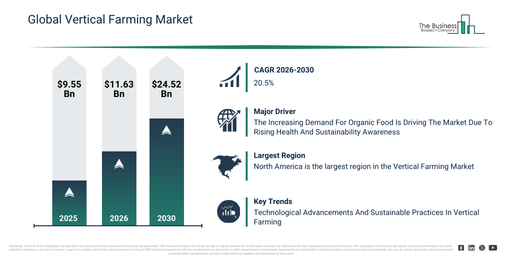
The vertical farming market has seen an exponential expansion in its size over recent years. Projections indicate it will grow from $9.55 billion in 2025 to $11.63 billion in 2026, achieving a compound annual growth rate (CAGR) of 21.8. The historic period’s growth can be linked to the limited availability of arable land, rising urban population density, early adoption of hydroponic systems, the demand for pesticide-free produce, and an increase in indoor farming practices.
The vertical farming market is anticipated to undergo substantial expansion over the next few years. It is forecast to achieve a valuation of $24.52 billion by 2030, exhibiting a compound annual growth rate (CAGR) of 20.5. This growth during the projected period stems from a heightened emphasis on food security, the proliferation of climate-resilient agriculture, a surging demand for high-yielding vertical farms, the embrace of resource-efficient cultivation practices, and an increase in urban commercial farming endeavors. Prominent trends for the forecast period include the increasing uptake of layer-based crop production, the expanding utilization of hydroponic and aeroponic systems, a greater focus on soil-free cultivation techniques, the enlargement of controlled environment farming, and a rising demand for pollution-free urban cultivation.
Download A Free Sample Report For Comprehensive Market Insights:
#Vertical Farming Market Growth Drivers And Industry Catalysts
The vertical farming market is anticipated to expand propelled by the rising demand for organic food. Organic food encompasses agricultural products grown and processed without synthetic fertilizers, chemical pesticides, genetically modified organisms, or artificial additives, instead adhering to methods that promote ecological balance and conserve biodiversity. The heightened need for organic food primarily stems from increasing consumer consciousness regarding health and environmental sustainability, as individuals progressively link organic items with safer consumption, enhanced nutritional value, and responsible production practices that minimize ecological harm. Vertical farming supports this growing demand by enabling the efficient, pesticide-free cultivation of organic produce within controlled environments, thereby ensuring consistent quality, minimized resource consumption, and a year-round sustainable supply. For instance, in August 2024, data from the United States Department of Agriculture, a US-based government agency, indicated that in 2023, consumer demand for organic products in the U.S. exceeded $69 billion, accounting for approximately 4 of the country’s total food sales. Thus, the escalating demand for organic food is driving the growth of the vertical farming market.
Vertical Farming Market Segment Outlook: Which Categories Are Expanding The Fastest?
The vertical farming market covered in this report is segmented –
1) By Component: Irrigation Component, Lighting, Sensor, Climate Control, Building Material, Other Components
2) By Structure: Shipping Container, Building-Based
3) By Type: Hydroponics, Aeroponics, Aquaponics
4) By Crop Type: Leafy Green, Pollinated Plants, Nutraceutical Plant
5) By Application: Indoor, Outdoor
Subsegments:
1) By Irrigation Component: Drip Irrigation Systems, Hydroponic Systems, Nutrient Delivery Systems
2) By Lighting: Led Grow Lights, High-Intensity Discharge (Hid) Lights, Fluorescent Lights
3) By Sensor: Soil Moisture Sensors, Temperature And Humidity Sensors, Light Sensors
4) By Climate Control: Hvac Systems, Dehumidifiers, Fans And Ventilation Systems
5) By Building Material: Racks And Shelving, Containers And Growing Media, Enclosures And Walls
6) By Other Components: Automation Systems, Monitoring And Control Software, Energy Management Systems
Vertical Farming Market Trends Driving Strategic Industry Expansion
Major entities within the vertical farming market are prioritizing technological advancements, such as vertical farming solutions housed in modular containers, which are designed to optimize both space and resources for efficient crop production. Vertical farming itself is defined as the cultivation of crops in stacked layers within controlled environments, utilizing methods like hydroponics to maximize space and enhance sustainability. For example, in October 2024, Growtainers, a U.S.-based vertical farm company operating with 30-60 lower CapEx than other farms, specializes in modular farming solutions, emphasizing efficient and sustainable agricultural practices. This specific vertical farm operates with 30-60 lower capital expenditure than traditional farms and integrates a modular design, energy efficiency achieved through LED lighting, hydroponic systems for soil-less cultivation, automated monitoring, sustainability practices, year-round production capabilities, and scalability to meet increasing demand.
Vertical Farming Market Key Players: Which Companies Shape Industry Competition?
Major companies operating in the vertical farming market are Philips Lighting N.V., Osram AG, Everlight Electronics Co Ltd., Infarms Indoor Forming GmbH, Spread Group GmbH, Bowery Farming Inc., Plenty Unlimited Inc., BrightFarms Inc., Mirai Co Ltd., Intelligent Growth Solutions Ltd., Freight Farms Inc., AeroFarms, General Hydroponics Inc., Agricool Group, CropOne Holdings Inc., CropOne Holdings Inc, AppHarvest Inc., Vertical Future Ltd., Valoya Inc., Kalera Public Limited Company, Agrilution Systems GmbH, American Hydroponics Inc., Square Mile Farms Ltd., Swegreen AB, Green Sense Farms Holdings Inc., Hort Americas LLC, Urban Crop Solutions, Eden Green Technology, Illumitex Inc., Heliospectra AB, Future Crops Vertical Farming B.V., Sky Urban Solutions Holding Pte Ltd.
Access The Complete Vertical Farming Market Report:
Vertical Farming Market Geographic Analysis: Where Is Demand Growing The Fastest?
North America was the largest region in the vertical farming market in 2025. Europe is expected to be the fastest-growing region in the forecast period. The regions covered in the vertical farming market report are Asia-Pacific, South East Asia, Western Europe, Eastern Europe, North America, South America, Middle East, Africa.
Access a Customized Vertical Farming Market Report for Deeper Competitive Insights
Get in touch with us:
The Business Research Company: https://www.thebusinessresearchcompany.com/?utm_source=BlogsPR&utm_medium=Paid&utm_campaign=home_page_test
Americas: +1 310-496-7795
Asia: +44 7882 955267 & +91 8897263534
Europe: +44 7882 955267
Email us at: marketing@tbrc.info
Follow us on:
LinkedIn: https://in.linkedin.com/company/the-business-research-company
YouTube: https://www.youtube.com/channel/UC24_fI0rV8cR5DxlCpgmyFQ
Global Market Model: https://www.thebusinessresearchcompany.com/global-market-model

Wasay has over a decade of experience in market research, data modelling, and analytics, with prior experience at GlobalData and Decision Tree Consulting Services. At The Business Research Company , he leads research operations across syndicated studies, customized consulting engagements, and the Global Market Model platform. His professional experience includes supporting organizations such as Boston Consulting Group, KPMG, and Ernst & Young. Wasay holds a degree in Electronics and Communications Engineering, postgraduate management qualifications from International Management Institute Belgium and Indian School of Business and Entrepreneurship, and completed the Integrated Program in Business Analytics from Indian Institute of Management Indore.