
Enhanced with market attractiveness analysis, total addressable market evaluation, company benchmarking matrices, interactive Excel dashboards, expanded supply chain intelligence, emerging startup coverage, and detailed product insights, The Business Research Company’s 2026 market reports deliver more actionable and strategically valuable research.
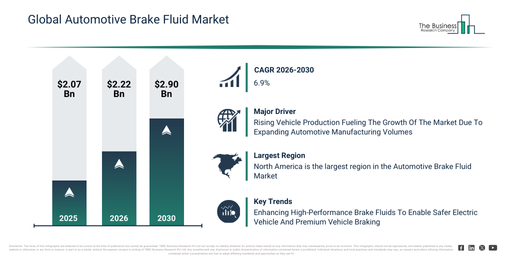
Automotive Brake Fluid Market Growth From $2.22 Billion In 2026 To $2.9 Billion By 2030 At A CAGR Of 6.9%
The automotive brake fluid market size has shown robust expansion in recent years. It is anticipated to expand from $2.07 billion in 2025 to $2.22 billion in 2026, achieving a compound annual growth rate (CAGR) of 7.2%. This historical growth can be attributed to several factors, including an increase in vehicle production and overall fleet size, a surge in vehicle sales within emerging economies, heightened recognition of vehicle safety and maintenance needs, rigorous safety standards for braking systems, and the broader adoption of commercial and heavy-duty vehicles.
The automotive brake fluid market is anticipated to experience substantial expansion over the coming years. This market is projected to reach $2.90 billion by 2030, exhibiting a compound annual growth rate (CAGR) of 6.9%. This projected growth is driven by several factors, including a rise in global vehicle manufacturing, an escalating need for sophisticated braking systems, more frequent replacements as vehicle fleets age, the proliferation of electric and hybrid vehicles, and a heightened focus on safety regulations and maintenance protocols. Key trends for the forecast duration involve a move towards high-performance synthetic brake fluids, the creation of environmentally friendly or bio-based brake fluids, advancements in fluid compositions (such as improved thermal stability and corrosion resistance), the necessity for brake fluids suitable for electric, hybrid, and advanced braking systems, and the incorporation of intelligent diagnostics and fluid-management technologies into these systems.
Download A Free Sample Report For Comprehensive Market Insights:
Automotive Brake Fluid Market Growth Momentum: Which Factors Are Influencing Demand?
Increased vehicle production is anticipated to boost the growth of the automotive brake fluid market in the future. Vehicle production refers to the manufacturing and assembly processes for motor vehicles, including passenger cars, trucks, and commercial transport vehicles. This increase in vehicle production is attributed to the rising consumer demand for both personal and commercial transportation. Automotive brake fluid is essential for vehicle production, as it ensures dependable hydraulic braking performance that complies with safety regulations across diverse temperatures and driving conditions, thereby enabling manufacturers to supply durable and compliant braking systems in mass-produced vehicles. For example, in January 2025, according to the State Council Information Office (SCIO) of the People’s Republic of China, a China-based government agency, China’s auto sector achieved a significant milestone in 2024, with both production and sales exceeding 31 million units. Total auto output reached 31.28 million units, an increase of 3.7% compared with 2023, while sales saw a 4.5% year-on-year rise to 31.44 million units. Thus, the growing volume of vehicle production is propelling the expansion of the automotive brake fluid market.
Automotive Brake Fluid Market Segments: Where Are The Largest Growth Opportunities?
The automotive brake fluid market covered in this report is segmented –
1) By Product Type Or Composition: DOT 3 (Glycol-Based), DOT 4 (Glycol-Based), DOT 5 (Silicone-Based), DOT 5.1 (Glycol-Based), Other Product Types Or Compositions
2) By Vehicle Type: Passenger Cars, Light Commercial Vehicles (LCVs), Heavy Commercial Vehicles (HCVs), Electric Vehicles (EVs), Hybrid Vehicles, Two-Wheelers
3) By Sales Channel: OEM (Original Equipment Manufacturer), Aftermarket
4) By Application In Braking System: Disc Brakes, Drum Brakes, Advanced Systems (ABS, ESC, Regenerative Braking)
5) By End-User: Authorized Service Centers, Independent Workshops, Fleet Operators, DIY Consumers
Subsegments:
1) By DOT 3 (Glycol-Based): Mineral Oil, Synthetic, Semi-Synthetic
2) By DOT 4 (Glycol-Based): Mineral Oil, Synthetic, Semi-Synthetic
3) By DOT 5 (Silicone-Based): Polydimethylsiloxane, Blended Silicone, High Performance Silicone
4) By DOT 5.1 (Glycol-Based): Mineral Oil, Synthetic, Semi-Synthetic
5) By Other Product Types Or Compositions: Mineral Oil–Based Brake Fluids, Bio-Based Brake Fluids, Specialty And Custom Formulations
Automotive Brake Fluid Market Trends Reshaping Industry Growth
Leading companies within the automotive brake fluid market are concentrating on developing advanced products, such as high-performance fully synthetic brake fluids, to improve braking safety, reliability, and compatibility with next-generation electric and premium vehicles. These high-performance fully synthetic brake fluids incorporate advanced boronic acid esterification chemistry, elevated boiling points, stable viscosity at low temperatures, and oxidation-resistant molecular structures, ensuring optimal performance under extreme heat, cold, and heavy-duty braking conditions. For instance, in October 2024, Jiangsu Lopal Tech Group Co. Ltd., a China-based automotive lubricants company, introduced its Class7 High-Performance Fully Synthetic Brake Fluid, targeting both new energy vehicles (NEVs) and premium fuel-powered cars. The product is compatible with electronic hydraulic braking (EHB) and other advanced braking systems, offering high-temperature stability, cold-weather performance down to -50°C, and corrosion resistance, thus facilitating safer, more responsive, and compact braking systems for modern vehicles.
Automotive Brake Fluid Market Major Participants And Competitive Dynamics
Major companies operating in the automotive brake fluid market are Sinopec, Exxon Mobil Corporation, TotalEnergies SE, BP p.l.c., Chevron Corporation, Robert Bosch GmbH, BASF SE, Repsol S.A., FUCHS SE, Valvoline Inc., LIQUI MOLY GmbH, Gulf Oil Lubricants India Limited, Golden Cruiser Lubricants, Prestone Products Corporation, Hi-Tec Oils Pty Ltd, Third Coast Chemicals LLC, Orthene Chemicals Ltd, Motul Asia Pacific Pte. Ltd., Technical Lubricants Internation B.V, KD Finechem Private Limited
Access The Complete Automotive Brake Fluid Market Report:
Automotive Brake Fluid Market Largest Region By Revenue And Market Share
North America was the largest region in the automotive brake fluid market in 2025. Asia-Pacific is expected to be the fastest-growing region in the forecast period. The regions covered in the automotive brake fluid market report are Asia-Pacific, South East Asia, Western Europe, Eastern Europe, North America, South America, Middle East, Africa.
Get in touch with us:
The Business Research Company: https://www.thebusinessresearchcompany.com/
Americas: +1 310-496-7795
Asia: +44 7882 955267 & +91 8897263534
Europe: +44 7882 955267
Email us at: marketing@tbrc.info
Follow us on:
LinkedIn: https://in.linkedin.com/company/the-business-research-company
YouTube: https://www.youtube.com/channel/UC24_fI0rV8cR5DxlCpgmyFQ
Global Market Model: https://www.thebusinessresearchcompany.com/global-market-model

Wasay has over a decade of experience in market research, data modelling, and analytics, with prior experience at GlobalData and Decision Tree Consulting Services. At The Business Research Company , he leads research operations across syndicated studies, customized consulting engagements, and the Global Market Model platform. His professional experience includes supporting organizations such as Boston Consulting Group, KPMG, and Ernst & Young. Wasay holds a degree in Electronics and Communications Engineering, postgraduate management qualifications from International Management Institute Belgium and Indian School of Business and Entrepreneurship, and completed the Integrated Program in Business Analytics from Indian Institute of Management Indore.