The Business Research Company’s 2026 market reports combine market attractiveness scoring, total addressable market sizing, company benchmarking matrices, interactive Excel dashboards, deeper supply chain intelligence, emerging startup tracking, and granular product-level insights to deliver research that is more actionable and strategically valuable.
Is The Baby Powder Market Expanding? Latest Size Estimates And 2030 Projections
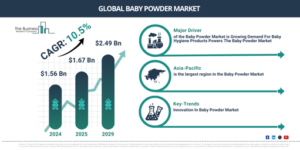
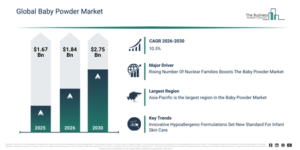
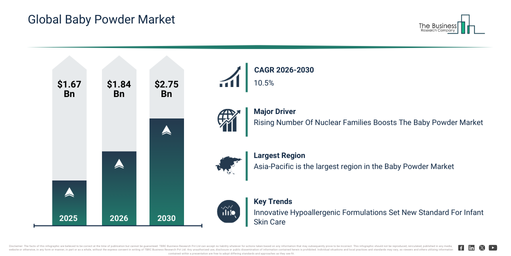
The baby powder market has seen rapid expansion in recent years. Its size is expected to increase from $1.67 billion in 2025 to $1.84 billion in 2026, achieving a compound annual growth rate (CAGR) of 10.6%. Historically, this growth can be attributed to heightened awareness of infant skin health, a rise in personal hygiene product consumption, the broadening of baby care product portfolios, the availability of talc-based formulations, and greater retail penetration.
The baby powder market is projected for significant expansion over the coming years, reaching a valuation of $2.75 billion by 2030, demonstrating a compound annual growth rate (CAGR) of 10.5%. This anticipated growth during the forecast period is driven by several factors, including the greater uptake of talc-free options, a growing consumer demand for clean-label items, the broadening range of premium baby hygiene products, increased regulatory oversight on product ingredients, and a heightened emphasis on plant-based formulas. Key trends expected to shape the market during this time encompass a move towards talc-free baby powders, a surging interest in natural and organic components, a stronger emphasis on products proven safe for skin, the development of more cornstarch-based formulations, and improved clarity in ingredient information.
Free Baby Powder Market Sample: Market Size, Growth Drivers And Competitive Landscape:
Baby Powder Market Drivers Explained: What Is Supporting A 10.5% CAGR?
A rise in the prevalence of nuclear families is anticipated to drive the expansion of the baby powder market in the future. This family structure comprises a household where two generations reside together, typically a married or cohabiting couple acting as parents, along with their dependent offspring. Within these family settings, baby powder serves as a widely utilized product for maintaining infant hygiene, absorbing dampness, and guarding against diaper rash. For example, data from November 2024, released by the Census Bureau, a US-based government entity, indicated that in 2024, nearly 74% of all family households were married-couple households. Consequently, the growing number of nuclear families is a key factor propelling the growth of the baby powder market.
Baby Powder Market Segment Guide: Main Divisions And Subsegments
The baby powder market covered in this report is segmented –
1) By Product: Talc-Based, Talc-Free
2) By Distribution Channel: Online, Offline
3) By End User: Infant, Toddler
Subsegments:
1) By Talc-Based: Talc Powder, Talc with Additional Ingredients
2) By Talc-Free: Cornstarch-Based Powder, Arrowroot Powder, Rice Powder, Other Natural Powders
Baby Powder Market Trends And Opportunities For 2026–2030
Leading companies in the baby powder market are focusing on creating advanced solutions, including hypoallergenic formulations, to ensure infants have access to products that are safer, milder, and more suitable for their skin. Hypoallergenic formulations are specifically designed to minimize the risk of causing allergic reactions. For example, in October 2025, Remark HB Limited, an India-based health and beauty firm, launched Bangladesh’s first 100% safe cornstarch baby powder. This product is formulated without talc or chemical additives, providing a natural and gentle alternative for delicate baby skin. The powder quickly attracted attention from parents and caregivers due to its hypoallergenic and skin-friendly qualities. It underwent rigorous safety and quality evaluations in various laboratories to confirm it meets international standards for infant care. With this introduction, Remark HB Limited aims to strengthen its presence in the Bangladesh baby care market while promoting safer, natural alternatives to traditional talc-based powders.
Which Major Players Are Active In The Baby Powder Market?
Major companies operating in the baby powder market are Johnson & Johnson, Pigeon Corporation, Prestige Brands Holdings Inc., Burt’s Bees, Mothercare, PZ Cussons, Himalaya Drug Company Pvt Ltd, Sebapharma GmbH & Co. KG, Kimberly-Clark Corporation, Mee Mee, Chattem Inc., GLÜKi Organics, Beiersdorf AG, Church & Dwight Co. Inc., Goodbaby International Holdings Limited, Gerber Products Company, Naterra International Inc., Unilever plc, Chicco, Artsana USA Inc., Bathtime Kids, Libero, Lion Corporation, Mamaearth, Mann & Schröder GmbH, Dabur Ltd, Oriflame Cosmetics
Unlock The Complete Baby Powder Market Report With Company Benchmarking:
Baby Powder Market World Regions Compared: Which Leads In Revenue?
Asia-Pacific was the largest region in the baby powder market in 2025. Asia-Pacific is expected to be the fastest-growing region in the forecast period. The regions covered in the baby powder market report are Asia-Pacific, South East Asia, Western Europe, Eastern Europe, North America, South America, Middle East, Africa
Reach Out To Our Team:
The Business Research Company: https://www.thebusinessresearchcompany.com/
Americas: +1 310-496-7795
Asia: +44 7882 955267 & +91 8897263534
Europe: +44 7882 955267
Email us at: marketing@tbrc.info
Follow us on:
LinkedIn: https://in.linkedin.com/company/the-business-research-company
YouTube: https://www.youtube.com/channel/UC24_fI0rV8cR5DxlCpgmyFQ
Global Market Model: https://www.thebusinessresearchcompany.com/global-market-model

Wasay has over a decade of experience in market research, data modelling, and analytics, with prior experience at GlobalData and Decision Tree Consulting Services. At The Business Research Company , he leads research operations across syndicated studies, customized consulting engagements, and the Global Market Model platform. His professional experience includes supporting organizations such as Boston Consulting Group, KPMG, and Ernst & Young. Wasay holds a degree in Electronics and Communications Engineering, postgraduate management qualifications from International Management Institute Belgium and Indian School of Business and Entrepreneurship, and completed the Integrated Program in Business Analytics from Indian Institute of Management Indore.