Enhanced with market attractiveness analysis, total addressable market evaluation, company benchmarking matrices, interactive Excel dashboards, expanded supply chain intelligence, emerging startup coverage, and detailed product insights, The Business Research Company’s 2026 market reports deliver more actionable and strategically valuable research.
Bio-Based Propylene Glycol Market Growth Potential: How Will Market Size Change Through 2030?
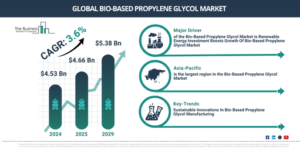
A steady increase in the market size for bio-based propylene glycol has been observed over recent years. This market is expected to expand from $4.66 billion in 2025 to $4.84 billion in 2026, exhibiting a compound annual growth rate (CAGR) of 3.9%. The growth seen in the past was due to the reliance on fossil-based glycols, demand within food and beverage processing, increased adoption in antifreeze applications, usage as industrial solvents, and the need for construction chemicals.
The bio-based propylene glycol market is predicted to see steady growth in the years ahead. By 2030, this market is expected to achieve a valuation of $5.54 billion, growing at a compound annual rate (CAGR) of 3.4%. Driving this projected expansion are several key elements, such as sustainability mandates, increased investment in bio-based chemical production, rising need for low-toxicity solvents, the spread of green building projects, and innovations in automotive coolant technology. Notable trends foreseen for this timeframe include the growing adoption of bio-based chemical substitutes, elevated demand within the food and cosmetics industries, wider accessibility of environmentally friendly antifreeze products, broader usage in sustainable building components, and a focus on sourcing renewable raw materials.
Download A Free Sample Report For Comprehensive Market Insights:
Bio-Based Propylene Glycol Market Growth Drivers: What Factors Are Accelerating Expansion?
The increasing financial commitment to renewable energy sources is anticipated to stimulate the expansion of the bio-based propylene glycol market in the future. This investment involves the allocation of funds towards sustainable power options like wind, solar, hydro, and biomass. Such growing investment indicates a global transition towards sustainable and eco-friendly power generation. It has also boosted the manufacturing of bio-based propylene glycol by fostering the creation of sustainable methods that utilize bio-based feedstocks. For example, in May 2023, the International Energy Agency, a France-based intergovernmental organization, reported that worldwide clean energy investment rose from $1,617 billion in 2022 to $1,740 billion in 2023, demonstrating a minor shift in financial resources towards sustainable energy solutions. Consequently, the rising investment in renewable energy is propelling the advancement of the bio-based propylene glycol market.
Bio-Based Propylene Glycol Market Segment Landscape: Which Areas Lead Market Development?
The bio-based propylene glycol market covered in this report is segmented –
1) By Type: Bio-Based 1, 2- Propylene Glycol, Bio-Based 1,3- Propylene Glycol
2) By Application: Solvent, Chemical Intermediates, Unsaturated Polyester Adhesives, Antifreeze And Coolant, Other Applications
3) By End-User Industry: Food Processing, Building And Construction, Cosmetics, Automotive, Pharmaceuticals, Transportation, Detergent And Household, Marine, Other End-User Industries
Bio-Based Propylene Glycol Market Trends: What Is Shaping Future Industry Growth?
Leading entities within the bio-based propylene glycol market are channeling their efforts into creating propylene glycol REN, which integrates ecolibrium bio-circular technology, to enhance sustainability and lessen carbon footprints. Propylene Glycol REN, featuring Ecolibrium bio-circular technology, represents an environmentally sound version of propylene glycol that is derived from renewable, bio-based raw materials through an ecologically responsible process. For example, in March 2024, Dow Inc., a US-based materials science company, introduced bio-circular and circular feedstocks, including two novel sustainable propylene glycol (PG) solutions, in North America. These pioneering solutions aim to reduce the environmental footprint of the company’s operations and products by leveraging renewable resources and minimizing waste. The bio-circular feedstocks are designed to substitute conventional fossil-based feedstocks, thereby fostering a more sustainable and eco-aware production method.
Bio-Based Propylene Glycol Market Industry Leaders And Market Competition
Major companies operating in the bio-based propylene glycol market are Shell Chemicals, Cargill Incorporated, Archer Daniels Midland Company, Repsol SA, ORLEN Poludnie SA, BASF SE, Dow Inc, LyondellBasell Industries N.V., Braskem SA, Huntsman Corporation, Clariant AG, Ashland Global Holdings Inc, Tate & Lyle Bio PLC, Global Bio-chem Technology Group Company Limited, Oleon NV, Houghton Chemical Corporation, Ayas Renewables Inc, Rennovia Inc., Vertec Biosolvents Inc.
Access The Complete Bio-Based Propylene Glycol Market Report:
Bio-Based Propylene Glycol Market Largest Region By Revenue And Market Share
Asia-Pacific was the largest region in the bio-based propylene glycol market in 2025. The regions covered in the bio-based propylene glycol market report are Asia-Pacific, South East Asia, Western Europe, Eastern Europe, North America, South America, Middle East, Africa
Get in touch with us:
The Business Research Company: https://www.thebusinessresearchcompany.com/
Americas: +1 310-496-7795
Asia: +44 7882 955267 & +91 8897263534
Europe: +44 7882 955267
Email us at: marketing@tbrc.info
Follow us on:
LinkedIn: https://in.linkedin.com/company/the-business-research-company
YouTube: https://www.youtube.com/channel/UC24_fI0rV8cR5DxlCpgmyFQ
Global Market Model: https://www.thebusinessresearchcompany.com/global-market-model

Wasay has over a decade of experience in market research, data modelling, and analytics, with prior experience at GlobalData and Decision Tree Consulting Services. At The Business Research Company , he leads research operations across syndicated studies, customized consulting engagements, and the Global Market Model platform. His professional experience includes supporting organizations such as Boston Consulting Group, KPMG, and Ernst & Young. Wasay holds a degree in Electronics and Communications Engineering, postgraduate management qualifications from International Management Institute Belgium and Indian School of Business and Entrepreneurship, and completed the Integrated Program in Business Analytics from Indian Institute of Management Indore.