With a focus on actionable insights and strategic value, The Business Research Company’s 2026 market reports include market attractiveness scoring, total addressable market sizing, company benchmarking matrices, interactive Excel dashboards, deeper supply chain intelligence, emerging startup tracking, and granular product-level insights.
Bio-Based Solvents Market Size Snapshot: 2026 Valuation, 2030 Projection And Key Growth Factors
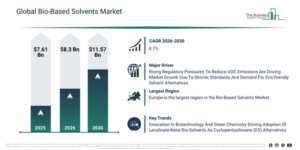
The bio-based solvents market has demonstrated robust expansion in recent years. This market is projected to grow from $7.61 billion in 2025 to $8.3 billion in 2026, exhibiting a compound annual growth rate (CAGR) of 9.0%. Its historical growth can be attributed to factors including the utilization of conventional organic solvents, an increase in chemical manufacturing, rising industrial cleaning demand, the availability of biomass feedstocks, and regulatory pressure concerning emissions.
The bio-based solvents market size is projected to experience substantial growth in the next few years. It is anticipated to expand to $11.57 billion by 2030, exhibiting a compound annual growth rate (CAGR) of 8.7%. This expansion during the forecast period can be attributed to stringent environmental regulations, an increase in sustainable manufacturing, advancements in bio-solvent chemistry, a rising demand for biodegradable products, and the expansion of green chemistry initiatives. Major trends for the forecast period include a shift from petroleum-based to renewable solvents, a growing demand for low-toxicity solvents, their increased application in paints and coatings, an expansion into personal care and pharmaceutical uses, and a focus on high-performance green solvents.
Get A No-Cost Sample Of The Bio-Based Solvents Market Study:
Major Factor Fueling The Bio-Based Solvents Market Through 2030
Heightened regulatory demands aimed at curbing volatile organic compound (VOC) emissions are anticipated to fuel the expansion of the bio-based solvent market. Volatile organic compounds are defined as organic chemicals that readily volatilize at ambient temperatures, playing a substantial role in air pollution, the formation of ground-level ozone, and negative health outcomes. This growing imperative to decrease volatile organic compound (VOC) releases stems from their detrimental environmental and health consequences, including their contribution to photochemical smog, respiratory ailments, and climate change. Bio-based solvents facilitate this reduction by offering alternatives that are low in volatile organic compound (VOC), environmentally sound, and compliant, thereby helping industries satisfy more stringent emission criteria and move towards sustainable manufacturing. For example, in July 2024, the California Department of Pesticide Regulation, a US-based government agency, indicated that while volatile organic compound (VOC) emissions in California’s primary ozone nonattainment regions stayed within state implementation plan (SIP) targets for 2023, certain areas showed an uptick compared to 2022. Specifically, in the San Joaquin Valley, emissions climbed by 2.26 tons per day (tpd), increasing from 12.528 tpd in 2022 to 14.788 tpd in 2023, with forecasts suggesting this upward trajectory will persist into 2024. Likewise, the Sacramento Metro area saw emissions rise from 1.097 tpd in 2022 to 1.371 tpd in 2023, while minor fluctuations were noted in the Southeast Desert, Ventura, and South Coast regions. Limitations on high-VOC applications are anticipated to remain in effect through 2025 to ensure ongoing regulatory adherence. Consequently, the growing regulatory push to curb volatile organic compound (VOC) emissions is propelling the bio-based solvent market.
Bio-Based Solvents Market Segment Landscape: Main Categories And Subcategories Covered
The bio-based solvents market covered in this report is segmented –
1) By Product Type: Bio-Alcohols, Bio-Glycols, Bio-Lactate Esters, Bio-Based Ketones, Bio-Based Ethers, D-Limonene, Other Bio-Based Solvents
2) By Solvent Properties: Solvency Power, Evaporation Rate, Toxicity Level, Biodegradability, Volatility
3) By Feedstock Source: Sugar-Based, Starch-Based, Cellulose-Based, Vegetable Oil-Based, Algae-Based , Glycerol-Based (By-Product Of Biodiesel)
4) By Application: Paints And Coatings, Adhesives And Sealants, Printing Inks, Industrial And Domestic Cleaners, Pharmaceuticals, Cosmetics And Personal Care, Other Applications
5) By End-User: Automotive, Construction, Packaging, Textiles, Other End-Users
Subsegments:
1) By Bio-Alcohols: Bio Ethanol, Bio Methanol, Bio Propanol, Bio Isopropanol, Bio Butanol, Bio Isobutanol
2) By Bio-Glycols: Bio Ethylene Glycol, Bio Propylene Glycol, Bio Diethylene Glycol, Bio Triethylene Glycol, Bio Butanediol
3) By Bio-Lactate Esters: Ethyl Lactate, Methyl Lactate, Propyl Lactate, Butyl Lactate, Isoamyl Lactate
4) By Bio-Based Ketones: Bio Acetone, Bio Methyl Ethyl Ketone, Bio Methyl Isobutyl Ketone, Bio Cyclohexanone, Bio Diisobutyl Ketone
5) By Bio-Based Ethers: Bio Diethyl Ether, Bio Dibutyl Ether, Bio Dipropyl Ether, Bio Tetrahydrofuran, Bio Methyltetrahydrofuran
6) By D-Limonene: Food Grade D Limonene, Technical Grade D Limonene, Industrial Grade D Limonene, Fragrance Grade D Limonene, High Purity D Limonene
7) By Other Bio-Based Solvents: Methyl Soyate, Ethyl Levulinate, Gamma Valerolactone, Propylene Carbonate From Bio Based Carbon Dioxide, Ethyl Acetate From Bio Ethanol
How Are Emerging Trends Influencing The Bio-Based Solvents Market’s Growth Path?
Leading firms within the bio-based solvent market are concentrating on advancing biotechnology and green chemistry innovations, including levulinate-ketal solvents, to substitute volatile silicones and petrochemical solvents in various formulations. These levulinate-ketal solvents are acetals derived from levulinic acid (sourced from second-generation biomass) and bio-diols; they offer volatility and sensory properties comparable to silicones, coupled with high biobased content and safer, biodegradable characteristics. As an example, GFBiochemicals, a biochemical firm based in France, launched RE:CHEMISTRY NEW320 (INCI: Ethyl Propanediol Acetal Levulinate) in October 2025, providing a plant-derived solvent and emollient option instead of cyclopentasiloxane (D5) for personal-care product formulations. Produced from second-generation biomass through levulinate-ketal chemistry, this particular solvent exhibits volatility and sensory performance akin to silicones, all while possessing a high biobased content and improved biodegradability. RE:CHEMISTRY NEW320 allows formulators to lessen their reliance on ingredients sourced from petrochemicals and palm, without negatively impacting texture, dry-down, or the overall quality of the product. This product introduction highlights GFBiochemicals’ dedication to promoting green chemistry solutions and signals a wider market trend towards sustainable, high-performance bio-based solvents within the cosmetics and personal-care industries.
Bio-Based Solvents Market Leading Players And Key Industry Participants In 2026
Major companies operating in the bio-based solvents market are Shell Catalysts & Technologies, Cargill Incorporated, Archer Daniels Midland Company (ADM), BASF SE, Merck KGaA, Dow Chemical Company, LyondellBasell Industries Holdings B.V., AkzoNobel N.V., Eastman Chemical Company, Solvay S.A., Huntsman Corporation, Clariant AG, Stepan Company , Ashland Global Holdings Inc., Corbion N.V., Genomatica Inc. , Gevo Inc., GFBiochemicals Ltd., Galactic S.A., INEOS Nitriles.
Check Out The Full Bio-Based Solvents Market Report 2026:
Bio-Based Solvents Market By Geography: Revenue Leaders Among Global Regions
Europe was the largest region in the bio-based Solvents market in 2025. Asia-Pacific is expected to be the fastest-growing region in the forecast period. The regions covered in the bio-based solvents market report are Asia-Pacific, South East Asia, Western Europe, Eastern Europe, North America, South America, Middle East, Africa
Reach Out To Our Team:
The Business Research Company: https://www.thebusinessresearchcompany.com/
Americas: +1 310-496-7795
Asia: +44 7882 955267 & +91 8897263534
Europe: +44 7882 955267
Email us at: marketing@tbrc.info
Follow us on:
LinkedIn: https://in.linkedin.com/company/the-business-research-company
YouTube: https://www.youtube.com/channel/UC24_fI0rV8cR5DxlCpgmyFQ
Global Market Model: https://www.thebusinessresearchcompany.com/global-market-model

Wasay has over a decade of experience in market research, data modelling, and analytics, with prior experience at GlobalData and Decision Tree Consulting Services. At The Business Research Company , he leads research operations across syndicated studies, customized consulting engagements, and the Global Market Model platform. His professional experience includes supporting organizations such as Boston Consulting Group, KPMG, and Ernst & Young. Wasay holds a degree in Electronics and Communications Engineering, postgraduate management qualifications from International Management Institute Belgium and Indian School of Business and Entrepreneurship, and completed the Integrated Program in Business Analytics from Indian Institute of Management Indore.