Delivering more actionable and strategically valuable research, The Business Research Company’s 2026 market reports feature market attractiveness analysis, total addressable market evaluation, company benchmarking matrices, interactive Excel dashboards, expanded supply chain intelligence, emerging startup coverage, and detailed product insights.
Biological Molluscicides Market Size, Value And Growth Trends Through 2030
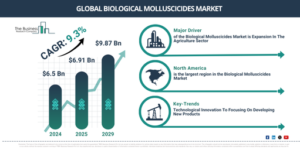
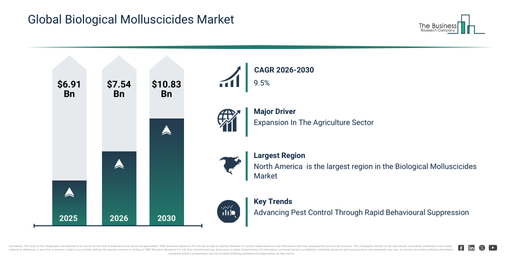
The biological molluscicides market has experienced substantial expansion in recent years. Projections indicate its value will rise from $6.91 billion in 2025 to $7.54 billion in 2026, reflecting a compound annual growth rate of 9.2%. Historically, key drivers for this growth include the escalating harm caused by slugs and snails, advancements in horticultural crop cultivation, stricter controls on chemical molluscicides, wider adoption of sustainable agriculture practices, and the availability of biological control agents.
The biological molluscicides market is anticipated to grow significantly in the foreseeable future, achieving a valuation of $10.83 billion by 2030, propelled by a compound annual growth rate (CAGR) of 9.5%. This anticipated expansion stems chiefly from influences like the emergence of organic and sustainable agricultural methods, broader adoption of pest control derived from plants, increased investment in eco-friendly crop safeguarding, an escalating consumer demand for residue-free produce, and a stronger focus on options preserving biodiversity. Significant trends expected throughout this timeframe include the broader adoption of ecologically sound mollusk management approaches, expanded use of ferrous phosphate-based goods, a sharp rise in the need for crop-specific molluscicides, the spread of products suitable for organic agriculture, and enhanced attention to precise pest eradication.
Download A Free Sample Report For Comprehensive Market Insights:
#Biological Molluscicides Market Demand Drivers Creating New Revenue Opportunities
The growth of the biological molluscicides market is anticipated to be propelled by the expanding agriculture sector. This sector encompasses businesses involved in cultivating crops, raising animals, and harvesting fish and other wildlife from farms, ranches, or their natural habitats. Biological molluscicides are crucial for controlling snails and slugs, in addition to eradicating weeds, insects, and fungal pests; therefore, the expansion of the agriculture sector is expected to significantly boost the biological molluscicides market. As an illustration, in December 2024, the Food and Agriculture Organization, an Italy-based specialized agency of the United Nations (UN) supporting sustainable agriculture globally, reported that the total global production of primary crops in 2023 reached around 9.9 billion tonnes, marking an increase of approximately 3% compared to 2022. Thus, the expansion within the agriculture sector is a primary driver for the biological molluscicides market’s growth.
Biological Molluscicides Market Segment Breakdown: Which Categories Generate The Most Revenue?
The biological molluscicides market covered in this report is segmented –
1) By Type: Ferrous Phosphate–Based Molluscicides, Plant-Based Molluscicides, Microbial Molluscicides, Biological Control Agents, Other Biological Molluscicides
2) By Form: Pellet, Liquids, Gels
3) By Application: Field Crops, Horticultural Crops, Turf And Ornamentals, Other Applications
Subsegments:
1) By Ferrous Phosphate–Based Molluscicides: Ferrous Phosphate Pellets, Ferrous Phosphate Granules, Iron-Chelated Ferrous Phosphate Formulations
2) By Plant-Based Molluscicides: Neem-Based Molluscicides, Botanical Extract-Based Molluscicides, Saponin-Based Molluscicides
3) By Microbial Molluscicides: Bacteria-Based Molluscicides, Fungi-Based Molluscicides, Microbial Metabolite-Based Products
4) By Biological Control Agents: Predatory Nematodes, Natural Mollusk Predators
5) By Other Biological Molluscicides: Essential Oil-Based Molluscicides, Bio-Derived Repellents, Integrated Biological Formulations
Biological Molluscicides Market Trends Driving Strategic Industry Expansion
Leading companies in the biological molluscicides market are introducing advanced products, such as rapid stop-feeding, which facilitates the immediate behavioral suppression of herbivory and control of molluscan pest populations. This rapid stop-feeding capability refers to the instant cessation of feeding behavior in molluscs after ingesting a molluscicidal bait, coinciding with the activation of its toxic or inhibitory effects. For instance, in February 2025, ADAMA Ltd., an Israel-based crop protection company, announced the launch of Feralla, an in-licensed mineral-based molluscicide active ingredient, developed to offer European farmers quick and effective control of slugs and snails while supporting sustainable agriculture goals. Additionally, this innovation provides rapid stop-feeding and enhanced pellet durability, ensuring crop protection without relying on high-risk chemical molluscicides.
Biological Molluscicides Market Key Players And Strategic Industry Positioning
Major companies operating in the biological molluscicides market are Certis Biologicals, Neudorff, Marrone Bio Innovations, Andermatt Biocontrol, Seipasa, De Sangosse, Koppert Biological Systems, Biobest Group, Novozymes, Lallemand Plant Care, IPL Biologicals, T. Stanes & Company, Valent BioSciences, BioWorks Inc., CBC (America) Corporation, Sumitomo Chemical, Syngenta Biologicals, UPL Ltd., Corteva Agriscience, Bayer CropScience
Access The Complete Biological Molluscicides Market Report:
Biological Molluscicides Market Regional Analysis And Leading Geography
North America was the largest region in the biological molluscicides market in 2025. The regions covered in the biological molluscicides market report are Asia-Pacific, South East Asia, Western Europe, Eastern Europe, North America, South America, Middle East, Africa
Get in touch with us:
The Business Research Company: https://www.thebusinessresearchcompany.com/
Americas: +1 310-496-7795
Asia: +44 7882 955267 & +91 8897263534
Europe: +44 7882 955267
Email us at: marketing@tbrc.info
Follow us on:
LinkedIn: https://in.linkedin.com/company/the-business-research-company
YouTube: https://www.youtube.com/channel/UC24_fI0rV8cR5DxlCpgmyFQ
Global Market Model: https://www.thebusinessresearchcompany.com/global-market-model

Wasay has over a decade of experience in market research, data modelling, and analytics, with prior experience at GlobalData and Decision Tree Consulting Services. At The Business Research Company , he leads research operations across syndicated studies, customized consulting engagements, and the Global Market Model platform. His professional experience includes supporting organizations such as Boston Consulting Group, KPMG, and Ernst & Young. Wasay holds a degree in Electronics and Communications Engineering, postgraduate management qualifications from International Management Institute Belgium and Indian School of Business and Entrepreneurship, and completed the Integrated Program in Business Analytics from Indian Institute of Management Indore.