Built to provide research that’s more actionable and strategically valuable, The Business Research Company’s 2026 market reports include market attractiveness analysis, total addressable market sizing, company benchmarking matrices, interactive Excel dashboards, broader supply chain intelligence, emerging startup tracking, and in-depth product insights.
Carbon Capture Materials Market Size, Value And Growth Trajectory Through 2030
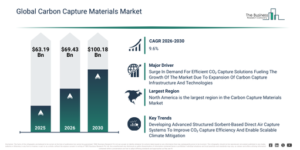
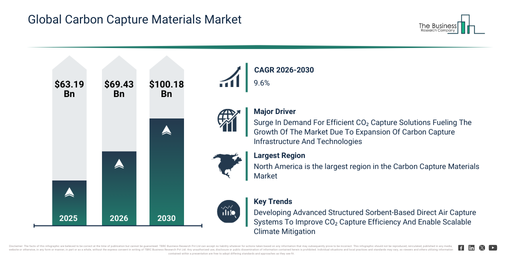
The carbon capture materials market has seen substantial growth in recent years. It is projected to expand from $63.19 billion in 2025 to $69.43 billion in 2026, driven by a compound annual growth rate (CAGR) of 9.9%. Historically, this growth has been fueled by the increasing implementation of early carbon capture pilot projects, a rising demand for solvent-based absorption materials, increased investment in industrial emission reduction programs, the expansion of carbon capture utilization and storage initiatives, and heightened regulatory pressure on high-emission industries.
The carbon capture materials market is expected to experience robust expansion in the coming years. Its valuation is projected to reach $100.18 billion by 2030, exhibiting a compound annual growth rate (CAGR) of 9.6%. This anticipated growth can be attributed to the escalating demand for highly efficient, low-energy capture substances; the increasing integration of carbon capture into hard-to-abate sectors; a rising need for advanced sorbents in large-scale initiatives; the broadening application of direct air capture materials; and greater government funding for next-generation capture technologies. Significant trends during the forecast period include advancements in new-generation solvent formulations, breakthroughs in metal-organic framework sorbent materials, developments in high-performance membrane separation methods, and ongoing research into low-energy regeneration materials.
Get A Free Sample Report With In-Depth Market Insights:
Carbon Capture Materials Market Growth Momentum: What Factors Are Shaping Demand?
The future expansion of the carbon capture materials market is anticipated due to the rising need for effective CO₂ capture solutions. These solutions involve cutting-edge materials and technologies that can absorb, adsorb, or bind carbon dioxide from industrial emissions or ambient air, demonstrating high selectivity and performance. The demand for such efficient CO₂ capture solutions stems from commitments by nations and industries to cut greenhouse gas emissions and achieve net-zero objectives. Carbon capture materials bolster these solutions by providing specialized substances like solvents, sorbents, membranes, and advanced frameworks, which enhance capture efficiency and lower operational expenses. For example, the International Energy Agency, a France-based intergovernmental organization, reported in March 2024 that the carbon dioxide capture capacity for 2030 grew by 35% in 2023, while storage capacity climbed by 70%, leading to a total capture potential exceeding 430 million tonnes per year and a storage capacity of approximately 620 million tonnes of carbon dioxide annually. Consequently, the expanding need for efficient CO₂ capture solutions is fueling the expansion of the carbon capture materials market.
Carbon Capture Materials Market Segment Outlook: Which Categories Are Growing Fastest?
The carbon capture materials market covered in this report is segmented –
1) By Product: Chemical Sorbents, Physical Adsorbents
2) By Material Type: Liquid Solvents, Solid Sorbents, Membranes, Emerging Materials
3) By Regeneration Method: Thermal Regeneration, Pressure Swing Adsorption, Vacuum Swing Adsorption, Electric Swing Adsorption
4) By Capture Process: Absorption, Adsorption, Membrane Separation, Cryogenic Distillation, Direct Air Capture
5) By End Use Sector: Industrial Facilities, Power Utilities, Direct Air Capture Operators, Carbon Capture Utilisation And Storage Developers
Subsegments:
1) By Chemical Sorbents: Amine Based Sorbents, Solid Amine Sorbents, Amino Functionalized Silica, Amine Functionalized Polymers, Carbonate Based Sorbents, Bicarbonate Based Sorbents
2) By Physical Adsorbents: Activated Carbon, Zeolite Adsorbents, Metal Organic Frameworks, Silica Gel Adsorbents, Mesoporous Silicas
Carbon Capture Materials Market Trends Redefining Industry Growth
Major companies within the carbon capture materials market are prioritizing the development of advanced solutions, such as structured sorbent-based direct air capture systems. These efforts aim to enhance CO₂ adsorption efficiency, minimize energy consumption, and prolong material lifespan for industrial and atmospheric carbon removal. Structured sorbent-based direct air capture systems are technologies that utilize engineered materials to capture CO₂ directly from the atmosphere, optimize surface contact, and support scalable deployment for climate mitigation. For instance, in May 2024, Climeworks AG, an engineered carbon removal company located in Switzerland, launched its Generation 3 Direct Air Capture (DAC) technology. This system employs newly developed structured sorbent materials to double CO₂ capture capacity per module, halve energy use compared to its previous generation, and extend sorbent life threefold, while enabling scalability to megaton-scale deployments. This launch represents a significant technological advancement by improving material performance, energy efficiency, and modular deployment, thus offering a practical solution for large-scale atmospheric carbon removal and reducing climate impact.
Carbon Capture Materials Market Top Companies Driving Competitive Growth
Major companies operating in the carbon capture materials market are Exxon Mobil Corporation, BASF SE, Dow Inc., Honeywell International Inc., Linde plc, Mitsubishi Heavy Industries Ltd., Toray Industries Inc., Sumitomo Chemical Co. Ltd., Evonik Industries AG, Air Products and Chemicals Inc., DuPont de Nemours Inc., Arkema S.A., Solvay S.A., Cabot Corporation, Hitachi Zosen Corporation, Calix Limited, Svante Inc., Carbon Clean Solutions Ltd., Climeworks AG, Membrane Technology and Research Inc.
View The Full Carbon Capture Materials Market Report:
Carbon Capture Materials Market Global Footprint: Which Region Leads The Industry?
North America was the largest region in the carbon capture materials market in 2025. Asia-Pacific is expected to be the fastest-growing region in the forecast period. The regions covered in the carbon capture materials market report are Asia-Pacific, South East Asia, Western Europe, Eastern Europe, North America, South America, Middle East, Africa.
Reach Out To Our Team:
The Business Research Company: https://www.thebusinessresearchcompany.com/
Americas: +1 310-496-7795
Asia: +44 7882 955267 & +91 8897263534
Europe: +44 7882 955267
Email us at: marketing@tbrc.info
Follow us on:
LinkedIn: https://in.linkedin.com/company/the-business-research-company
YouTube: https://www.youtube.com/channel/UC24_fI0rV8cR5DxlCpgmyFQ
Global Market Model: https://www.thebusinessresearchcompany.com/global-market-model

Wasay has over a decade of experience in market research, data modelling, and analytics, with prior experience at GlobalData and Decision Tree Consulting Services. At The Business Research Company , he leads research operations across syndicated studies, customized consulting engagements, and the Global Market Model platform. His professional experience includes supporting organizations such as Boston Consulting Group, KPMG, and Ernst & Young. Wasay holds a degree in Electronics and Communications Engineering, postgraduate management qualifications from International Management Institute Belgium and Indian School of Business and Entrepreneurship, and completed the Integrated Program in Business Analytics from Indian Institute of Management Indore.