Featuring market attractiveness scoring, total addressable market sizing, company benchmarking matrices, interactive Excel dashboards, deeper supply chain intelligence, emerging startup tracking, and granular product-level insights, The Business Research Company’s 2026 market reports are built to deliver research that is both more actionable and more strategically valuable.
Cellulose Derivatives Market Size Forecast: How Big Could The Market Get By 2030?
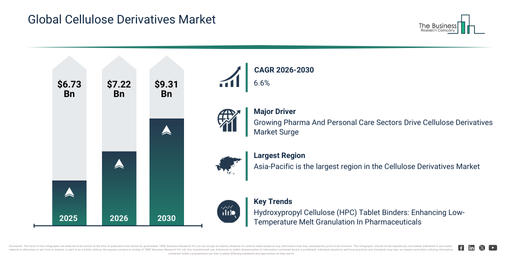
The cellulose derivatives market has experienced robust expansion in recent years. It is projected to grow from $6.73 billion in 2025 to $7.22 billion in 2026, at a compound annual growth rate (CAGR) of 7.4%. The historical increase can be attributed to the rising usage of pharmaceutical excipients, the expanding food processing industry, increased demand for construction materials, the early adoption of cellulose-based polymers, and regulatory support for biodegradable materials.
The cellulose derivatives market is projected to experience robust expansion over the coming years. This market is anticipated to reach a valuation of $9.31 billion by 2030, exhibiting a compound annual growth rate (CAGR) of 6.6%. Key factors driving this growth during the forecast period include an increasing need for sustainable packaging solutions, the burgeoning green construction sector, the expansion of plant-based pharmaceuticals, stricter environmental regulations, and ongoing technological advancements in cellulose modification techniques. Prominent trends observed within the forecast period encompass an escalating demand for biodegradable polymers, their widening application in pharmaceutical formulations, growth in their use for food texture and stabilization, increased integration into construction materials, and a heightened emphasis on sustainable and plant-based ingredients.
Get A Free Sample Report With In-Depth Market Insights:
Cellulose Derivatives Market Expansion Drivers: What’s Shaping Future Growth?
The burgeoning need for pharmaceuticals and personal care items is anticipated to accelerate the expansion of the cellulose derivatives market. This rising use of pharmaceuticals and personal care products is propelled by enhanced health awareness, an increasingly older global population, and ongoing developments in medical and cosmetic technologies. Cellulose derivatives are incorporated into pharmaceuticals and personal care products as thickeners, stabilizers, and excipients, improving the texture, stability, and delivery of active ingredients. For instance, in April 2025, according to Eurostat, a Luxembourg-based government agency, in 2024, EU exports of medicinal and pharmaceutical products climbed by 13.5% compared with 2023, amounting to $316.38 billion (€313.4 billion). Simultaneously, imports registered a modest increase of 0.5%, reaching $112.7 billion (€119.7 billion). Therefore, the escalating demand for pharmaceuticals and personal care products will propel the growth of the cellulose derivatives market.
Cellulose Derivatives Market Breakdown By Product Type And Application
The cellulose derivatives market covered in this report is segmented –
1) By Type: Methyl Cellulose, Hydroxypropyl Methylcellulose (HPMC), Hydroxypropyl Cellulose (HPC), Carboxymethyl Cellulose, Hydroxyethyl Cellulose (HEC), Ethyl Cellulose, Other Types
2) By Grade: Industrial Grade, Food Grade, Pharmaceutical Grade
3) By End Users: Food Industry, Pharmaceutical Industry, Personal Care, Construction, Paint Industry, Other End Users
Subsegments:
1) By Methyl Cellulose: Hydroxypropyl Methylcellulose (HPMC), Hydroxypropyl Methylcellulose Acetate Succinate (HPMCAS)
2) By Hydroxypropyl Methylcellulose (HPMC): Pharmaceutical Grade, Food Grade, Industrial Grade
3) By Hydroxypropyl Cellulose (HPC): Low Viscosity, Medium Viscosity, High Viscosity
4) By Carboxymethyl Cellulose (CMC): Sodium Carboxymethyl Cellulose (NaCMC), Calcium Carboxymethyl Cellulose (CaCMC), Other Salts
5) By Hydroxyethyl Cellulose (HEC): Low Viscosity, Medium Viscosity, High Viscosity
6) By Ethyl Cellulose: Pharmaceutical Grade, Food Grade, Industrial Grade
7) By Other Types: Ethyl Hydroxyethyl Cellulose (EHEC), Sodium Hydroxyethyl Cellulose (NaHEC), Other Modified Cellulose Derivatives
Cellulose Derivatives Market Strategic Trends: What Defines The Next Growth Phase?
Leading companies in the cellulose derivatives market are focusing on innovative and sustainable solutions, such as hydroxypropyl cellulose (HPC) tablet binders, to improve low-temperature melt granulation efficiency and tablet cohesion. Hydroxypropyl cellulose (HPC) tablet binder is defined as a water-soluble polymeric excipient used in pharmaceutical formulations to facilitate the binding of powder particles during granulation and tablet formation. For example, in October 2023, Ashland Inc., a US-based specialty ingredients company, introduced Klucel Fusion HPC, which was developed to tackle critical issues in low-temperature melt granulation. This hydroxypropyl cellulose-based tablet binder features low melt viscosity, thermal and moisture stability, strong binding at reduced processing temperatures (50 °C–80 °C), and compatibility with thermolabile active pharmaceutical ingredients, making it an optimal choice for efficient, robust, and high-quality tablet production while minimizing API degradation and energy consumption.
Cellulose Derivatives Market Company Landscape And Competitive Strategy
Major companies operating in the cellulose derivatives market are The Dow Chemical Company, Shin-Etsu Chemical Co. Ltd., Akzo Nobel N.V., Eastman Chemical Company, Celanese Corporation, Nippon Paper Industries Co. Ltd., Sappi Limited, Nouryon, SNF Group, Daicel Corporation, Ashland Global Holdings Inc, Rayonier Advanced Materials Inc, LOTTE Fine Chemical Co. Ltd, Viscofan, CP Kelco ApS, Lamberti SpA, Yueyang Xingchang Petrochemical Co Ltd, DKS Co Ltd, Shandong Head Co Ltd, J RETTENMAIER & SÖHNE GmbH + Co KG, Reliance Cellulose Products Ltd, SE Tylose GmbH & Co KG, Hangzhou Dayangchem Co Ltd
View The Full Cellulose Derivatives Market Report:
Cellulose Derivatives Market Regional Outlook: Where Is Opportunity Concentrated?
Asia-Pacific was the largest region in the cellulose derivatives market in 2025 and is expected to be the fastest-growing region in the forecast period. The regions covered in the cellulose derivatives market report are Asia-Pacific, South East Asia, Western Europe, Eastern Europe, North America, South America, Middle East, Africa
Reach Out To Our Team:
The Business Research Company: https://www.thebusinessresearchcompany.com/
Americas: +1 310-496-7795
Asia: +44 7882 955267 & +91 8897263534
Europe: +44 7882 955267
Email us at: marketing@tbrc.info
Follow us on:
LinkedIn: https://in.linkedin.com/company/the-business-research-company
YouTube: https://www.youtube.com/channel/UC24_fI0rV8cR5DxlCpgmyFQ
Global Market Model: https://www.thebusinessresearchcompany.com/global-market-model

Wasay has over a decade of experience in market research, data modelling, and analytics, with prior experience at GlobalData and Decision Tree Consulting Services. At The Business Research Company , he leads research operations across syndicated studies, customized consulting engagements, and the Global Market Model platform. His professional experience includes supporting organizations such as Boston Consulting Group, KPMG, and Ernst & Young. Wasay holds a degree in Electronics and Communications Engineering, postgraduate management qualifications from International Management Institute Belgium and Indian School of Business and Entrepreneurship, and completed the Integrated Program in Business Analytics from Indian Institute of Management Indore.