Built to provide research that’s more actionable and strategically valuable, The Business Research Company’s 2026 market reports include market attractiveness analysis, total addressable market sizing, company benchmarking matrices, interactive Excel dashboards, broader supply chain intelligence, emerging startup tracking, and in-depth product insights.
Crosslinking Agent Market Expansion Outlook: What Revenue Opportunities Are Ahead?
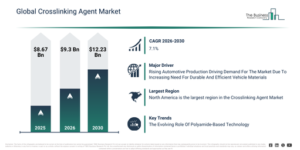
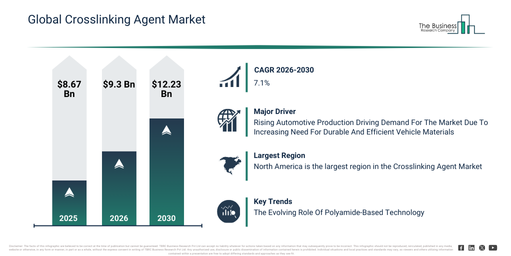
The crosslinking agent market size has seen substantial growth in recent years. This market is expected to expand from $8.67 billion in 2025 to $9.3 billion in 2026, achieving a compound annual growth rate (CAGR) of 7.4%. The historical development of the market can be linked to the expansion of polymer processing, the necessity for durable rubber products, the broadening of industrial coatings, their incorporation into adhesive formulations, and the progress in synthetic materials.
The crosslinking agent market size is expected to show significant expansion in the next few years. It is forecast to grow to $12.23 billion in 2030, achieving a compound annual growth rate (CAGR) of 7.1%. This growth during the forecast period can be attributed to the rising demand for lightweight materials, an increase in electric vehicles, the broadening scope of specialty polymers, enhanced usage in electronics, and innovations in bio-based crosslinkers. Noteworthy trends in the upcoming period include a heightened demand for high performance polymers, increasing application in advanced coatings, the expansion of rubber vulcanization uses, greater adoption in adhesives and sealants, and a focus on creating controlled polymer networks.
Get A Free Sample Report With In-Depth Market Insights:
Crosslinking Agent Market Development Factors: What’s Supporting Demand?
An anticipated increase in automotive manufacturing is projected to fuel expansion within the crosslinking agent market. Automotive production encompasses the entire spectrum of creating motor vehicles, from their initial design and assembly to the rigorous testing of various components like engines, chassis, body parts, electronic systems, and interior features. This surge in automotive output is largely attributable to a growing worldwide appetite for vehicles, propelled by global economic prosperity and increasing urbanization, which collectively enhance consumer purchasing ability and elevate the necessity for personal transport options. In automotive manufacturing, crosslinking agents prove valuable for improving the resilience, chemical inertness, and thermal stability of coatings, adhesives, and composite materials, thereby contributing to the creation of vehicles that are more robust, enduring, and consume less fuel. Illustratively, data from a report issued by ICAEW, a UK-based professional membership body, indicated that global motor vehicle production hit 93,546,599 units in October 2025, representing an increase from 85,016,728 units recorded in 2022. Consequently, the expanding volume of automotive production is a key impetus for the development of the crosslinking agent market.
Crosslinking Agent Market Segment Breakdown: Which Categories Lead On Revenue?
The crosslinking agent market covered in this report is segmented –
1) By Crosslinker Type: Epoxy Crosslinkers, Amine Crosslinkers, Peroxide Crosslinkers, Isocyanate Crosslinkers, Silane Crosslinkers
2) By Chemistry: Amine, Amino, Amide, Aziridine, Carbodiimide, Isocyanate, Other Chemistries
3) By End-Use Industry: Automotive, Construction, Packaging, Electronics, Medical
Subsegments:
1) By Epoxy Crosslinkers: Aliphatic Epoxy, Aromatic Epoxy, Cycloaliphatic Epoxy, Glycidyl Ether Epoxy, Epoxy Phenol Novolac (EPN)
2) By Amine Crosslinkers: Aliphatic Amines, Cycloaliphatic Amines, Aromatic Amines, Polyetheramines, Amidoamines
3) By Peroxide Crosslinkers: Dicumyl Peroxide (DCP), Benzoyl Peroxide (BPO), Tert-Butyl Peroxide, Peroxy Ketals, Hydroperoxides
4) By Isocyanate Crosslinkers: Monomeric Diisocyanates (MDI), Polymeric Isocyanates, Blocked Isocyanates, Aliphatic Isocyanates, Aromatic Isocyanates
5) By Silane Crosslinkers: Vinyl Silanes, Epoxy Silanes, Amino Silanes, Methacryloxy Silanes, Sulfur Silanes
Crosslinking Agent Market Transformation Trends: What Innovations Are Driving Change?
Leading companies within the crosslinking agent market are prioritizing technological advancements, specifically polyamide-based technology, to improve the flexibility, mechanical strength, environmental safety, and curing efficiency of epoxy systems for challenging applications like civil engineering and industrial flooring. This technology incorporates polyamide materials into products, such as epoxy curing agents, making them more flexible, robust, and chemically resistant. For instance, in September 2024, Evonik Industries AG, a Germany-based chemicals company, introduced Ancamide 2853 and Ancamide 2865, two novel polyamide-based, nonylphenol-free epoxy curing agents. These formulations act as polyamide-based crosslinking agents, formulated to cure standard diluted epoxy resins without the need for supplementary polyurethane modifiers. They deliver high flexibility, substantial mechanical strength, rapid curing, and feature up to 40% bio-based content, rendering them optimal for civil engineering and flooring uses. This initiative seeks to elevate sustainability, safety, and performance in epoxy systems through the provision of eco-friendly, quick-curing, and highly flexible polyamide-based curing agents specifically designed for demanding applications such as civil engineering and industrial flooring.
Crosslinking Agent Market Leading Players And Competitive Positioning
Major companies operating in the crosslinking agent market are BASF SE, The Dow Chemical Company, Mitsubishi Chemical Corporation, Sumitomo Chemical Co. Ltd., Toray Industries Inc., Evonik Industries AG, Covestro AG, INEOS Group Holdings S.A., Arkema S.A., LANXESS AG, Huntsman Corporation, DIC Corporation, H.B. Fuller Company, Aditya Birla Management Corporation Pvt. Ltd., EMS-CHEMIE HOLDING AG, Allnex Holdings S.à r.l., Ashland LLC, Momentive Performance Materials Inc., Perstorp Holding AB, Hexion Inc.
View The Full Crosslinking Agent Market Report:
Crosslinking Agent Market Regional Analysis And Leading Geography
North America was the largest region in the crosslinking agents market in 2025. Asia-Pacific is expected to be the fastest-growing region in the forecast period. The regions covered in the crosslinking agent market report are Asia-Pacific, South East Asia, Western Europe, Eastern Europe, North America, South America, Middle East, Africa
Reach Out To Our Team:
The Business Research Company: https://www.thebusinessresearchcompany.com/
Americas: +1 310-496-7795
Asia: +44 7882 955267 & +91 8897263534
Europe: +44 7882 955267
Email us at: marketing@tbrc.info
Follow us on:
LinkedIn: https://in.linkedin.com/company/the-business-research-company
YouTube: https://www.youtube.com/channel/UC24_fI0rV8cR5DxlCpgmyFQ
Global Market Model: https://www.thebusinessresearchcompany.com/global-market-model

Wasay has over a decade of experience in market research, data modelling, and analytics, with prior experience at GlobalData and Decision Tree Consulting Services. At The Business Research Company , he leads research operations across syndicated studies, customized consulting engagements, and the Global Market Model platform. His professional experience includes supporting organizations such as Boston Consulting Group, KPMG, and Ernst & Young. Wasay holds a degree in Electronics and Communications Engineering, postgraduate management qualifications from International Management Institute Belgium and Indian School of Business and Entrepreneurship, and completed the Integrated Program in Business Analytics from Indian Institute of Management Indore.