Enhanced with market attractiveness analysis, total addressable market evaluation, company benchmarking matrices, interactive Excel dashboards, expanded supply chain intelligence, emerging startup coverage, and detailed product insights, The Business Research Company’s 2026 market reports deliver more actionable and strategically valuable research.
Dispersant Polymer Market Size Outlook: How Fast Will Revenue Grow Through 2030?
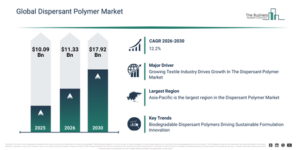
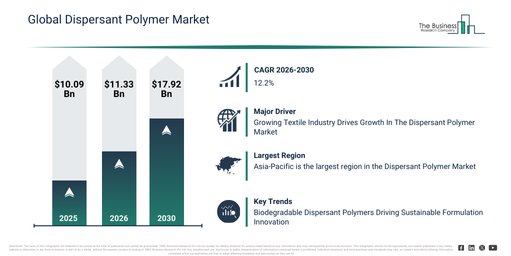
The dispersant polymers market has seen considerable growth in recent years. It is expected to expand from $10.09 billion in 2025 to $11.33 billion in 2026, registering a compound annual growth rate (CAGR) of 12.3%. The growth witnessed historically can be attributed to factors such as advancements in the coatings and construction materials industries, the increase in detergent manufacturing, a rising need for water treatment chemicals, improved industrial process optimization, and the accessibility of low molecular weight polymers.
The dispersant polymer market is set for considerable growth in the coming years, with projections indicating it will reach a value of $17.92 billion by 2030, demonstrating a compound annual growth rate (CAGR) of 12.2%. This expected increase is primarily attributed to factors such as a heightened demand for environmentally friendly formulations, an expanding adoption of solvent-free manufacturing processes, the penetration of specialty chemicals into developing economies, an increased focus on dispersion effectiveness, and a rise in industrial water treatment applications. Significant developments over the forecast period are anticipated to encompass a broader application of water-based dispersant polymers, an uptick in demand from the paints and coatings industry, greater acceptance in detergent compositions, the advancement of high-performance dispersion technologies, and a strong commitment to ensuring process stability.
Download A Free Sample Report For Comprehensive Market Insights:
Dispersant Polymer Market Industry Drivers: What Is Driving Revenue Growth?
The expanding textile industry is projected to boost the dispersant polymer market in the future. This growth in the textile sector stems from several elements, such as heightened consumer desire for sustainable and novel fabrics, technological progress in textiles, and the emergence of e-commerce, which broadens market reach for textile manufacturers. In the textile industry, dispersant polymers are utilized to enhance dye distribution, ensure consistent color, and hinder clumping during dyeing, thereby leading to superior fabric quality and uniformity. For example, as reported by the United States Fashion Industry Association, a US-based trade association, in April 2025, the U.S. textile & apparel industry continues to exhibit high output, with textile goods (NAICS 313 + 314) accounting for more than 83% of the total output by 2023. Consequently, the expanding textile industry is set to fuel the dispersant polymer market.
Dispersant Polymer Market Categorization By Product Type And Application
The dispersant polymer market covered in this report is segmented –
1) By Type: Acrylic Acid–Based Dispersant Polymers, Maleic Anhydride–Based Dispersant Polymers, Sulfonated Polymer Dispersants, Phosphonated Polymer Dispersants, Lignosulfonate-Based Dispersants, Other Anionic Dispersant Polymers
2) By Ionic Nature: Anionic Dispersant Polymers, Copolymeric Anionic Dispersants
3) By Form: Liquid, Powder, Granular
4) By Technology: Water-Soluble Dispersant Polymers, Water-Dispersible Dispersant Polymers
5) By Application: Paints and Coatings, Detergents and Cleaning Formulations, Pulp and Paper Processing, Water Treatment, Agriculture (Agrochemical Formulations), Oil and Gas, Pharmaceuticals and Personal Care, Other Applications
Subsegments:
1) By Acrylic Acid–Based Dispersant Polymers: Polyacrylic Acid (PAA) Dispersants, Acrylic Acid–Maleic Acid Copolymer Dispersants, Acrylic Acid–Sulfonic Acid Copolymer Dispersants, Modified Acrylic Dispersant Polymers
2) By Maleic Anhydride–Based Dispersant Polymers: Maleic Anhydride–Acrylic Acid Copolymer Dispersants, Maleic Anhydride–Olefin Copolymer Dispersants, Hydrolyzed Maleic Anhydride Polymer Dispersants
3) By Sulfonated Polymer Dispersants: Sulfonated Polystyrene Dispersants, Sulfonated Polyacrylate Dispersants, Sulfonated Naphthalene Polymer Dispersants
4) By Phosphonated Polymer Dispersants: Phosphonate-Functional Acrylic Polymer Dispersants, Polyphosphonate Dispersant Polymers, Phosphonated Copolymer Dispersants
5) By Lignosulfonate-Based Dispersants: Calcium Lignosulfonate Dispersants, Sodium Lignosulfonate Dispersants, Modified Lignosulfonate Dispersants
6) By Other Anionic Dispersant Polymers: Carboxylate-Based Dispersant Polymers, Sulfate-Based Dispersant Polymers, Anionic Polyether Dispersants
#Dispersant Polymer Market Growth Trends: What Is Influencing The Future Outlook?
Leading companies in the dispersant polymer market are focusing on developing innovative products, including readily biodegradable dispersants, to improve the stability and efficiency of agricultural formulations. A readily biodegradable dispersant acts as a chemical agent that effectively distributes ingredients within formulations and rapidly decomposes in the environment, thereby minimizing its ecological impact. For example, in April 2025, BASF SE, a Germany-based chemical company, introduced Sokalan CP 301, specifically designed for optimal performance in stable agricultural formulations. This product enhances the dispersion of active ingredients in crop protection and fertilizer applications, thereby supporting sustainable agricultural practices while maintaining the formulation’s stability and efficacy. This launch provides BASF with a competitive advantage by delivering a more environmentally friendly, high-performance solution that meets the increasing demand for sustainable agricultural chemicals.
Dispersant Polymer Market Company Landscape And Strategic Competition
Major companies operating in the dispersant polymer market are Dow, Covestro AG, Evonik Industries AG, The Lubrizol Corporation (Berkshire Hathaway), Nippon Shokubai Co. Ltd, Nouryon, Ashland Inc, Lanxess, Croda International, EOC Polymers India Private Limited, Weifang Ruiguang Chemical Co. Ltd, Shanghai Yunsong Technology Development Co. Ltd, Jiangsu Kaiyuan Technology Co. Ltd, Tianjin Royal Land Chemical Co. Ltd, Solvay, Uniqchem, Toagosei Co., BASF, King Industries Inc, SNF United Arab Emirates, KMT Polymers
Access The Complete Dispersant Polymer Market Report:
Dispersant Polymer Market Geographic Landscape: Which Region Dominates Industry Growth?
Asia-Pacific was the largest region in the dispersant polymer market in 2025. Asia-Pacific is expected to be the fastest-growing region in the forecast period. The regions covered in the dispersant polymer market report are Asia-Pacific, South East Asia, Western Europe, Eastern Europe, North America, South America, Middle East, Africa
Get in touch with us:
The Business Research Company: https://www.thebusinessresearchcompany.com/
Americas: +1 310-496-7795
Asia: +44 7882 955267 & +91 8897263534
Europe: +44 7882 955267
Email us at: marketing@tbrc.info
Follow us on:
LinkedIn: https://in.linkedin.com/company/the-business-research-company
YouTube: https://www.youtube.com/channel/UC24_fI0rV8cR5DxlCpgmyFQ
Global Market Model: https://www.thebusinessresearchcompany.com/global-market-model

Wasay has over a decade of experience in market research, data modelling, and analytics, with prior experience at GlobalData and Decision Tree Consulting Services. At The Business Research Company , he leads research operations across syndicated studies, customized consulting engagements, and the Global Market Model platform. His professional experience includes supporting organizations such as Boston Consulting Group, KPMG, and Ernst & Young. Wasay holds a degree in Electronics and Communications Engineering, postgraduate management qualifications from International Management Institute Belgium and Indian School of Business and Entrepreneurship, and completed the Integrated Program in Business Analytics from Indian Institute of Management Indore.