Featuring market attractiveness scoring, total addressable market sizing, company benchmarking matrices, interactive Excel dashboards, deeper supply chain intelligence, emerging startup tracking, and granular product-level insights, The Business Research Company’s 2026 market reports are built to deliver research that is both more actionable and more strategically valuable.
E-Series Glycol Ether Market Growth From $2.36 Billion In 2026 To $2.82 Billion By 2030 At A CAGR Of 4.6%
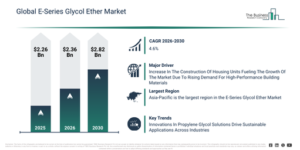
The e-series glycol ether market size has demonstrated consistent expansion in recent years. It is anticipated to increase from $2.26 billion in 2025 to $2.36 billion in 2026, reflecting a compound annual growth rate (CAGR) of 4.7%. Historically, this growth can be ascribed to the development of the coatings industry, the growth of industrial cleaning, the need for effective solvents, the availability of ethylene glycol derivatives, and the expansion of the printing sector.
The e-series glycol ether market size is anticipated to demonstrate continuous growth over the next few years. It is projected to achieve a value of $2.82 billion by 2030, growing at a compound annual growth rate (CAGR) of 4.6%. The expansion foreseen in this period can be ascribed to factors such as the increasing demand for high performance coatings, the development of electronics manufacturing, the broadening scope of automotive refinishing, more rigorous solvent performance requirements, and advancements in solvent chemistry. Key trends for the forecast period include the increasing application in paints and coatings, the growth of industrial cleaning applications, a rising need for low evaporation solvents, escalating consumption in printing inks, and a focus on performance based solvent formulations.
Get A Free Sample Report With In-Depth Market Insights:
E-Series Glycol Ether Market Growth Catalysts And Demand Drivers
The anticipated rise in the construction of housing units is set to drive the expansion of the e-series glycol ether market moving forward. The demand for new housing structures is fueled by the adoption of modern building practices that enhance durability, improve energy efficiency, and ensure long-term sustainability. E-series glycol ethers are frequently utilized in housing unit construction due to their ability to boost the performance of paints, coatings, and cleaning products, making them vital for maintaining quality and efficiency in construction projects. For example, in February 2025, according to the United States Census Bureau, a US-based government agency, US privately owned housing completions reached 1,651,000 units, representing a 7.6% increase from December 2024 and a 9.8% rise year-over-year. Single-family home completions amounted to 982,000, indicating a 7.1% monthly growth. Therefore, the increasing construction of housing units is propelling the growth of the e-series glycol ether market.
E-Series Glycol Ether Market Segment Breakdown: Which Categories Lead On Revenue?
The e-series glycol ether market covered in this report is segmented –
1) By Type: Ethylene Glycol Propyl Ether (EGPE), Ethylene Glycol Ethyl Ether (EGEE), Ethylene Glycol Monomethyl Ether (EGME), Ethylene Glycol Butyl Ether (EGBE), Ethylene Glycol Butyl Ether Acetate (EGBEA), Other Types
2) By Molecular Weight: Low Molecular Weight E-Series Glycol Ether, High Molecular Weight E-Series Glycol Ether
3) By Application: Printing Inks, Cleansers, Chemical Intermediates, Plasticizers, Laxatives, Eye Drops, Hydraulic Brakes, Paints, Other Applications
4) By End Users: Commercial, Industrial, Institutional, Residential
Subsegments:
1) By Ethylene Glycol Propyl Ether (EGPE): Ethylene Glycol Propyl Ether Industrial Grade, Ethylene Glycol Propyl Ether Pharmaceutical Grade, Ethylene Glycol Propyl Ether Electronics Grade
2) By Ethylene Glycol Ethyl Ether (EGEE): Ethylene Glycol Ethyl Ether Industrial Grade, Ethylene Glycol Ethyl Ether Laboratory Grade, Ethylene Glycol Ethyl Ether Solvent Applications
3) By Ethylene Glycol Monomethyl Ether (EGME): Ethylene Glycol Monomethyl Ether Coatings And Paints Grade, Ethylene Glycol Monomethyl Ether Electronics And Semiconductor Grade, Ethylene Glycol Monomethyl Ether Adhesives And Sealants
4) By Ethylene Glycol Butyl Ether (EGBE): Ethylene Glycol Butyl Ether Paints And Coatings Grade, Ethylene Glycol Butyl Ether Cleaning Agents Grade, Ethylene Glycol Butyl Ether Printing Inks And Dyes
5) By Ethylene Glycol Butyl Ether Acetate (EGBEA): Ethylene Glycol Butyl Ether Acetate Automotive Coatings, Ethylene Glycol Butyl Ether Acetate Wood Finishes, Ethylene Glycol Butyl Ether Acetate Industrial Solvents
6) By Other Types: Ethylene Glycol Phenyl Ether (EGPhE), Ethylene Glycol Dimethyl Ether (EGDME), Ethylene Glycol Diethyl Ether (EGDEE)
E-Series Glycol Ether Market Trends Shaping Long-Term Demand
Major companies operating in the E-Series Glycol Ether Market are concentrating on developing advanced sustainable solutions, such as low-carbon, bio-based, and circular feedstock technologies, to enhance environmental sustainability and reduce their carbon footprint. These technologies leverage alternative raw materials and advanced recycling processes to provide high-quality propylene glycol while simultaneously minimizing environmental impact. For instance, in September 2023, Dow, a Switzerland-based company, introduced a new range of propylene glycol solutions that incorporate Decarbia, Ecolibrium, and Renuva technologies. The products launched include Propylene Glycol RDC, featuring reduced carbon solutions derived from renewable energy sources; Propylene Glycol REN, utilizing bio-based technology from second-generation raw materials; and Propylene Glycol CIR, which uses recycled content from post-consumer waste streams. These solutions are suitable for various applications in the pharmaceutical, agricultural, cosmetics, textile, and food industries, and are certified through ISCC PLUS, ensuring the traceable and verifiable use of sustainable materials. The adoption of mass balance approaches enables the traceability of sustainable materials through complex value chains without altering existing production processes, offering measurable sustainability benefits for end-users.
E-Series Glycol Ether Market Leading Players And Competitive Positioning
Major companies operating in the e-series glycol ether market are Shell Plc, BASF SE, Dow Inc., Saudi Basic Industries Corporation, LyondellBasell, Merck KGaA, INEOS Group, Eastman Chemical Company, Polynt S.p.A, Sadara Chemical Company, India Glycols Limited, Monument Chemical LLC, ANDOH PARACHEMIE CO. LTD., Manali Petrochemicals Limited, Union Petrochemical Public Company Ltd., Central Drug House (P) Ltd, Otto Chemie Pvt Ltd, ADVANCE PETROCHEMICALS LTD, Henan GP Chemicals Co. Ltd.
View The Full E-Series Glycol Ether Market Report:
E-Series Glycol Ether Market Regional Split: Which Areas Are Fueling Growth?
Asia-Pacific was the largest region in the e-series glycol ether market in 2025. The regions covered in the e-series glycol ether market report are Asia-Pacific, South East Asia, Western Europe, Eastern Europe, North America, South America, Middle East, Africa
Reach Out To Our Team:
The Business Research Company: https://www.thebusinessresearchcompany.com/
Americas: +1 310-496-7795
Asia: +44 7882 955267 & +91 8897263534
Europe: +44 7882 955267
Email us at: marketing@tbrc.info
Follow us on:
LinkedIn: https://in.linkedin.com/company/the-business-research-company
YouTube: https://www.youtube.com/channel/UC24_fI0rV8cR5DxlCpgmyFQ
Global Market Model: https://www.thebusinessresearchcompany.com/global-market-model

Wasay has over a decade of experience in market research, data modelling, and analytics, with prior experience at GlobalData and Decision Tree Consulting Services. At The Business Research Company , he leads research operations across syndicated studies, customized consulting engagements, and the Global Market Model platform. His professional experience includes supporting organizations such as Boston Consulting Group, KPMG, and Ernst & Young. Wasay holds a degree in Electronics and Communications Engineering, postgraduate management qualifications from International Management Institute Belgium and Indian School of Business and Entrepreneurship, and completed the Integrated Program in Business Analytics from Indian Institute of Management Indore.