Through market attractiveness analysis, total addressable market evaluation, company benchmarking matrices, interactive Excel dashboards, expanded supply chain intelligence, emerging startup coverage, and detailed product insights, The Business Research Company’s 2026 market reports provide more actionable and strategically valuable research.
Glycol Market Growth Analysis: How Will Revenue Expand During The Forecast Period?
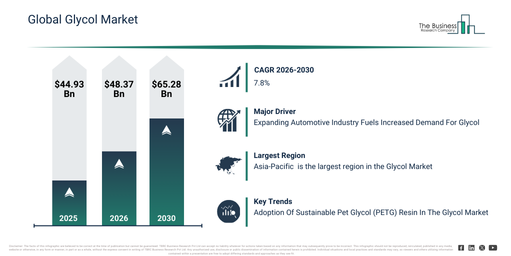
The glycol market has witnessed considerable expansion over recent years. Its value is projected to climb from $44.93 billion in 2025 to $48.37 billion in 2026, representing a compound annual growth rate (CAGR) of 7.7%. Historically, the growth of this market has stemmed from factors including increased automotive production volumes, a thriving polyester fiber manufacturing industry, rising demand for refrigeration systems, the expanding use of glycols in chemical intermediates, and the availability of extensive petrochemical production facilities.
The glycol market is poised for significant expansion in the coming years. Its valuation is predicted to reach $65.28 billion by 2030, demonstrating a compound annual growth rate (CAGR) of 7.8%. This projected growth throughout the forecast period is propelled by multiple factors, including the escalating requirements for electric vehicle thermal management, a rising necessity for sustainable packaging materials, the broadening of bio-based chemical output, wider deployment in data center cooling systems, and an increased focus on energy-efficient heat transfer fluids. Major developments anticipated within this timeframe include an increasing demand for automotive antifreeze and coolants, greater application in PET packaging and polyester fibers, the expanding adoption of bio-based glycols, an increase in industrial heat transfer uses, and a refined emphasis on high-purity glycol variants.
Download A Free Sample Report For Comprehensive Market Insights:
Glycol Market Growth Factors Supporting Long-Term Expansion
The expanding automotive industry is anticipated to fuel the growth of the glycol market going forward. This sector involves the development, production, marketing, and sale of motor vehicles, including automobiles, trucks, and motorcycles. Glycol is a crucial component in engine coolants and antifreeze formulations used in the automobile sector. It helps regulate engine temperature, preventing overheating in warm conditions and freezing in cold weather. For example, in March 2024, the European Automobile Manufacturers’ Association, a Belgium-based vehicle industry association, reported that the EU car market experienced a robust expansion of 13.9% in 2023 compared to 2022, achieving a volume of 10.5 million units. Consequently, the expanding automotive industry is driving the growth of the glycol market.
Glycol Market Categorization By Product Type And Application
The glycol market covered in this report is segmented –
1) By Type: Ethylene Glycol, Propylene Glycol
2) By Application: Antifreeze And Coolants, Polyester Fiber Production, PET Bottles And Packaging, Solvents And Humectants, Dehydrating Agent, Chemical Intermediates
3) By End User: Automotive And Transportation, Packaging, Textile, Other End-Users
Subsegments:
1) By Ethylene Glycol: Monoethylene Glycol (MEG), Diethylene Glycol (DEG), Triethylene Glycol (TEG)
2) By Propylene Glycol: Industrial Grade Propylene Glycol, Food Grade Propylene Glycol, Pharmaceutical Grade Propylene Glycol
Glycol Market Industry Trends Shaping Future Revenue Growth
Leading companies in the glycol market are adopting strategic alliances to leverage PET glycol (PETG) resin, which in turn accelerates the integration of renewable materials into various plastic applications. Such strategic partnerships represent a process where businesses combine their individual strengths and resources to achieve mutual benefits and success. For instance, in June 2023, UPM Biochemicals GmbH, a chemical company based in Germany, partnered with Selenis NA, a plastics resin manufacturer company from the US. Through this collaboration, they aim to produce sustainable PETG (polyethylene terephthalate glycol) for plastic packaging applications by using forest-sourced materials from Germany, thereby effectively reducing carbon emissions.
Glycol Market Company Landscape And Strategic Competition
Major companies operating in the glycol market are BASF, Dow, SABIC, Shell Chemicals, ExxonMobil Chemical, Sinopec, LG Chem, LyondellBasell, Formosa Plastics, INEOS, Reliance Industries, Mitsubishi Chemical Group, Sumitomo Chemical, Eastman Chemical, Huntsman, Lanxess, Arkema, Wanhua Chemical, Celanese, Chevron Phillips Chemical
Access The Complete Glycol Market Report:
Glycol Market Geographic Analysis: Where Is Demand Growing The Fastest?
Asia-Pacific was the largest region in the glycol market in 2025, and is expected to be the fastest-growing region in the forecast period. The regions covered in the glycol market report are Asia-Pacific, South East Asia, Western Europe, Eastern Europe, North America, South America, Middle East, Africa
Get in touch with us:
The Business Research Company: https://www.thebusinessresearchcompany.com/
Americas: +1 310-496-7795
Asia: +44 7882 955267 & +91 8897263534
Europe: +44 7882 955267
Email us at: marketing@tbrc.info
Follow us on:
LinkedIn: https://in.linkedin.com/company/the-business-research-company
YouTube: https://www.youtube.com/channel/UC24_fI0rV8cR5DxlCpgmyFQ
Global Market Model: https://www.thebusinessresearchcompany.com/global-market-model

Wasay has over a decade of experience in market research, data modelling, and analytics, with prior experience at GlobalData and Decision Tree Consulting Services. At The Business Research Company , he leads research operations across syndicated studies, customized consulting engagements, and the Global Market Model platform. His professional experience includes supporting organizations such as Boston Consulting Group, KPMG, and Ernst & Young. Wasay holds a degree in Electronics and Communications Engineering, postgraduate management qualifications from International Management Institute Belgium and Indian School of Business and Entrepreneurship, and completed the Integrated Program in Business Analytics from Indian Institute of Management Indore.