Designed to make market research more actionable and strategically valuable, The Business Research Company’s 2026 market reports feature market attractiveness scoring, total addressable market sizing, company benchmarking matrices, interactive Excel dashboards, deeper supply chain intelligence, emerging startup tracking, and granular product-level insights.
Herbicide Safeners Market Forecast 2026–2030: Size, Value And Compound Annual Growth Rate
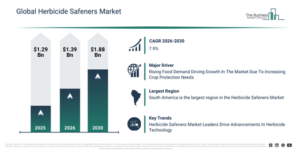
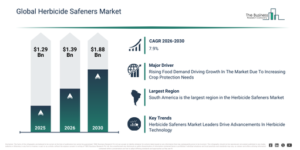
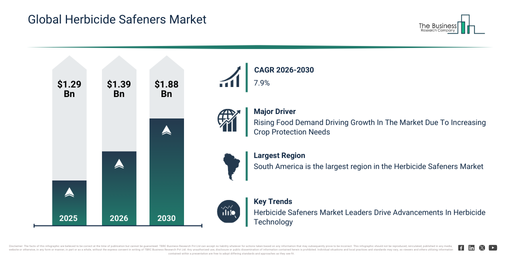
The herbicide safeners market has experienced robust expansion in recent years. The market is forecast to expand from $1.29 billion in 2025 to $1.39 billion in 2026, with a compound annual growth rate (CAGR) of 7.6%. This historical expansion can be linked to factors such as the broadening of commercial agriculture, greater herbicide application in row crops, the increase in cereal crop cultivation, heightened understanding of crop damage prevention, and the introduction of advanced agrochemical formulations.
The herbicide safeners market is projected to experience robust expansion over the coming years, reaching a value of $1.88 billion by 2030, at a compound annual growth rate (CAGR) of 7.9%. This anticipated growth is driven by several factors, including the escalating demand for sustainable weed management, the increasing embrace of precision agriculture methods, the broader application of safeners in developing economies, a heightened emphasis on managing herbicide resistance, and greater investments in research and development for crop protection. Key trends expected during this period involve the wider acceptance of herbicide formulations that protect crops, an increasing need for solutions offering selective weed control, the expanding application of safeners in cereal crops, the spread of integrated weed management approaches, and a more stringent regulatory focus on ensuring crop protection safety.
Try Before You Buy: Free Sample Of The Herbicide Safeners Market Report:
Herbicide Safeners Market Growth Engine: The Factor Boosting Demand Globally
An anticipated increase in food consumption is projected to fuel the expansion of the herbicide safeners market. Food demand signifies the amount of food items consumers are prepared and capable of acquiring at various price points within a given timeframe. This surge in food demand is primarily driven by global population growth, necessitating larger quantities of sustenance to fulfill nutritional requirements. Herbicide safeners play a crucial role in addressing this need by shielding crops from herbicide-induced harm, allowing farmers to control weeds efficiently without compromising crop health, thereby boosting yields. For example, in January 2024, the United States Department of Agriculture reported that in 2023, food expenditures accounted for an average of 12.9% of U.S. household spending, up slightly from 12.8% in 2022. Consequently, the increasing demand for food is propelling the expansion of the herbicide safeners market.
Which Categories And Subcategories Shape The Herbicide Safeners Market?
The herbicide safeners market covered in this report is segmented –
1) By Type: Benoxacor, Furilazole, Dichlormid, Isoxadifen, Other Types
2) By Herbicide Selectivity: Selective Herbicides, Non-Selective Herbicides
3) By Crop: Corn, Soybean, Wheat, Sorghum, Barley, Rice, Other Crops
4) By Application: Post-Emergence, Pre-Emergence
Herbicide Safeners Market Trend Insights: Strategic Focus Areas Of Leading Companies
Major companies operating in the herbicide safeners market are prioritizing the development of innovative solutions, such as advanced herbicide technology. This technology encompasses the scientific and technical methods and breakthroughs applied to the research, formulation, and application of herbicides. For example, in November 2023, Nufarm, a Canada-based agricultural chemical firm, introduced its ‘Duplosan’ technology. This innovation serves as a powerful booster for cereal herbicides, allowing for maximum control of weeds in cereal crops. The technology is generating positive results for a forthcoming range of solutions, supporting farmers in overcoming ongoing weed issues in cereal cultivation.
Leading Organizations In The Herbicide Safeners Market
Major companies operating in the herbicide safeners market are BASF SE, Bayer AG, Syngenta Group, Corteva, Inc., FMC Corporation, UPL Limited, ADAMA Agricultural Solutions Ltd., Nufarm Limited, Sumitomo Chemical Company, Limited, Nissan Chemical Corporation, Kumiai Chemical Industry Co., Ltd., Ishihara Sangyo Kaisha, Ltd., Albaugh, LLC, Sharda Cropchem Limited, Rotam CropSciences Ltd., Lier Chemical Co., Ltd., Jiangsu Yangnong Chemical Co., Ltd., Anhui Huaxing Chemical Industry Co., Ltd., Zhejiang Yongnong Chemical Co., Ltd., Sinon Corporation
Continue Reading: The Full Herbicide Safeners Market Report:
Herbicide Safeners Market Regional Spotlight: Top Geography And Report Coverage
South America was the largest region in the herbicide safeners market in 2025. The regions covered in the herbicide safeners market report are Asia-Pacific, South East Asia, Western Europe, Eastern Europe, North America, South America, Middle East, Africa
Reach Out To Our Team:
The Business Research Company: https://www.thebusinessresearchcompany.com/
Americas: +1 310-496-7795
Asia: +44 7882 955267 & +91 8897263534
Europe: +44 7882 955267
Email us at: marketing@tbrc.info
Follow us on:
LinkedIn: https://in.linkedin.com/company/the-business-research-company
YouTube: https://www.youtube.com/channel/UC24_fI0rV8cR5DxlCpgmyFQ
Global Market Model: https://www.thebusinessresearchcompany.com/global-market-model

Wasay has over a decade of experience in market research, data modelling, and analytics, with prior experience at GlobalData and Decision Tree Consulting Services. At The Business Research Company , he leads research operations across syndicated studies, customized consulting engagements, and the Global Market Model platform. His professional experience includes supporting organizations such as Boston Consulting Group, KPMG, and Ernst & Young. Wasay holds a degree in Electronics and Communications Engineering, postgraduate management qualifications from International Management Institute Belgium and Indian School of Business and Entrepreneurship, and completed the Integrated Program in Business Analytics from Indian Institute of Management Indore.