
Enhanced with market attractiveness analysis, total addressable market evaluation, company benchmarking matrices, interactive Excel dashboards, expanded supply chain intelligence, emerging startup coverage, and detailed product insights, The Business Research Company’s 2026 market reports deliver more actionable and strategically valuable research.
#High-Thermal-Conductivity Gap-Fill Adhesives For EV Battery Cooling Plates Market Size And Revenue Forecast Through 2030
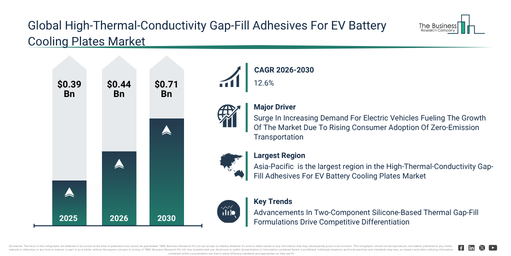
The market size for high-thermal-conductivity gap-fill adhesives designed for EV battery cooling plates has experienced rapid expansion in recent years. This market is anticipated to expand from $0.39 billion in 2025 to $0.44 billion in 2026, demonstrating a compound annual growth rate (CAGR) of 12.3%. The historical growth of this market can be attributed to several factors, including constrained EV adoption and initial challenges with battery thermal management, a dependence on traditional thermal pads and silicone greases, lower energy density battery systems resulting in reduced heat loads, the widespread use of air-cooled and rudimentary liquid cooling systems, and limited deployment of fast charging infrastructure.
The market size for high-thermal-conductivity gap-fill adhesives utilized in EV battery cooling plates is set for significant growth in the upcoming years. It is forecast to grow to $0.71 billion by 2030, with a compound annual growth rate (CAGR) of 12.6%. This expansion during the forecast period stems from factors such as the increasing thermal stress caused by expanding ultra-fast charging networks, the rising adoption of high-energy-density battery chemistries, the implementation of stricter global battery safety and thermal regulation standards, the growth of cell-to-pack and structural battery designs, and an increasing demand for extended EV range and enhanced performance efficiency. Prominent trends for this period include the development of high thermal conductivity (>6 w/mk) gap-fill adhesives for ultra-fast heat dissipation in EV battery packs, advancements in ultra-thin bond line thermal interface materials for cell-to-pack architectures, a growing need for fast-charging compatible thermal adhesives with high thermal stability, increased use of lightweight thermal interface materials to improve electric vehicle driving range, and the creation of recyclable and reworkable thermal gap fillers for sustainable battery lifecycle management.
Download A Free Sample Report For Comprehensive Market Insights:
https://www.thebusinessresearchcompany.com/sample_request?id=64421318&type=smp
High-Thermal-Conductivity Gap-Fill Adhesives For EV Battery Cooling Plates Market Industry Drivers: What Is Driving Revenue Growth?
The increasing demand for electric vehicles is projected to boost the growth of the high-thermal-conductivity gap-fill adhesives for EV battery cooling plates market. Electric vehicles are automobiles that operate using one or more electric motors powered by rechargeable battery packs, resulting in zero direct tailpipe emissions. The escalating demand for these vehicles is driven by a rising consumer preference for zero-emission transportation, influenced by heightened environmental awareness and supportive government policies such as purchase incentives, emission mandates, and infrastructure investments, which make EV ownership more accessible and attractive. High-thermal-conductivity gap-fill adhesives are vital in addressing this demand by providing the precise thermal interface management required in EV battery cooling plates to maintain optimal battery temperatures. This, in turn, extends battery life, improves range, and ensures the safety standards demanded by both consumers and regulators. For instance, according to the International Energy Agency (IEA), a France-based intergovernmental energy organization, global electric car sales surpassed 17 million units in 2024, representing over 20% of all new cars sold worldwide for the first time, as reported in April 2025. Furthermore, sales in the first quarter of 2025 grew 35% year-on-year, with global EV sales forecast to exceed 20 million units in 2025, accounting for more than one in four cars sold worldwide. Therefore, the expanding demand for electric vehicles is significantly propelling the growth of the high-thermal-conductivity gap-fill adhesives for EV battery cooling plates market.
High-Thermal-Conductivity Gap-Fill Adhesives For EV Battery Cooling Plates Market Segment Analysis And Revenue Opportunities
The high-thermal-conductivity gap-fill adhesives for EV battery cooling plates market covered in this report is segmented –
1) By Battery Architecture: Cell-To-Cooling-Plate Interface, Module-To-Cooling-Plate Interface, Cell-To-Pack Thermal Coupling, Battery Repair Or Rework Gap Filling, Power Electronics Adjacent Cooling Interfaces
2) By Vehicle Type: Battery Electric Vehicles (BEVs), Plug-in Hybrid Electric Vehicles (PHEVs), Electric Buses, Electric Trucks Or Commercial EVs
3) By Material Type: Silicone-Based Adhesives, Epoxy-Based Adhesives, Polyurethane-Based Adhesives, Other Material Types
4) By Thermal Conductivity Band: 3–6 W/mK, 1–3 W/mK, Above 6 W/mK, Below 1 W/mK
5) By End-User: Automotive Manufacturers, Battery Manufacturers, Electric Vehicle Component Suppliers, Other End Users
Subsegments:
1) By Cell-To-Cooling-Plate Interface: Direct Bonding Interface, Thermal Pad Assisted Interface, Liquid Gap Fill Interface, Adhesive Bonded Interface, Hybrid Thermal Interface
2) By Module-To-Cooling-Plate Interface: Bottom Plate Contact Interface, Side Wall Thermal Interface, Encapsulated Module Interface, Adhesive Layered Interface
3) By Cell-To-Pack Thermal Coupling: Structural Adhesive Coupling, Flexible Gap Fill Coupling, Encapsulated Thermal Coupling, Direct Contact Thermal Coupling, Hybrid Bonded Coupling
4) By Battery Repair Or Rework Gap Filling: Manual Gap Filling Solutions, Automated Dispensing Solutions, Rework Adhesive Systems, Thermal Paste Reapplication, Localized Gap Repair Materials
5) By Power Electronics Adjacent Cooling Interfaces: Inverter Cooling Interface, Control Unit Thermal Interface, Converter Thermal Interface, Heat Sink Bonding Interface, Hybrid Electronics Cooling Interface
#High-Thermal-Conductivity Gap-Fill Adhesives For EV Battery Cooling Plates Market Growth Trends: What Is Influencing The Future Outlook?
Companies active in the high-thermal-conductivity gap-fill adhesives for EV battery cooling plates market are prioritizing the development of advanced solutions, such as two-component (2K) silicone-based thermally conductive gap-fill systems. These systems are designed to improve heat dissipation efficiency, enhance processability and automated dispensing, accommodate thermal expansion stresses, and ensure the long-term reliability and safety of EV battery packs during high-performance operation. Two-component silicone-based thermally conductive gap-fill systems represent room-temperature-curing, electrically insulating adhesive formulations that employ a dual-part addition reaction to create a flexible, repairable elastomer. This elastomer can fill surface irregularities between battery cells and cooling plates, all while sustaining stable thermal and mechanical performance across extreme operating conditions. As an illustration, in June 2025, WACKER Chemie AG, a Germany-based specialty chemicals company, unveiled SEMICOSIL 9649 TC, a thermally conductive gap filler specifically engineered for power electronics in electric and hybrid vehicles. It features a thermal conductivity of approximately 4 W/mK, maintains performance at temperatures up to 150°C, and exhibits resistance to thermal shocks within a range of -40°C to +150°C.
High-Thermal-Conductivity Gap-Fill Adhesives For EV Battery Cooling Plates Market Leading Players Shaping Industry Direction
Major companies operating in the high-thermal-conductivity gap-fill adhesives for ev battery cooling plates market are BASF SE, Dow Inc., 3M Company, Henkel AG & Co. KGaA, Parker Hannifin Corporation, Shin-Etsu Chemical Co. Ltd., DuPont de Nemours Inc., Arkema S.A., Wacker Chemie AG, Huntsman Corporation, H.B. Fuller Company, Momentive Performance Materials Inc., Laird Performance Materials, Panacol-Elosol GmbH, Fujipoly America Corporation, Polymer Science Inc., Master Bond Inc., Aremco Products Inc., ThreeBond Co. Ltd., CollTech Group.
Access The Complete High-Thermal-Conductivity Gap-Fill Adhesives For EV Battery Cooling Plates Market Report:
#High-Thermal-Conductivity Gap-Fill Adhesives For EV Battery Cooling Plates Market Largest Region: Which Geography Holds The Highest Market Share?
Asia-Pacific was the largest region in the high-thermal-conductivity gap-fill adhesives for electric vehicle battery cooling plates market in 2025. North America is expected to be the fastest-growing region in the forecast period. The regions covered in the high-thermal-conductivity gap-fill adhesives for EV battery cooling plates market report are Asia-Pacific, South East Asia, Western Europe, Eastern Europe, North America, South America, Middle East, Africa.
Get in touch with us:
The Business Research Company: https://www.thebusinessresearchcompany.com/
Americas: +1 310-496-7795
Asia: +44 7882 955267 & +91 8897263534
Europe: +44 7882 955267
Email us at: marketing@tbrc.info
Follow us on:
LinkedIn: https://in.linkedin.com/company/the-business-research-company
YouTube: https://www.youtube.com/channel/UC24_fI0rV8cR5DxlCpgmyFQ
Global Market Model: https://www.thebusinessresearchcompany.com/global-market-model

Wasay has over a decade of experience in market research, data modelling, and analytics, with prior experience at GlobalData and Decision Tree Consulting Services. At The Business Research Company , he leads research operations across syndicated studies, customized consulting engagements, and the Global Market Model platform. His professional experience includes supporting organizations such as Boston Consulting Group, KPMG, and Ernst & Young. Wasay holds a degree in Electronics and Communications Engineering, postgraduate management qualifications from International Management Institute Belgium and Indian School of Business and Entrepreneurship, and completed the Integrated Program in Business Analytics from Indian Institute of Management Indore.