Through market attractiveness analysis, total addressable market evaluation, company benchmarking matrices, interactive Excel dashboards, expanded supply chain intelligence, emerging startup coverage, and detailed product insights, The Business Research Company’s 2026 market reports provide more actionable and strategically valuable research.
Homogeneous Precious Metal Catalyst Market Size, Value And Growth Trends Through 2030
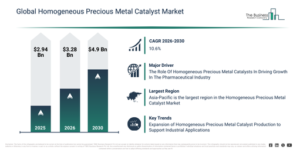
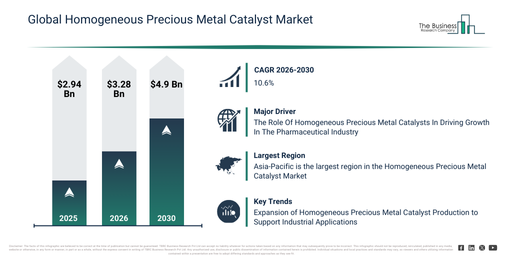
The homogeneous precious metal catalyst market has undergone considerable expansion in recent years. Projections indicate it is set to grow from $2.94 billion in 2025 to $3.28 billion in 2026, showing a compound annual growth rate (CAGR) of 11.7%. This notable growth is driven by several pivotal factors, including the increasing growth of petrochemical refining, the expansion of pharmaceutical manufacturing, the early adoption of precious metal catalysis, a heightened demand for high yield reactions, and the ongoing development of homogeneous catalysis techniques.
The homogeneous precious metal catalyst market size is expected to undergo substantial growth in the years ahead. It is foreseen to reach $4.9 billion by 2030, displaying a compound annual growth rate (CAGR) of 10.6%. This projected expansion during the forecast period is fueled by elements such as the progress of green chemistry initiatives, a rise in pharmaceutical research and development activities, an elevated demand for effective catalysts, improvements in catalyst design, and the widening scope of fine chemical production. Prominent trends throughout the forecast period include an expanding use in pharmaceutical synthesis, increasing integration into green chemistry applications, a heightened requirement for high selectivity catalysts, the enlargement of petrochemical refining processes, and a stronger emphasis on the recovery and recycling of catalysts.
Download A Free Sample Report For Comprehensive Market Insights:
Homogeneous Precious Metal Catalyst Market Growth Factors Supporting Long-Term Expansion
The expanding pharmaceutical industry is anticipated to boost the development of the homogeneous precious metal catalyst market. This sector encompasses the economic activities related to researching, developing, manufacturing, and distributing medicines and various health-related items. Its growth stems from several factors, such as progress in medical science and technology, an aging worldwide demographic, a higher incidence of chronic illnesses, escalating healthcare spending, and broader access to medical services in emerging economies. These catalysts play a crucial role within the pharmaceutical sector by enabling numerous chemical reactions necessary for the creation of intricate organic molecules and active pharmaceutical ingredients (APIs). For example, data from October 2025, released by the European Federation of Pharmaceutical Industries and Associations (EFPIA), a Belgium-headquartered body for the pharmaceutical sector, indicated that European pharmaceutical output significantly increased, moving from $471.70 billion (€405.7 billion) in 2023 to $510.93 billion (€440.0 billion) in 2024. Consequently, the expansion of the pharmaceutical industry is propelling the growth of the homogeneous precious metal catalyst market.
Homogeneous Precious Metal Catalyst Market Segment Landscape: Which Areas Lead Market Development?
The homogeneous precious metal catalyst market covered in this report is segmented –
1) By Product: Palladium-Based Homogeneous Catalysts, Rhodium-Based Homogeneous Catalysts, Ruthenium-Based Homogeneous Catalysts, Iridium-Based Homogeneous Catalysts, Platinum-Based Homogeneous Catalysts, Gold-Based Homogeneous Catalysts, Other Products
2) By Solvent: Polar Protic Solvents, Polar Aprotic Solvents, Nonpolar Solvents, Other Solvents
3) By Application: Pharmaceutical Synthesis, Agrochemical Intermediates, Fine Chemicals And Specialty Chemicals, Flavors And Fragrances, Polymer And Resin Synthesis, Electrochemical And Redox Systems, Academic And Research Applications
Subsegments:
1) By Palladium-Based Homogeneous Catalysts: Palladium–Phosphine Complexes, Palladium–N-Heterocyclic Carbene (NHC) Complexes, Palladium(0) Homogeneous Catalysts, Palladium(II) Homogeneous Catalysts, Palladium Coupling Reaction Catalysts
2) By Rhodium-Based Homogeneous Catalysts: Rhodium–Phosphine Complexes, Rhodium Carbonyl Complexes, Rhodium Hydroformylation Catalysts, Rhodium Asymmetric Catalysts, Rhodium Hydrogenation Catalysts
3) By Ruthenium-Based Homogeneous Catalysts: Ruthenium Olefin Metathesis Catalysts, Ruthenium Transfer Hydrogenation Catalysts, Ruthenium Carbonyl Complexes, Ruthenium Oxidation Catalysts, Ruthenium Chiral Catalysts
4) By Iridium-Based Homogeneous Catalysts: Iridium Asymmetric Hydrogenation Catalysts, Iridium C–H Activation Catalysts, Iridium Transfer Hydrogenation Catalysts, Iridium Redox Catalysts, Iridium Pincer Complexes
5) By Platinum-Based Homogeneous Catalysts: Platinum Phosphine Complexes, Platinum Hydrosilylation Catalysts, Platinum Oxidation Catalysts, Platinum Alkene Functionalization Catalysts, Platinum Carbonyl Complexes
6) By Gold-Based Homogeneous Catalysts: Gold(I) Homogeneous Catalysts, Gold(III) Homogeneous Catalysts, Gold Carbene Catalysts, Gold p-Activation Catalysts, Gold Green Chemistry Catalysts
7) By Other Products: Osmium-Based Homogeneous Catalysts, Mixed Precious Metal Catalysts (Bimetallic Systems), Emerging Precious Metal Complexes
Homogeneous Precious Metal Catalyst Market Industry Trends Shaping Future Revenue Growth
Companies at the forefront of the homogeneous precious metal catalyst market are concentrating on developing technological advancements, specifically the scalable manufacturing of liquid-phase organometallic catalysts for industrial uses, to satisfy the growing demand across pharmaceuticals, fine chemicals, and polymer manufacturing. This large-scale production of homogeneous catalysts involves the creation and fabrication of soluble metal–ligand complexes through controlled liquid-phase methods. This approach offers benefits such as uniform activity, high selectivity, and reproducibility when contrasted with heterogeneous or solid-supported catalysts, which operate in a different phase than reactants. As an illustration, in May 2025, Umicore S.A., a Belgium-based materials technology and recycling company, announced the expansion of its homogeneous catalyst production at the Catoosa, Oklahoma site. The upgraded facility aims to provide multi-ton volumes of homogeneous catalysts for industrial-scale applications, thereby supporting high-purity, high-performance catalytic processes while upholding consistency, efficiency, and environmental compliance.
Homogeneous Precious Metal Catalyst Market Industry Leaders And Market Competition
Major companies operating in the homogeneous precious metal catalyst market are BASF SE, Johnson Matthey plc, Heraeus Group, Umicore SA, Solvay SA, Evonik Industries AG, Clariant International Ltd., W. R. Grace & Co., Arkema S.A., Dow Inc., DuPont de Nemours Inc., LANXESS AG, Nippon Shokubai Co. Ltd., Mitsubishi Chemical Group, Sumitomo Chemical Co. Ltd., Asahi Kasei Corporation, Tanaka Holdings Co. Ltd., Materion Corporation, Fine Chemicals Corporation (Pty) Ltd., Kaili Catalyst New Materials Co. Ltd., Sinocompound Catalysts Co. Ltd.
Access The Complete Homogeneous Precious Metal Catalyst Market Report:
Homogeneous Precious Metal Catalyst Market Regional Analysis: Which Region Leads By Revenue?
Asia-Pacific was the largest region in the homogeneous precious metal catalyst market in 2025. The regions covered in the homogeneous precious metal catalyst market report are Asia-Pacific, South East Asia, Western Europe, Eastern Europe, North America, South America, Middle East, Africa
Get in touch with us:
The Business Research Company: https://www.thebusinessresearchcompany.com/
Americas: +1 310-496-7795
Asia: +44 7882 955267 & +91 8897263534
Europe: +44 7882 955267
Email us at: marketing@tbrc.info
Follow us on:
LinkedIn: https://in.linkedin.com/company/the-business-research-company
YouTube: https://www.youtube.com/channel/UC24_fI0rV8cR5DxlCpgmyFQ
Global Market Model: https://www.thebusinessresearchcompany.com/global-market-model

Wasay has over a decade of experience in market research, data modelling, and analytics, with prior experience at GlobalData and Decision Tree Consulting Services. At The Business Research Company , he leads research operations across syndicated studies, customized consulting engagements, and the Global Market Model platform. His professional experience includes supporting organizations such as Boston Consulting Group, KPMG, and Ernst & Young. Wasay holds a degree in Electronics and Communications Engineering, postgraduate management qualifications from International Management Institute Belgium and Indian School of Business and Entrepreneurship, and completed the Integrated Program in Business Analytics from Indian Institute of Management Indore.