Delivering more actionable and strategically valuable research, The Business Research Company’s 2026 market reports feature market attractiveness analysis, total addressable market evaluation, company benchmarking matrices, interactive Excel dashboards, expanded supply chain intelligence, emerging startup coverage, and detailed product insights.
Humectants Market Size Forecast: How Large Could The Market Become By 2030?
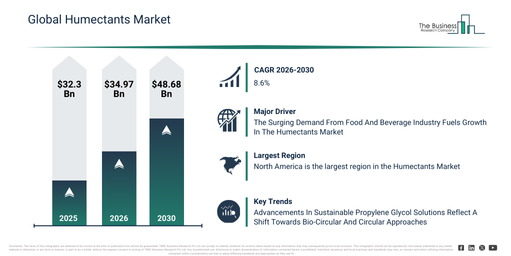
The humectants market has exhibited considerable growth in recent years. Its value is expected to climb from $32.3 billion in 2025 to $34.97 billion in 2026, reflecting a compound annual growth rate (CAGR) of 8.3%. This past growth can be attributed to various elements, including the evolution of the personal care and cosmetic industries, a rising consumer preference for processed foods, the expansion of pharmaceutical manufacturing, increased application in animal nutrition, and the presence of synthetic humectant creation technologies.
The humectants market is anticipated to experience substantial expansion in the coming years. It is forecasted to reach $48.68 billion by 2030, exhibiting a compound annual growth rate (CAGR) of 8.6%. This projected growth is driven by several factors, including the rising demand for clean-label components, increased integration into premium skincare items, the growth of functional food preparations, higher pharmaceutical usage, and a greater emphasis on acquiring sustainable ingredients. Key trends foreseen during the forecast period include the growing utilization of natural and bio-based humectants, escalating demand in personal care product formulations, expanding applications in pharmaceutical goods, the broader use of humectants in preserving food, and an improved emphasis on their moisture retention capabilities.
Download A Free Sample Report For Comprehensive Market Insights:
Humectants Market Development Factors: Which Trends Are Supporting Demand?
The rising need from the food and beverage sector is projected to enhance the expansion of the humectants market in the future. This sector includes enterprises engaged in creating, supplying, and selling food items and beverages, from farming and production to eateries and coffee shops. Humectants are utilized within the food and beverage industry for moisture retention, prolonging shelf life, and preserving the freshness of products. As an illustration, in July 2025, according to the Government of Canada, a Canada-based federal government, data revealed that in 2024, exports of processed food and beverage products reached a record $59.8 billion, marking a 3.8% rise compared with 2023. Consequently, the increasing demand from the food and beverage industry is fueling the growth of the humectants market.
#Humectants Market Segment Landscape And Growth Potential
The humectants market covered in this report is segmented –
1) By Product: Sugar Alcohol, Glycols, Other Products
2) By Source: Synthetic, Natural
3) By Application: Food And Beverages, Oral And Personal Care, Pharmaceuticals, Animal Feed, Other Application
Subsegments:
1) By Sugar Alcohol: Glycerin, Sorbitol
2) By Glycols: Propylene Glycol, Ethylene Glycol
3) By Other Products: Urea, Honey
Humectants Market Transformation Trends: Which Innovations Are Driving Change?
Leading companies in the humectants markets are concentrating on developing sophisticated options, notably bio-circular and circular propylene glycol solutions. Bio-circular propylene glycol solutions are sourced from renewable resources or post-consumer waste, combining biological and circular economies to diminish fossil fuel consumption. Conversely, circular propylene glycol solutions employ recycled materials to reduce waste and advance sustainability by completing the production loop. For example, in March 2024, Dow Jones Industrial Average, a US-based materials science company, introduced Propylene Glycol CIR and Propylene Glycol REN, which incorporate bio-circular and circular feedstocks. These products are developed using a mass balance approach and have achieved certification from International Sustainability and Carbon Certification Plus (ISCC), signaling Dow’s commitment to sustainable manufacturing. Propylene Glycol CIR incorporates Renuva recycled content, converting hard-to-recycle waste into valuable feedstocks, while Propylene Glycol REN aims to lessen dependence on fossil fuels through Ecolibrium bio-circular technology.
Humectants Market Competitive Landscape: Who Are The Leading Companies?
Major companies operating in the humectants market are BASF, Dow, Evonik Industries, Lanxess, Cargill, ADM (Archer Daniels Midland), Corbion, Jungbunzlauer, DSM-Firmenich, Roquette, Ingredion, Tate And Lyle, Ashland, Lubrizol, Croda International, Kao Corporation, Clariant, Solvay, Arkema, Mitsubishi Chemical Corporation
Access The Complete Humectants Market Report:
Humectants Market Regional Distribution: Which Areas Drive Market Expansion?
North America was the largest region in the humectants market in 2025. Asia-Pacific is expected to be the fastest-growing region in the global humectants market during the forecast period. The regions covered in the humectants market report are Asia-Pacific, South East Asia, Western Europe, Eastern Europe, North America, South America, Middle East, Africa
Get in touch with us:
The Business Research Company: https://www.thebusinessresearchcompany.com/
Americas: +1 310-496-7795
Asia: +44 7882 955267 & +91 8897263534
Europe: +44 7882 955267
Email us at: marketing@tbrc.info
Follow us on:
LinkedIn: https://in.linkedin.com/company/the-business-research-company
YouTube: https://www.youtube.com/channel/UC24_fI0rV8cR5DxlCpgmyFQ
Global Market Model: https://www.thebusinessresearchcompany.com/global-market-model

Wasay has over a decade of experience in market research, data modelling, and analytics, with prior experience at GlobalData and Decision Tree Consulting Services. At The Business Research Company , he leads research operations across syndicated studies, customized consulting engagements, and the Global Market Model platform. His professional experience includes supporting organizations such as Boston Consulting Group, KPMG, and Ernst & Young. Wasay holds a degree in Electronics and Communications Engineering, postgraduate management qualifications from International Management Institute Belgium and Indian School of Business and Entrepreneurship, and completed the Integrated Program in Business Analytics from Indian Institute of Management Indore.