Featuring market attractiveness scoring, total addressable market sizing, company benchmarking matrices, interactive Excel dashboards, deeper supply chain intelligence, emerging startup tracking, and granular product-level insights, The Business Research Company’s 2026 market reports are built to deliver research that is both more actionable and more strategically valuable.
Inorganic Ceramic Membrane Market Growth Potential: How Will Market Size Shift Through 2030?
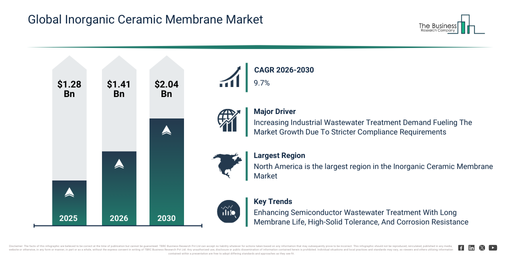
The inorganic ceramic membrane market size has experienced rapid expansion in recent years. It is anticipated to increase its value from $1.28 billion in 2025 to $1.41 billion in 2026, at a compound annual growth rate (CAGR) of 10.0%. This historical growth can be primarily linked to factors such as the greater adoption in water and wastewater treatment, increasing demand for membranes offering chemical and thermal resistance, a heightened focus on industrial effluent treatment, expanding applications within food and beverage processing, and a growing understanding of the benefits of long-lasting filtration solutions.
The inorganic ceramic membrane market is expected to experience significant expansion in the upcoming years. This market is projected to reach $2.04 billion by 2030, demonstrating a compound annual growth rate (CAGR) of 9.7%. The anticipated growth over the forecast period is attributed to increased investment in advanced water purification systems, rising adoption in the pharmaceutical and biotechnology industries, a growing demand for high-flux and selective membranes, expanding integration with industrial process optimization, and an increasing emphasis on sustainable and energy-efficient filtration technologies. Major developments foreseen during this period include technological advancements in membrane surface modification, innovations in anti-fouling and high-performance ceramic membranes, the development of hybrid and composite membrane systems, extensive research and development in nanoscale pore engineering, and progress in automated and smart filtration monitoring systems.
Get A Free Sample Report With In-Depth Market Insights:
Inorganic Ceramic Membrane Market Growth Backed By Core Demand Fundamentals
The inorganic ceramic membrane market is expected to grow due to the increasing demand for industrial wastewater treatment. This treatment involves processes used by manufacturing, chemical, pharmaceutical, food processing, and other industrial sectors to remove contaminants, suspended solids, heavy metals, and harmful pollutants from wastewater before its discharge or reuse. The heightened demand for industrial wastewater treatment stems from stringent environmental regulations, which mandate companies to minimize pollutant discharge and adhere to legal standards. Inorganic ceramic membranes facilitate industrial wastewater treatment by offering high-performance filtration that meets stricter discharge standards and enables advanced processes like nutrient and micropollutant removal. For instance, in May 2025, Imperial College London, a UK-based public research university, reported that English water companies discharged untreated sewage for 3.614 million hours in 2024, a slight increase from 3.606 million hours recorded in 2023, after spills had already more than doubled in 2023 compared to 1.75 million hours in 2022. Therefore, the rising need for industrial wastewater treatment is a key driver for the inorganic ceramic membrane market’s growth.
Inorganic Ceramic Membrane Market Segment Analysis: What Are The Core Market Categories?
The inorganic ceramic membrane market covered in this report is segmented –
1) By Type: Microfiltration Membranes, Ultrafiltration Membranes, Nano-filtration Membranes, Reverse Osmosis Membranes, Vacuum Membrane Distillation Membranes
2) By Material Type: Alumina (Al2O3), Titania (TiO2), Zirconia (ZrO2), Silica (SiO2), Mixed Oxides
3) By Technology Used: Filtration Technology, Membrane Separation Technology, Membrane Bioreactor Technology, Hybrid Membrane Processes, Electrodialysis Technology
4) By Application: Water And Wastewater Treatment, Food And Beverage Processing, Pharmaceuticals, Chemical Processing, Gas Separation, Other Applications
5) By End-User Industry: Industrial, Municipal, Pharmaceutical, Food And Beverage, Chemical, Other End-User Industries
Subsegments:
1) By Microfiltration Membranes: Polyvinylidene Fluoride Membranes, Polyethersulfone Membranes, Polypropylene Membranes, Ceramic Microfiltration Membranes, Polytetrafluoroethylene Membranes
2) By Ultrafiltration Membranes: Polyethersulfone Ultrafiltration Membranes, Polyvinylidene Fluoride Ultrafiltration Membranes, Regenerated Cellulose Ultrafiltration Membranes, Ceramic Ultrafiltration Membranes, Polyacrylonitrile Ultrafiltration Membranes
3) By Nano-Filtration Membranes: Polyamide Thin Film Composite Membranes, Ceramic Nano-Filtration Membranes, Polypiperazine Membranes, Composite Nano-Filtration Membranes, Low-Pressure Nano-Filtration Membranes
4) By Reverse Osmosis Membranes: Thin Film Composite Reverse Osmosis Membranes, Cellulose Acetate Reverse Osmosis Membranes, Brackish Water Reverse Osmosis Membranes, Seawater Reverse Osmosis Membranes, High-Pressure Reverse Osmosis Membranes
5) By Vacuum Membrane Distillation Membranes: Hydrophobic Polyvinylidene Fluoride Membranes, Polytetrafluoroethylene Distillation Membranes, Polypropylene Distillation Membranes, Ceramic Distillation Membranes, Composite Distillation Membranes
Inorganic Ceramic Membrane Market Growth Trends Reshaping The Competitive Landscape
Key players in the inorganic ceramic membrane market are concentrating on crafting precisely engineered solutions, such as ceramic ultrafiltration modules, to address industrial wastewater issues, bolster operational robustness, and further sustainability and reuse aims. Ceramic ultrafiltration modules are high-performance filtration systems that utilize ceramic membranes to extract suspended solids and pathogens from complex and difficult wastewater streams, enabling the recovery of valuable water. For example, in May 2025, Nanostone Water, an advanced water treatment company based in the US, unveiled CUFShieldPlus, an inorganic ceramic membrane module engineered to tackle the most severe wastewater challenges in the semiconductor industry. This module provides outstanding chemical and thermal resilience, an extended operational life, and dependable performance in high-solid, corrosive environments, thereby helping semiconductor manufacturers achieve efficient water recovery, reduced waste, and consistent product quality.
Inorganic Ceramic Membrane Market Competitive Overview And Top Companies
Major companies operating in the inorganic ceramic membrane market are GEA Group Aktiengesellschaft, NGK Insulators Ltd., Meidensha Corporation, Veolia Water Technologies, Pall Corporation, Kovalus Separation Solutions, Mott Corporation, Jiangsu Jiuwu Hi-Tech Co. Ltd., Nanostone Water Inc., Qua Group, TAMI Industries, LiQTech International Inc., Mantec Filtration Ltd., Hydrasyst, Atech Innovations GmbH, Lenntech B.V., Inopor GmbH, Ceraflo Pte Ltd., CTI Advanced Materials LLC, Novasep Holding S.A.S.
View The Full Inorganic Ceramic Membrane Market Report:
Inorganic Ceramic Membrane Market Top Region: Where Does Most Revenue Come From?
North America was the largest region in the inorganic ceramic membrane market in 2025. Asia-Pacific is expected to be the fastest-growing region in the forecast period. The regions covered in the inorganic ceramic membrane market report are Asia-Pacific, South East Asia, Western Europe, Eastern Europe, North America, South America, Middle East, Africa.
Reach Out To Our Team:
The Business Research Company: https://www.thebusinessresearchcompany.com/
Americas: +1 310-496-7795
Asia: +44 7882 955267 & +91 8897263534
Europe: +44 7882 955267
Email us at: marketing@tbrc.info
Follow us on:
LinkedIn: https://in.linkedin.com/company/the-business-research-company
YouTube: https://www.youtube.com/channel/UC24_fI0rV8cR5DxlCpgmyFQ
Global Market Model: https://www.thebusinessresearchcompany.com/global-market-model

Wasay has over a decade of experience in market research, data modelling, and analytics, with prior experience at GlobalData and Decision Tree Consulting Services. At The Business Research Company , he leads research operations across syndicated studies, customized consulting engagements, and the Global Market Model platform. His professional experience includes supporting organizations such as Boston Consulting Group, KPMG, and Ernst & Young. Wasay holds a degree in Electronics and Communications Engineering, postgraduate management qualifications from International Management Institute Belgium and Indian School of Business and Entrepreneurship, and completed the Integrated Program in Business Analytics from Indian Institute of Management Indore.